
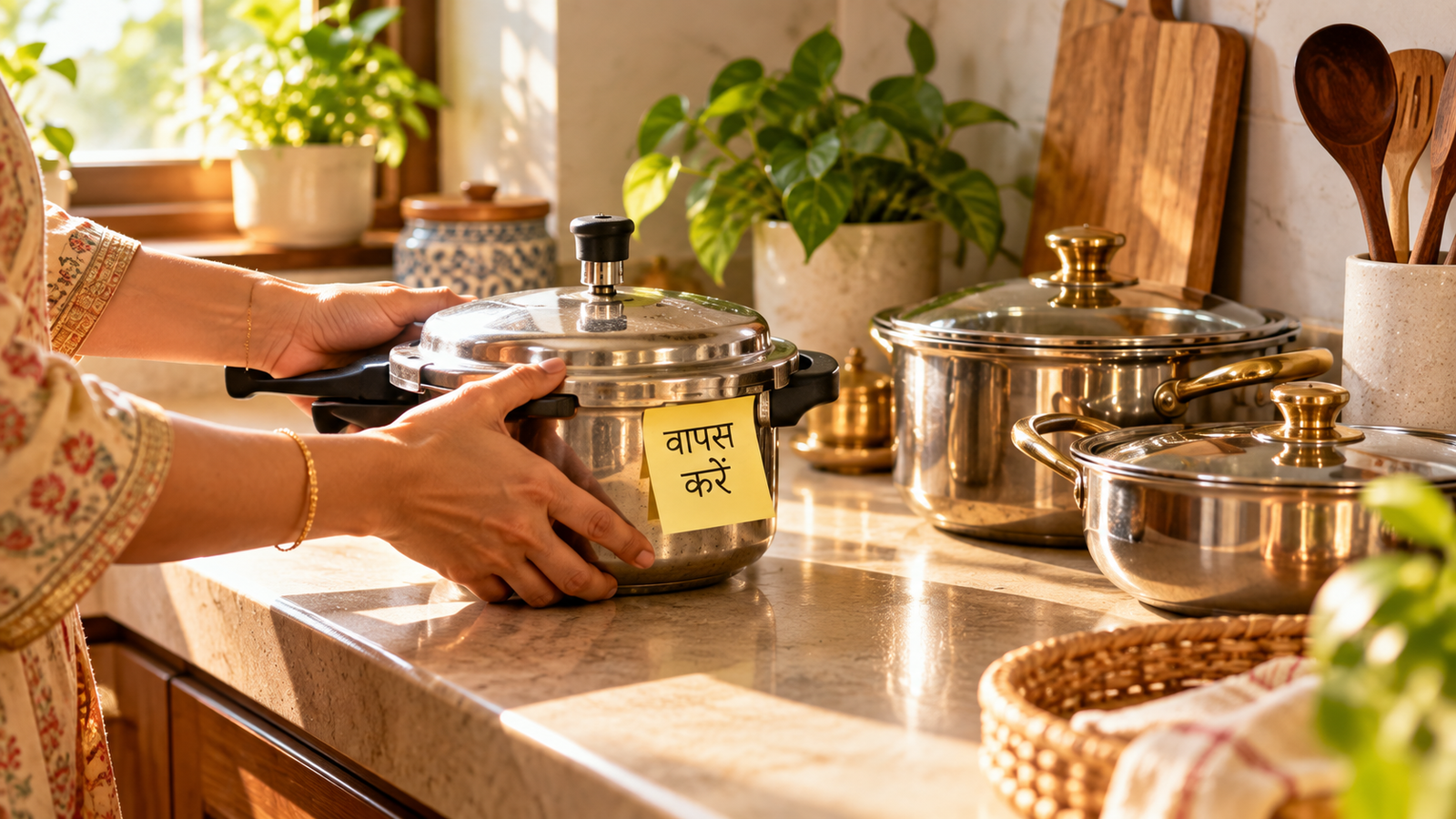
Here's a question that has circulated in Indian households for as long as households have existed:
"Is it bad to keep borrowed things at home?"
Your grandmother said yes, firmly, before you even finished asking. Your mother has a specific list — clocks, brooms, and money chief among them. A neighbor's borrowed pressure cooker has been sitting in your kitchen for eleven months and you both pretend not to notice.
This is, quietly, one of the most universally felt but least understood areas of practical Vastu. And like most things that have circulated as folk wisdom for centuries, the tradition's reasoning is more interesting — and more practically grounded — than "it's just bad luck."
This guide explains what the tradition actually says, why it says it, which objects carry the most significance, which are genuinely harmless, and — most importantly — what to do about the eleven-month pressure cooker situation.
The Core Principle: Objects Carry the Energy of Their Relationships
Before the specific list, the foundational idea — because without it, the rules read as superstition rather than system.
In Vastu's understanding, every object in a home is not just a physical thing. It is also the accumulated energy of every interaction it has been part of — every hand that has held it, every emotion that surrounded it, every relationship context it has existed within.
This is not mystical. It is, in a real sense, psychological. The chair your grandmother used carries something of her. A gift from someone who loves you carries the warmth of that regard. An object bought with anxious money carries the anxiety of that purchase. You may not use these words for what you feel, but you feel it — which is why you can walk into a room full of beautiful objects and feel inexplicably heavy, or walk into a humble room with worn furniture and feel inexplicably at ease.
Borrowed objects carry a specific additional layer: they belong to someone else's life. They are physically present in your home but energetically anchored to another household, another relationship, another set of circumstances. The longer they stay, and the more they are used for core household functions, the more that otherness creates a subtle but real interference in the home's energetic coherence.
The tradition's position is not "borrowed things are evil." It is: your home should be primarily composed of what is genuinely yours. Objects at the periphery of your possession — borrowed, lent, held temporarily — are fine in transit. They become a concern when they settle.
With that foundation in place, the specific guidance:
The Objects the Tradition Treats Most Seriously
1. The Clock
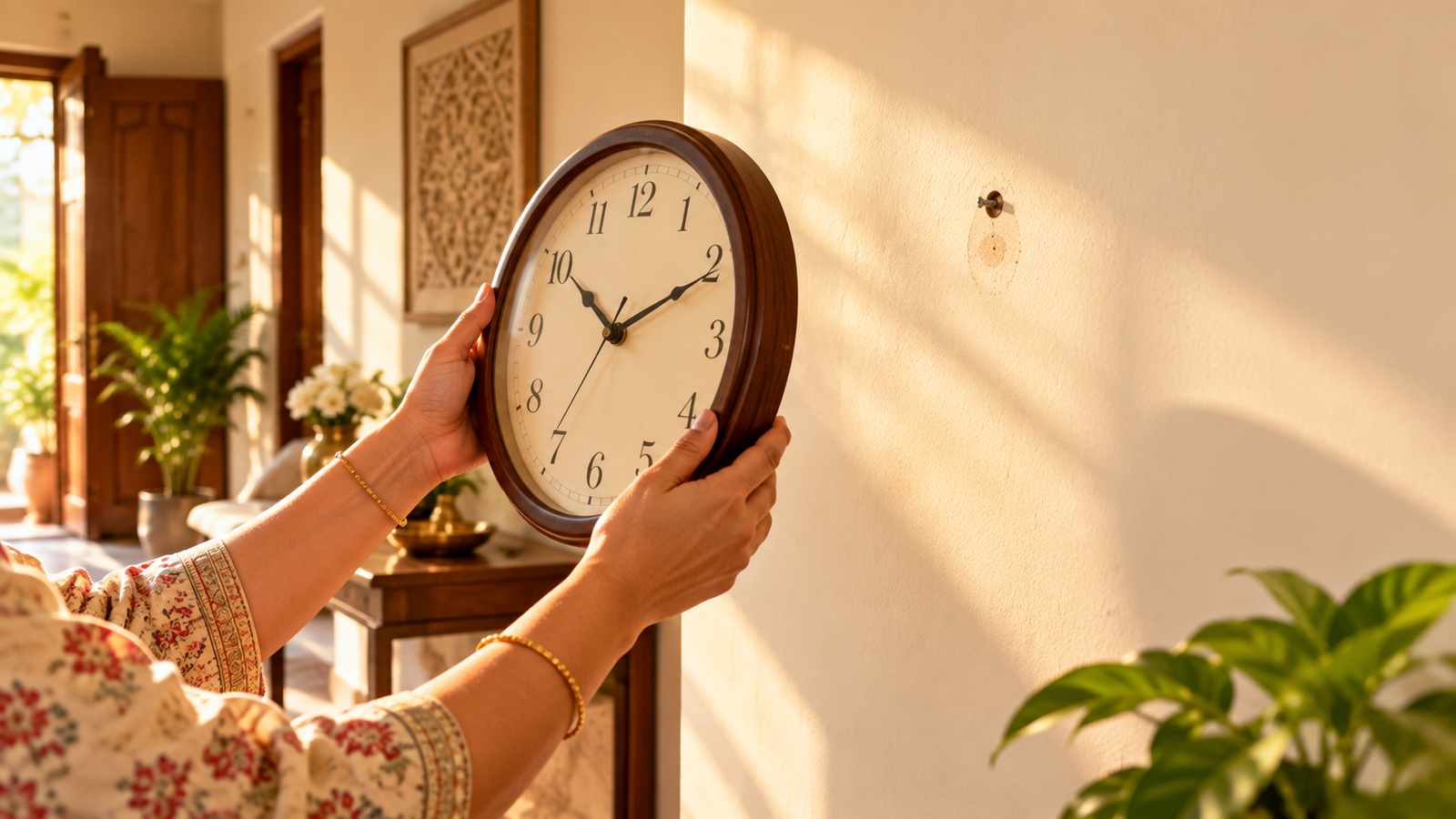
The clock is perhaps the most consistently mentioned borrowed object across every regional version of this tradition — and the reasoning, once you hear it, is obvious.
A clock governs time in a home — the pace at which the household moves, the rhythm of the day, the family's relationship with punctuality and pace. It is one of the most psychologically central objects in any living space.
A borrowed clock, in the tradition's reading, is another household's time sitting in your home. Their rhythm. Their relationship with time. Their pace — which may be rushed, or anxious, or chaotic — subtly imposed on your family's daily tempo.
What to do: return borrowed clocks, always. A new clock — even a modest one — is a small investment in having your home's time be genuinely yours. If you've been using a borrowed clock for months or years: return it this week, buy a simple replacement, and notice whether the quality of your mornings shifts.
2. The Broom / Jhaadu
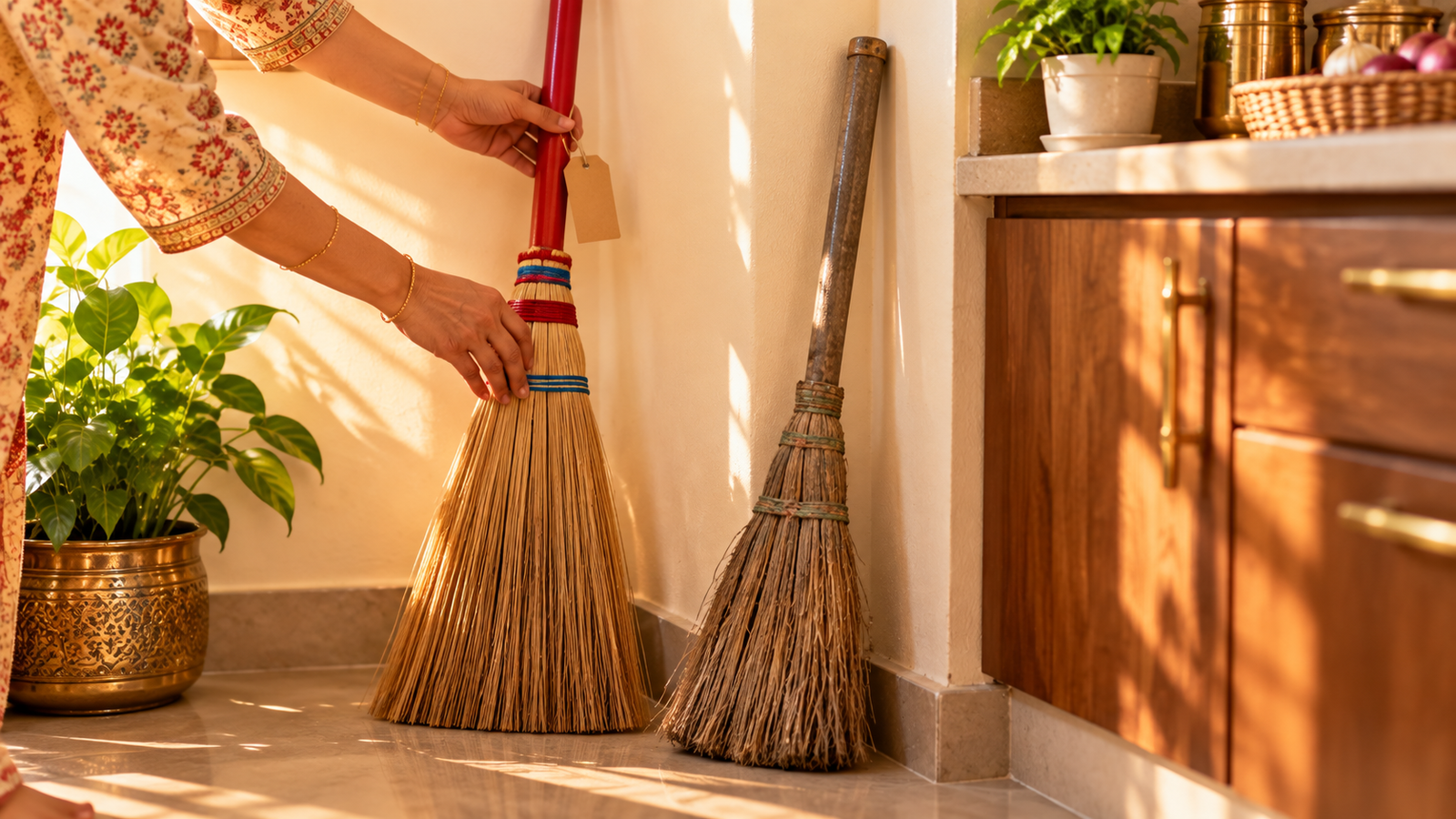
The broom is Vastu's most symbolically loaded cleaning implement — it is the instrument of removing what doesn't belong, and its presence in a home carries associations with that home's purification and clearing.
A borrowed broom is clearing your home with someone else's clearing instrument — carrying the dust and residue of another household's patterns into yours. The tradition considers this one of the more significant forms of energetic cross-contamination, and in many regional practices, borrowing or lending a broom is specifically cautioned against.
What to do: each household should have its own broom, never borrowed. If you're using a borrowed one, replace it — it's the least expensive fix on this entire list — and return the borrowed one respectfully.
3. Money
Borrowed money — kept in the home, sitting in the wallet, in the locker — is the tradition's most clear-cut case. Money carries the energy of its source. Borrowed money carries the energy of debt — of something owed, of incompleteness, of a relationship that is financially unresolved.
Kept in a locker or wallet alongside the family's own resources, borrowed money is (in the tradition's reading) a drain rather than an addition — the debt energy subtly undermining the abundance energy of the rest of the locker's contents. (The full locker guide.)
What to do: borrowed money should pass through, not settle. Return it on schedule, or ahead of it. The home locker's "seed note" tradition — the note kept permanently and never spent — should always be money that is genuinely, uncomplicatedly yours.
4. Knives and Sharp Objects
Sharp objects — knives, scissors, blades — carry the energy of severance and cutting. The tradition's concern with borrowed versions: you're cutting the threads of your own life's fabric with someone else's cutting implement, metaphorically carrying their severing energy into your home.
This is one of the more regionally variable entries — some traditions treat borrowed scissors as particularly cautioned, others extend it to all sharp implements. The common thread: instruments that cut or separate should belong to the household using them.
What to do: kitchen knives especially should be your own. If someone has lent you scissors or a knife that's been living in your kitchen drawer for months, return it and buy your own.
5. The Broken Object Someone Lent You "To Fix"
This one is specific but extremely common: a friend lent you a broken gadget, lamp, or item with the promise that you'd "get it fixed" — and it has been sitting in a corner, broken, for months.
This is actually two Vastu problems in one: a borrowed object and a broken object. Both are independently flagged in the tradition; together they are among the most concentrated forms of stagnation a home can hold. (Broken objects and the neglect principle.)
What to do: fix it and return it this week, or return it unfixed with an honest explanation. The corner it's occupying needs to breathe.
The Objects That Are Fine — With Awareness
Not everything borrowed is a concern. The tradition distinguishes between:
Objects in transit: tools borrowed for a specific task and returned within days — a ladder, a drill, a cookbook. These are in genuine transit and carry no settling energy. Return them promptly when the task is complete.
Objects of everyday necessity in short-term situations: a student borrowing textbooks, a family temporarily using a relative's cookware while theirs arrives. The key is genuine temporariness — and the intention to return clearly held on both sides.
Books: borrowing and lending books is one of the most widely encouraged forms of exchange in traditional Indian households. Knowledge and wisdom are considered objects of daan (giving) — their movement from home to home is blessed rather than cautioned. The exception: books borrowed and never returned, sitting permanently on your shelf with someone else's name in them. Return those.

Clothes for a single occasion: borrowing a saree or sherwani for a wedding is a common and harmless practice — it is temporary, celebratory, and returned. Clothes borrowed and absorbed into the wardrobe permanently are a different matter.
The Objects You've Lent — The Other Direction
The tradition's guidance runs in both directions. Objects you've lent that never returned carry their own concerns:
A lent object that has settled in someone else's home is still energetically yours — your clock governing their time, your broom clearing their home. If you no longer need it, consider releasing it formally — either by genuinely gifting it (converting a lent item into a gift clarifies the energy relationship) or by asking for it back and then deciding.
The social awkwardness of "the lent thing" is almost universally felt and almost universally avoided. The tradition provides a framework for why it's worth resolving: the indefinite lent object is a relationship that is energetically unresolved, and unresolved relationships accumulate in exactly the same way that cluttered corners do — not dramatically, but persistently.
The Annual Borrowed-Objects Audit

Here is the most practically useful thing this article can offer: once a year — Diwali cleaning season, the Sankranti reset (our New Year guide), or simply any Sunday you're feeling courageous — walk through your home and make two lists:
What is in my home that genuinely belongs to someone else?
- Name the object
- Name the person it belongs to
- Decide: return this week, gift formally, or acknowledge as genuinely abandoned by the owner
What have I lent that is still "out there"?
- Name the object
- Name the person who has it
- Decide: ask for it back, formally gift it to them, or release it
Both lists, cleared consciously, tend to be shorter than people fear and more relieving than they expect. The social awkwardness of the conversation is almost always less than the ongoing background hum of the unresolved object.
When Gifts Become Borrowed Objects
A specific situation worth naming: a gift you received but genuinely don't want, kept purely out of obligation.
In the tradition's reading, this is functionally a borrowed object — it lives in your home against your genuine preference, obligated there by social contract rather than chosen. The gift framework from our Newlyweds guide applies here too: use it genuinely, pass it on to someone who will, or store it properly and intentionally rather than leaving it to become the object nobody discusses.
A gift received in love that you later pass on to someone who will use it is not disrespectful. It is the gift continuing its journey. That is very different from keeping it displayed for obligation while feeling vaguely resentful every time you dust it.
The Deepest Reason to Return Things Promptly
Here's the principle underneath all the specific objects: your home's energy is a reflection of your relationship clarity.
A home full of borrowed, lent, and indefinitely-kept objects is a home where many relationships are slightly unresolved — the clock owed, the money pending, the broom someone forgot to ask for, the book with someone else's name in it. None of these are dramatic. All of them together create a subtle but real background feeling of incompleteness.
Returning things promptly — keeping the exchange of objects in your life clean and current — is one of the most practical expressions of the Vastu principle of clear energy flow. It is also simply good relationship maintenance, which is what Vastu has always been, underneath the compass and the directions.
The pressure cooker: you know what to do.
📐 How Cluttered Is Your Home With What Doesn't Belong?
The borrowed objects in your home are often in specific zones — and those zones have their own Vastu significance. An indefinitely borrowed clock in the North-East, a permanent lent-item corner in the South-West, a cluttered borrowed-tools area in the North — all compound the zone's own challenges.
We built a free tool where you can upload your floor plan and instantly see it mapped according to proper Vastu directions — so you can locate where your borrowed objects are living, and understand what zone they're affecting.
👉 Upload your floor plan and map your home's zones in 30 seconds
Just a photo or scan (PNG, JPG, JPEG). Clear the object. Clear the zone. Clear the relationship.
Final Thoughts

The tradition's guidance on borrowed objects is not really about objects. It's about relationships — specifically, about keeping them current, clear, and completed rather than letting them accumulate as background unresolvedness in your home's corners.
Return the clock. Buy your own broom. Pay back the money ahead of schedule. Return the borrowed scissors before they become a fixture. Return the thing you borrowed with the intention to fix.
These are small acts. But small acts of relationship clarity, repeated through a home, accumulate into a household that feels genuinely, uncomplicatedly its own.
And the pressure cooker? Today. Return it today.
The neighbor will be relieved. So will you. So will the kitchen. 🏠🔄