
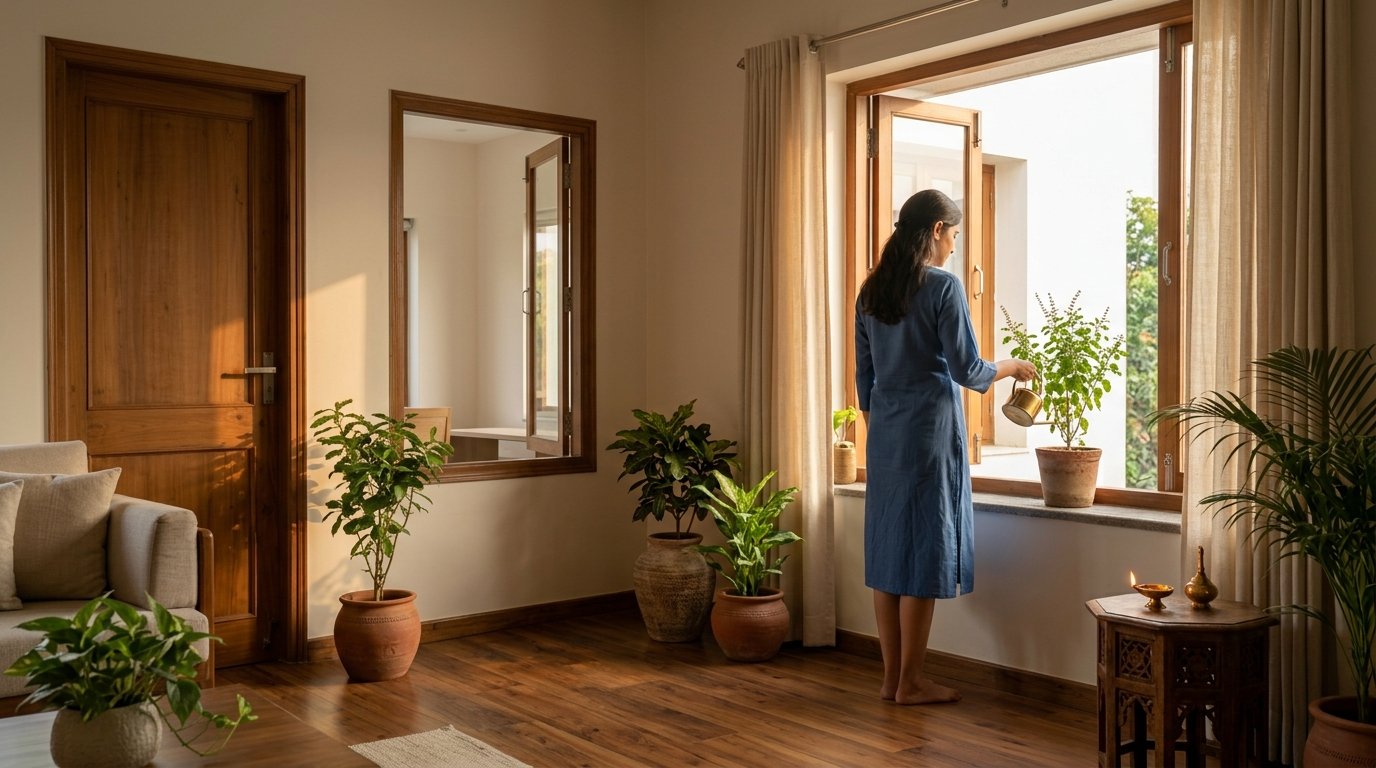
If you had told a 25-year-old software engineer in Bangalore ten years ago that they'd one day be researching Vastu Shastra, they would have laughed.
Vastu? That thing their grandmother mentioned about which corner the money plant should go in? That mysterious ancient system that seemed to belong to a different India — an India of joint families, arranged marriages, and superstitious forwards?
And yet here we are.
That same 25-year-old is now 35. They live in a small flat in a green-certified building. They compost their kitchen waste. They've installed solar panels. They obsess over indoor air quality. They read biophilic design articles. They care about circadian lighting, cross-ventilation, and toxin-free paints.
And somewhere along the way, they've started to wonder: why does my Vastu-observing grandmother's home always feel more peaceful, more balanced, and honestly more "healthy" than the modern flats we design with all our progressive knowledge?
Here's the answer that's quietly transforming how a new generation is thinking about their homes:
Vastu Shastra and modern sustainable living aren't opposing philosophies. They're the same philosophy, translated across 3,000 years.
Everything the sustainability movement is discovering about how buildings affect humans — natural light, ventilation, biophilia, circadian design, material choices, connection to earth and season — Vastu articulated with startling precision thousands of years ago. Different vocabulary. Same insights.
For anyone who has dismissed Vastu as superstition, this article is an invitation to look again. And for anyone who follows Vastu but wonders how to reconcile it with modern eco-conscious living, this is a beautiful bridge.
Let's explore how these two worlds — one ancient, one contemporary — are quietly the same. And how you can build a home that honors both.
Why This Conversation Matters Now
The world's biggest environmental challenges have made us radically rethink how we live in our homes.
Air quality. Water conservation. Energy efficiency. Material sustainability. Toxin-free interiors. Circadian health. Connection to nature. Sound design principles that respect the humans inside.
Modern architects and designers, faced with these challenges, have developed frameworks like LEED certification, biophilic design, passive house principles, green building standards, WELL certification, and circadian lighting design.
Meanwhile, in Indian homes across generations, another framework has been quietly working through the same principles — just in different language.
Kubera's direction is what modern architects call optimizing for morning solar gain.
Agni's zone is what fire safety codes call proper ventilation of cooking areas.
The Brahmasthan is what biophilic design calls "open central atria that support well-being."
Pooja rooms in the North-East align with what circadian science calls the optimal orientation for spaces meant for meditation and contemplation.
Ishan Kona — the sacred water-blessed corner — happens to be the direction from which morning UV-rich sunlight enters most Indian homes, providing natural sanitization and mood support.
Modern research is quietly confirming, one principle at a time, what Indian families have known for generations. The confluence is becoming impossible to ignore.
Principle #1: Natural Light — Vastu Called It "Prana" 🌅
Modern sustainable design obsesses over natural light. Studies consistently show that homes with abundant natural light have:
- Better sleep patterns for residents
- Higher productivity for those working from home
- Improved mood and lower rates of seasonal depression
- Reduced electricity consumption
- Better physiological synchronization with circadian rhythm
What Vastu said 3,000 years ago:
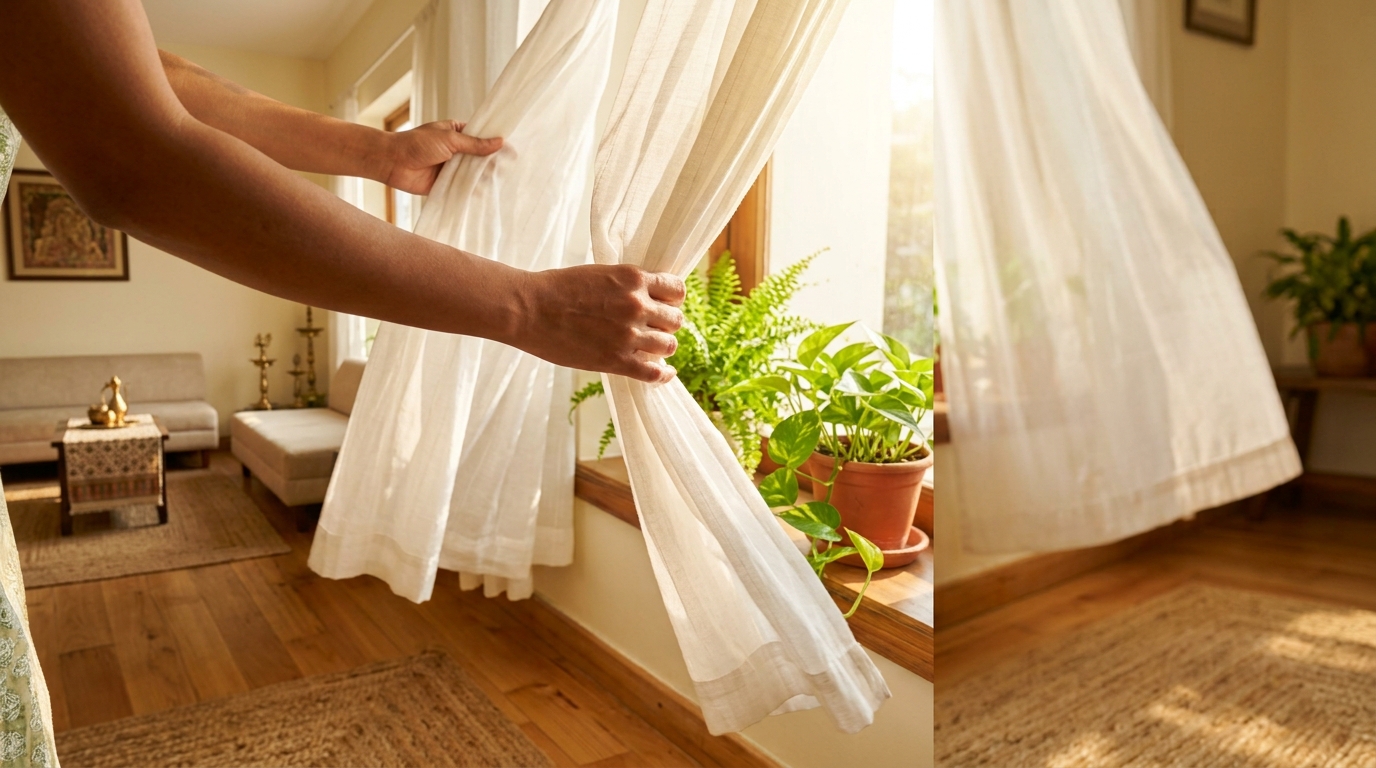
The East and North-East are the sacred zones of the home because they are where morning sunlight enters. Vastu insists that living areas, pooja rooms, and children's play areas be placed to receive this light. The kitchen ideally faces East so the cook is bathed in morning sun. Windows should be positioned to allow sunlight to travel across the home from East to West throughout the day.
Modern sustainable design tells us: orient your home for optimal solar gain, place living spaces to receive morning light, minimize artificial lighting during daytime hours.
Vastu said the same thing 3,000 years ago: honor the East. Let the sun consecrate your home each morning. Design your daily rhythm around light.
Practical application for your home:
- Keep East and North-East windows unobstructed
- Use light, sheer curtains that allow morning light through
- Place your bed to receive morning sunlight
- Design your day so morning activities happen in East-facing rooms
- Minimize thick blackout curtains in daytime living spaces
We covered this principle in our wake up tired article — homes that receive proper morning light produce genuinely different mornings.
Principle #2: Cross-Ventilation — Vastu Called It "Vayu Flow" 💨
Modern green building standards make cross-ventilation non-negotiable. Passive cooling, indoor air quality, humidity control, and thermal comfort all depend on continuous airflow through a home.
Research has shown that homes with excellent cross-ventilation have:
- Lower indoor CO2 levels (directly affecting cognitive performance)
- Reduced growth of mold and bacteria
- Less accumulation of volatile organic compounds (VOCs)
- Better regulation of indoor temperature without excessive air conditioning
- Improved respiratory health for residents
What Vastu said:
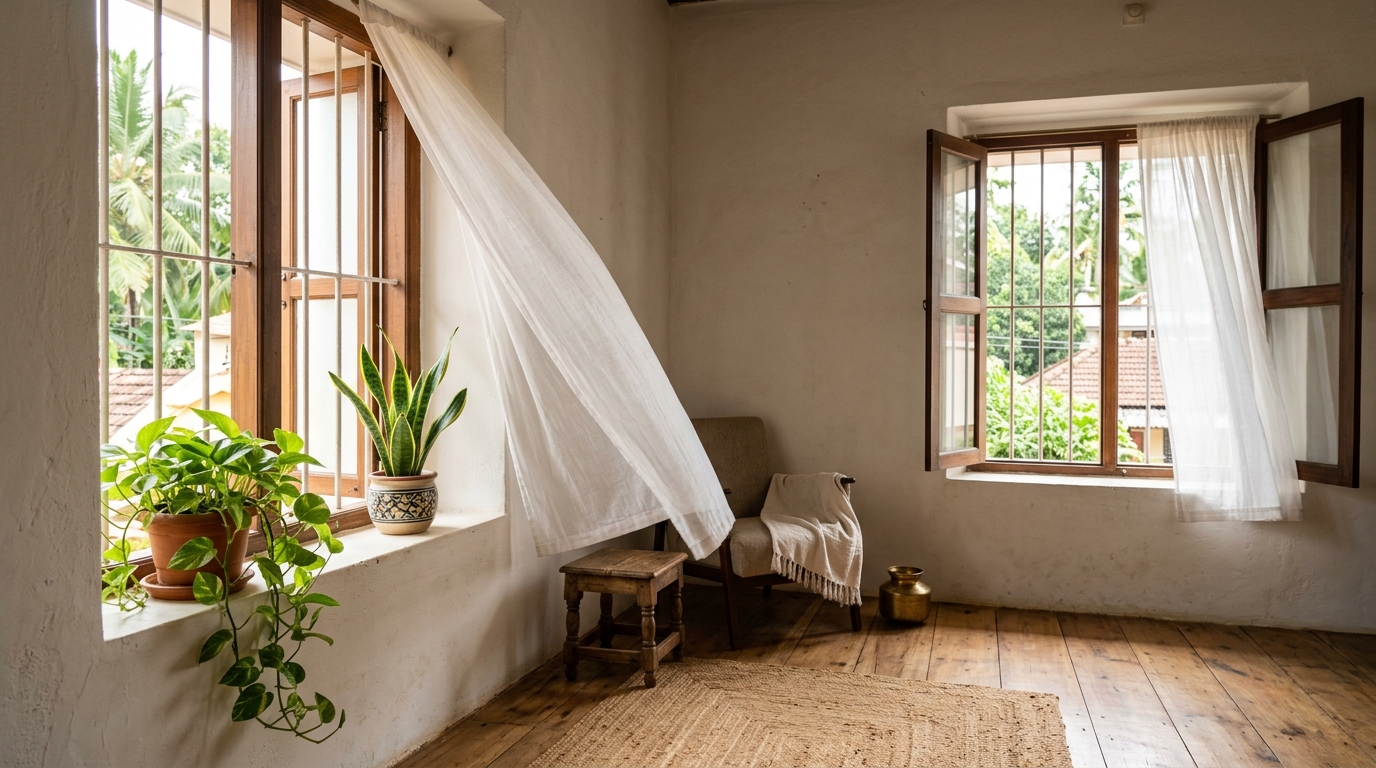
The North-West is ruled by Vayu — the god of wind and air. Vastu explicitly designs homes to allow air to flow through — with openings positioned to enable natural cross-ventilation. Windows should be aligned to allow breeze to move from one side of the home to the other. Rooms should have at least two openings to allow air circulation.
Ancient Indian homes were architectural marvels of natural cooling — courtyards, jaali (perforated screens), high ceilings, thick walls, cross-ventilation everywhere. These weren't design choices. They were Vastu.
Practical application for your home:
- Ensure at least two windows in every major room (across walls if possible)
- Never permanently block cross-ventilation with heavy furniture
- Open all windows for 15 minutes every morning
- Use ceiling fans instead of AC when possible
- Consider adding a small terrace/balcony garden that supports natural cooling
We wrote about how stagnant air affects a home's energy in our negative energy article — both Vastu and modern science agree: moving air is life.
Principle #3: Living Plants — Vastu Called It "Sacred Green" 🌿
Modern biophilic design places living plants at the center of healthy interior spaces. Research on plants in homes has demonstrated:
- Improved indoor air quality (specific plants absorb specific toxins)
- Reduced cortisol levels in residents
- Lower blood pressure and improved mood
- Faster recovery from illness
- Better focus and reduced mental fatigue
What Vastu said:
Plants are considered active carriers of positive energy. Specific plants belong in specific directions — Tulsi in the North or East, money plant in the South-East, jade in the entrance, lucky bamboo in the East. We covered this in detail in our wealth-attracting plants article.
But Vastu goes further than modern biophilic design. It teaches that plants aren't just aesthetic or air-cleaning — they're living relationships. You care for a plant. It responds. The plant becomes a small living being in your home. That relationship itself is health-giving.
Practical application for your home:
- Every room should have at least one living plant
- The kitchen benefits from a small Tulsi or basil
- The entrance welcomes with a healthy jade or money plant
- The bedroom rests with a snake plant (produces oxygen at night)
- The bathroom cleanses with a pothos or peace lily
- Avoid artificial or plastic plants — they're the opposite of living energy
Principle #4: Non-Toxic Materials — Vastu Called It "Sattvic Building" 🏗️
The modern sustainable building movement rejects synthetic finishes, VOC-heavy paints, formaldehyde-treated wood, and toxic sealants. WELL and LEED certifications prioritize natural, non-toxic materials.
Studies on indoor air quality now clearly show that synthetic building materials off-gas chemicals for years after installation, contributing to:
- Chronic respiratory issues
- Endocrine disruption
- Increased cancer risk with prolonged exposure
- Sleep disruption
- Skin conditions in sensitive individuals
What Vastu said:
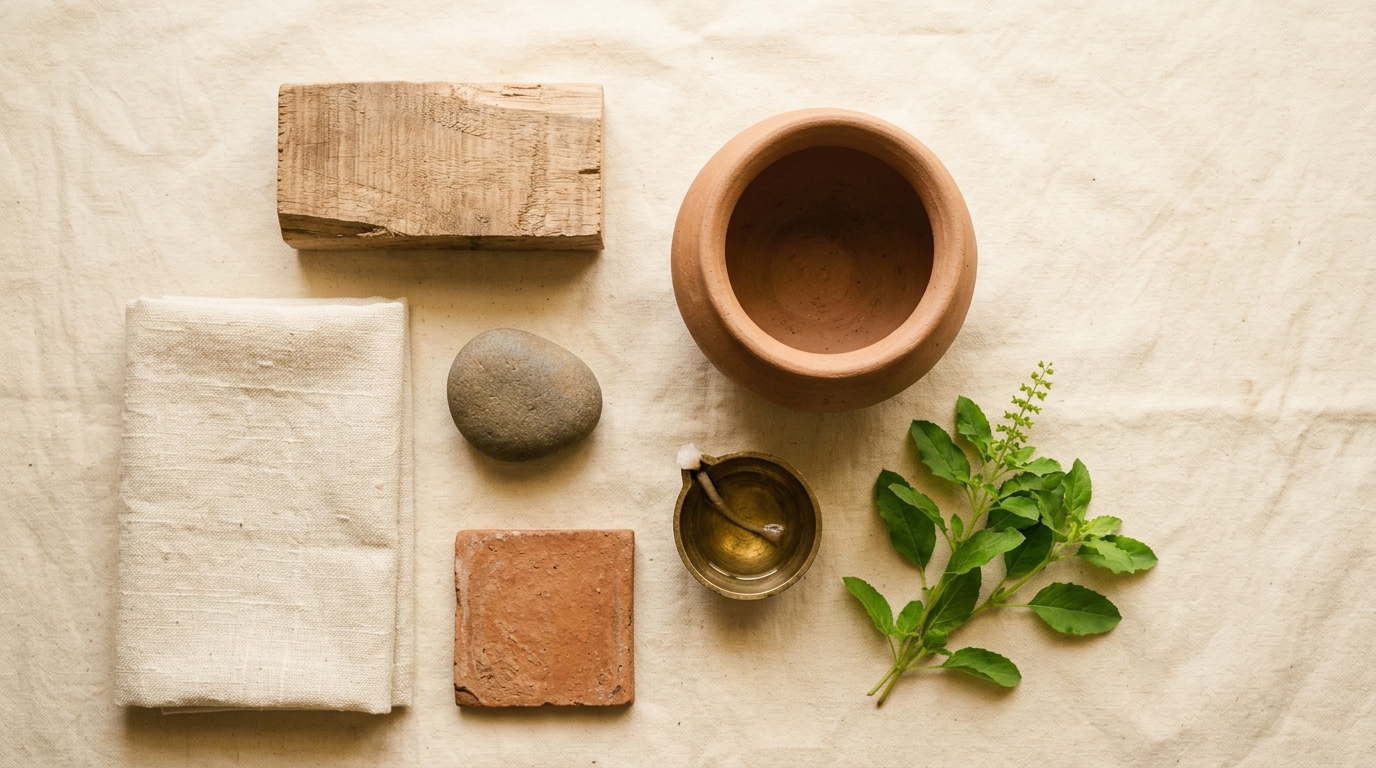
Traditional Vastu recommends natural materials — wood, stone, clay, brass, copper, cotton, silk, wool. These materials are described as sattvic (pure, life-giving) as opposed to rajasic (agitating) or tamasic (heavy/dulling) materials.
Modern research has independently confirmed that natural materials generally have significantly lower off-gassing, better breathability, and more compatible resonance with human physiology than synthetic alternatives.
Practical application for your home:
- Choose natural stone, wood, or clay tiles over synthetic vinyl
- Use low-VOC or natural paints (available now from many Indian brands)
- Prefer cotton, silk, wool, or linen textiles over polyester
- Use solid wood furniture over particle board where possible
- Choose brass, copper, or steel over plastic in kitchenware
- Avoid heavy synthetic carpeting in main living areas
Our kitchen Vastu article covered why traditional cooking materials (brass, iron, clay) also happen to be scientifically healthier — Vastu had good reasons.
Principle #5: Water — Vastu Called It "Jal Element" 💧
Modern sustainable design elevates water conservation as a moral imperative. Rainwater harvesting, greywater reuse, water-efficient fixtures, and mindful water management are now central to eco-conscious homes.
What Vastu said:
Water is a sacred element (Jal) associated with the North-East. Water storage should be in the North-East. Wells (in traditional homes) should be in the North-East. Water sources should never be allowed to leak (a chronic leak is considered a serious Vastu drain — and matches modern principles of water conservation exactly).
Practical application for your home:
- Position water storage (tanks, purifiers) in the North-East if possible
- Fix every leak immediately (Vastu and sustainability agree completely)
- Consider a small water feature (a small indoor fountain or Tulsi setup with water) in the North-East for both energetic and humidity balance
- Install low-flow taps and shower heads
- Consider greywater reuse for plants
- If you have space, rainwater harvesting is deeply Vastu-aligned
Principle #6: Waste — Vastu Called It "Right Elimination" 🗑️
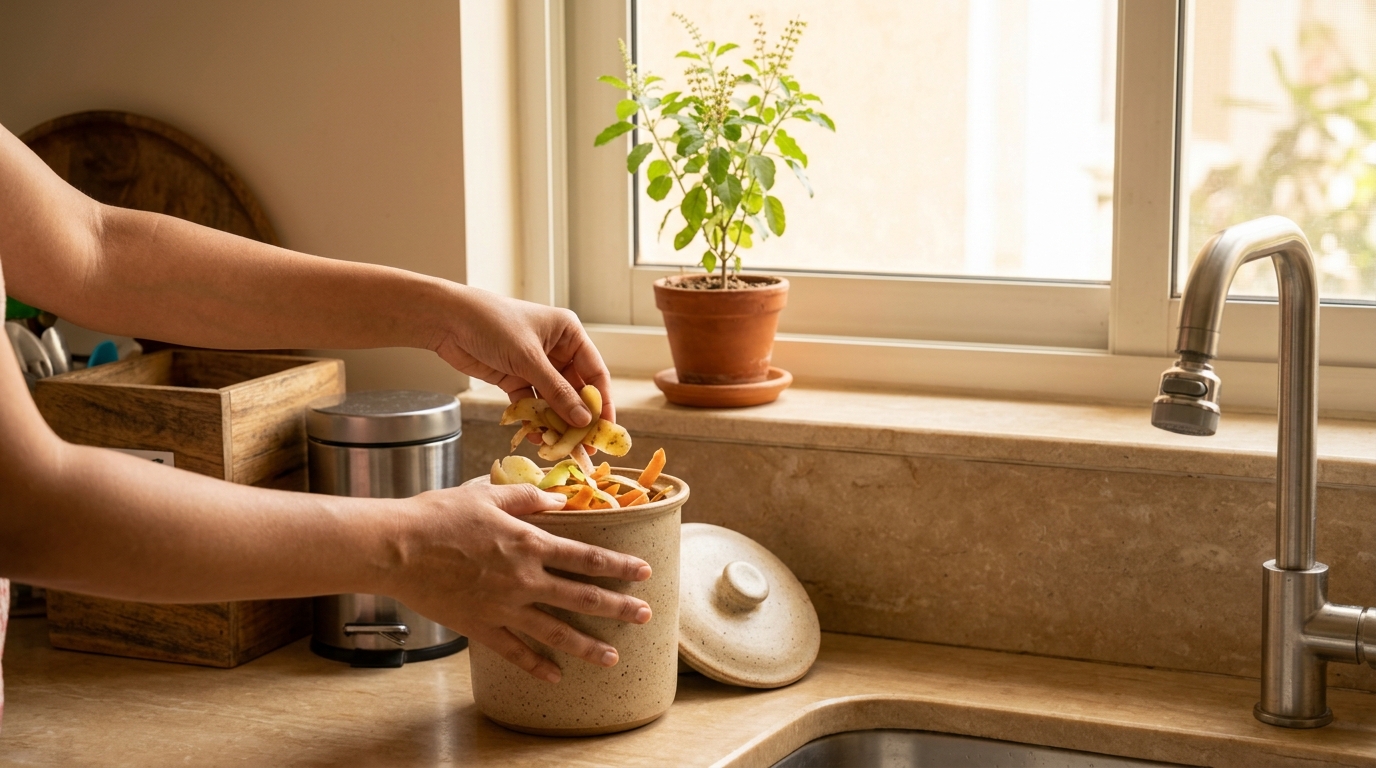
Modern sustainable living emphasizes composting, recycling, reducing plastic, and mindful waste management.
What Vastu said:
Waste has a proper place — the South-West or South of the home, or better, outside the home entirely. Dustbins should not be visible in living spaces. Waste should never sit in the sacred North-East. Kitchens should be cleaned nightly. Broken things should be disposed of promptly, not accumulated.
Modern composting, recycling, and waste-reduction practices align beautifully with Vastu's principle that waste should be managed, not accumulated.
Practical application for your home:
- Keep dustbins in the South or South-West of each room
- Never keep dustbins in the North-East (major Vastu defect + poor sustainability practice)
- Start home composting if possible
- Segregate wet and dry waste properly
- Dispose of broken things immediately — don't accumulate
- Reduce, reuse, recycle — deeply Vastu-aligned
Principle #7: Connection to Nature and Season — Vastu Called It "Ritu Chakra" 🌸
Modern biophilic design emphasizes connection to natural rhythms, seasonal awareness, and integration with the outdoor environment.
What Vastu said:
Vastu treats the home as an active participant in the seasonal cycle — the Ritu Chakra. Homes should feel different in monsoon vs summer vs winter. Windows should be adjustable to seasonal light. Fabrics should change with the seasons. Even the pooja room shifts subtly with seasonal festivals.
The traditional Indian home wasn't a climate-controlled bubble. It was a living participant in the natural world — a philosophy modern sustainability is now trying to rediscover.
Practical application for your home:
- Notice how different rooms feel in different seasons
- Adjust curtains, fabrics, and layouts seasonally
- Celebrate seasonal festivals with your home — they're Vastu practices in disguise
- Grow a small seasonal garden if possible
- Sleep with an open window in summer when possible
- Reduce dependence on air conditioning
The Modern Vastu Home: A Complete Vision 🏡
If you were to design a home that honored both Vastu and modern sustainability, here's what it would look like:
Location and orientation:
- Home oriented to receive morning sunlight from the East and North-East
- Windows aligned for cross-ventilation across the home
- Central atrium or open Brahmasthan for air and light flow
Materials:
- Natural stone, wood, clay, brass predominantly
- Low-VOC or natural paints in warm, calming tones
- Cotton, silk, wool textiles instead of synthetics
- Solid wood or bamboo furniture over particle board
Layout:
- Kitchen in the South-East (Agni's zone, also matches fire safety principles)
- Master bedroom in the South-West (grounding, matches biophilic principles for deep sleep)
- Pooja space or meditation corner in the North-East (peace, matches circadian science)
- Bathrooms in the North-West or West (proper waste elimination direction)
- Living areas in the North and East (light, energy, social interaction)
Living systems:
- Living plants in every room, positioned by Vastu direction
- Rainwater harvesting or water-efficient fixtures
- Home composting for organic waste
- Solar panels if possible (sun energy — deeply Vastu-aligned)
- Cross-ventilation as primary cooling, ACs as backup
Rhythms:
- Morning light, evening diyas, seasonal adjustments
- Daily cleaning, weekly deeper practices, monthly rituals
- Seasonal festivals celebrated as home-consecration moments
- Regular decluttering as both sustainability and Vastu practice
This is the modern Indian home at its best — technologically sophisticated, environmentally conscious, and energetically aligned. Not "traditional vs modern." Both. Deeply.
For Skeptics Reading This 🤔
I want to speak directly to anyone who has always dismissed Vastu as superstition.
You're not entirely wrong. A lot of what circulates as "Vastu" is genuinely nonsense — WhatsApp uncle forwards, dramatic urgency-based warnings, commercial exploitation. We wrote a whole article about this: debunking WhatsApp Vastu myths.
But underneath the noise is a genuine ancient science — one that anticipated a startling number of principles that modern research, sustainable design, and environmental psychology are only now catching up on.
You don't have to believe in Kubera to appreciate that the direction of morning sunlight matters for circadian health.
You don't have to accept that a bathroom in the North-East will curse your family to see that improper waste placement affects indoor air quality and family well-being.
You don't have to perform a Bhoomi puja before renovation to acknowledge that intentional pauses shape human relationships with spaces.
Vastu, in its authentic form, is essentially: thoughtful, principled, environmentally-aware home design that respects the humans who live inside.
That's not superstition. That's exactly what sustainability advocates are asking us to do — with an extra 3,000 years of refinement.
Approach it that way. See what you find.
The Generation Gap Bridge 💚
I want to write directly to two audiences here:
To the grandparents: Your grandchildren aren't rejecting Vastu because they don't respect tradition. They're rejecting it because much of what they encounter as "Vastu" is genuinely poor content — fear-based, commercially exploitative, or disconnected from any real reasoning. When you can offer them the authentic Vastu — the observation-based ancient science — they will engage with it. Trust that. Show them the sophistication, not the superstition.
To the young adults: Your grandparents aren't being irrational when they insist on Vastu principles. They're carrying accumulated wisdom that they may not be able to articulate in modern terms — but that generations of Indian families observed and refined. When they say "don't put your bed there," they may be transmitting something real. Listen. Ask them why. And use your modern research skills to explore whether there's more to it than initially seems.
Both generations have something important to offer each other. This eco-Vastu conversation is where you can meet.
A Quick Eco-Vastu Audit ✅
Take 15 minutes and check your home:
- Does my home get abundant natural light from East and North-East?
- Do windows on opposite walls allow cross-ventilation?
- Are there living plants in every room?
- Are my primary materials natural (wood, stone, cotton) or synthetic?
- Is my paint low-VOC or natural?
- Are water sources positioned in supportive zones (North-East)?
- Are dustbins kept in South/South-West, never North-East?
- Does my home feel connected to the seasonal cycle?
- Are broken things fixed or removed promptly?
- Do I practice small daily rituals (diyas, plant care, cleaning)?
Each "yes" is a point of alignment between Vastu and sustainable living. Each "no" is an opportunity to bridge both worlds.
🗺️ Design Your Eco-Vastu Home from Scratch
If you're planning a new home, renovation, or interior redesign — this is your chance to integrate Vastu and sustainability from the beginning.
We built a free tool where you can upload your floor plan and instantly see it mapped according to proper Vastu directions — helping you make design choices that honor both ancient wisdom and modern eco-conscious living.
👉 Upload your floor plan and design your Eco-Vastu home in 30 seconds
Just a photo or scan (PNG, JPG, JPEG). Whether you're a Vastu practitioner exploring sustainability, or a sustainable-design enthusiast rediscovering ancient wisdom — this is where the two paths beautifully meet.
Final Thoughts: The Home Our Ancestors Would Recognize 💫
Here's a thought worth sitting with:
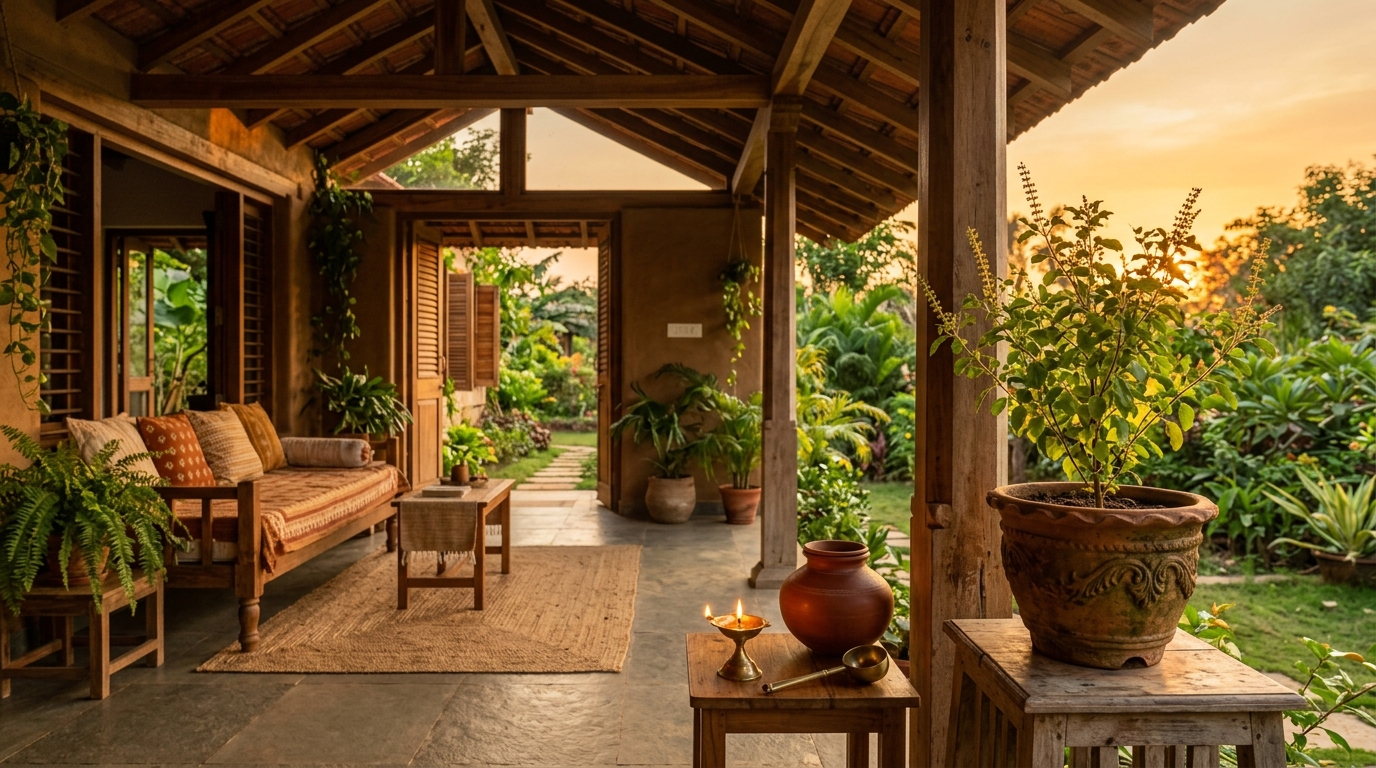
Somewhere in India, right now, your great-great-grandmother's spirit might be watching over an urban flat with solar panels, low-VOC paint, cross-ventilation, morning-light-filled living rooms, healthy plants in every corner, and a small pooja space in the North-East corner.
She would recognize it immediately.
She wouldn't know the vocabulary — LEED, biophilic design, WELL certification, circadian lighting — but she would look around and say: "Yes. This home is set up correctly. This is a home where a family can thrive."
That's the beauty of what's happening in this moment of Indian home design. We're not choosing between honoring tradition and embracing progress. We're discovering they were always the same thing.
Vastu at its best is sustainable design. Sustainable design at its best is Vastu. The names are different. The wisdom is the same.
Build your home this way — with awareness of light, air, plants, materials, water, waste, seasons, and rhythm — and you're honoring both your ancestors AND the future. You're building a home that's both traditional and progressive. Both sacred and scientific.
That's not a compromise between old and new. That's an integration that both are the better for.
Welcome to Eco-Vastu — where 3,000 years of ancient wisdom meets modern conscious living, and both are richer for the meeting. 🌍🌿🕉️
Are you rediscovering Vastu through a sustainability lens, or exploring sustainability through a Vastu lens? Share this article with someone from the other generation — the elder who's been trying to explain Vastu, or the young adult who's been dismissing it. Sometimes the greatest gift is a shared vocabulary for what we've all been reaching toward. 🙏