
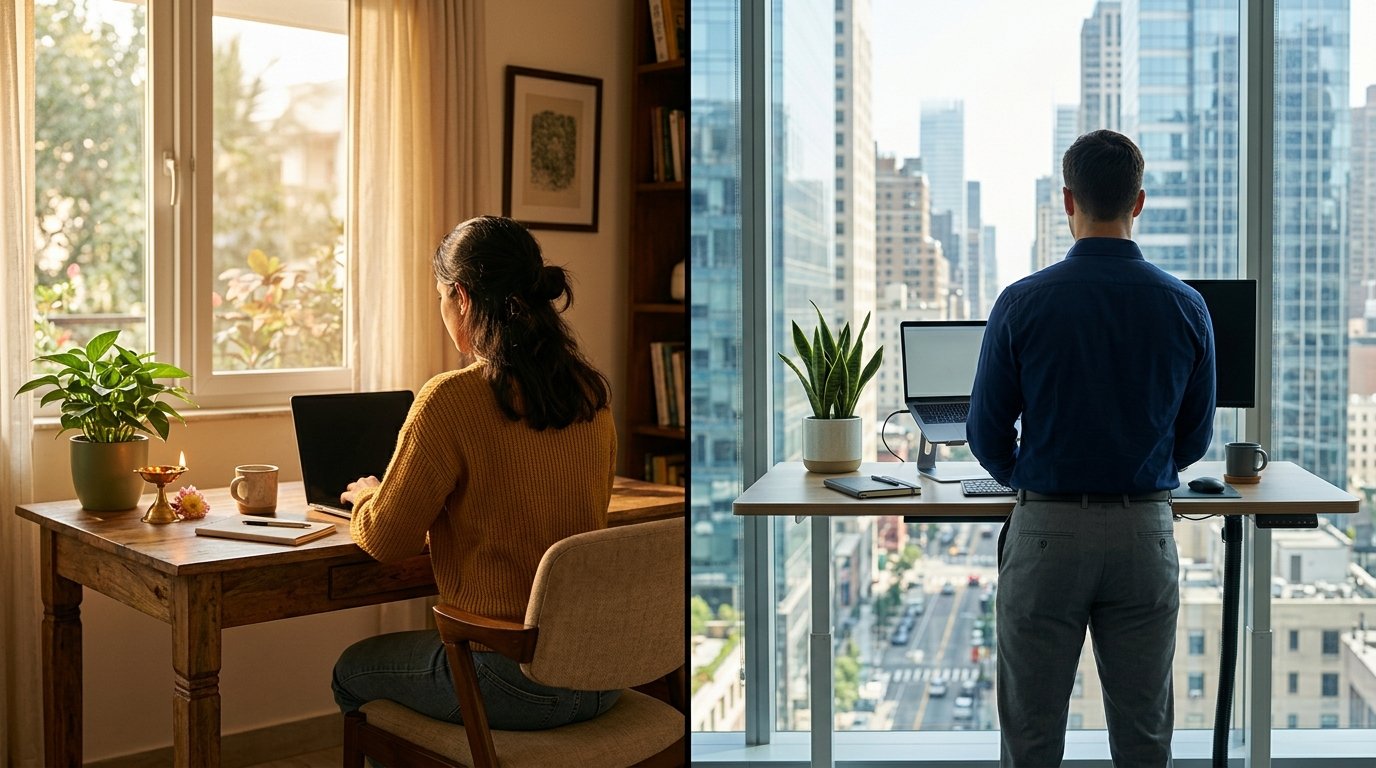
You probably split your work life across two very different spaces these days.
Some mornings you commute to a proper corporate office — the glass building, the security desk, the elevator, the open floor with your team, the meeting rooms you book on an app, the cafeteria for lunch. Other days you're in your home office — the room in the corner (or the corner of a room), the door you close to signal "work mode," the laptop on the wooden desk, the calls taken with your bookshelf as background.
Two very different environments. Two very different work realities.
And yet — most professionals treat them as if the same rules apply to both.
Here's what almost nobody in the modern hybrid work era has stopped to consider: the Vastu principles that make a home office energizing are meaningfully different from the ones that make a corporate office productive. Applying home-office principles to corporate settings often fails. Applying corporate-office principles at home often creates burnout.
We've written before about desk direction (desk Vastu article) and work-from-home productivity (WFH Vastu article). This article builds on both — but goes into the specific, nuanced differences between the two environments, and how modern hybrid professionals can optimize each one for what it's actually for.
Whether you're a founder building your first office, a mid-career professional splitting time between home and headquarters, or a manager thinking about how team seating affects performance — this guide will help you understand which Vastu principles matter where, and why.
Why Home and Corporate Offices Are Actually Different (Beyond the Obvious)
The differences between home and corporate offices aren't just about who owns the space or how many people are there. They're about what each environment is for.
A home office is fundamentally about:
- Deep individual focus without interruption
- Managing the boundary between work and personal life
- Restoration between calls and tasks
- Solo decision-making
- Longer, uninterrupted stretches of thinking
A corporate office is fundamentally about:
- Collaboration and momentum with teams
- Rapid decision-making with visible authority
- Networking, meetings, chance encounters
- Structured productivity within set hours
- Being seen working (both a benefit and a burden)
These different purposes require different energetic setups. What supports one often undermines the other.
For example: a home office needs strong personal-space boundaries (you should feel you can close a door and be "at work"). A corporate office needs the opposite — permeability, visibility, easy collaboration.
A home office thrives on personalization, warmth, and elements that make you feel supported. A corporate office thrives on clean, focused, minimally distracting design.
Vastu principles adapt to serve these different purposes. Let's explore how.
Principle #1: Direction You Face — Both Matter, But Differently 🧭
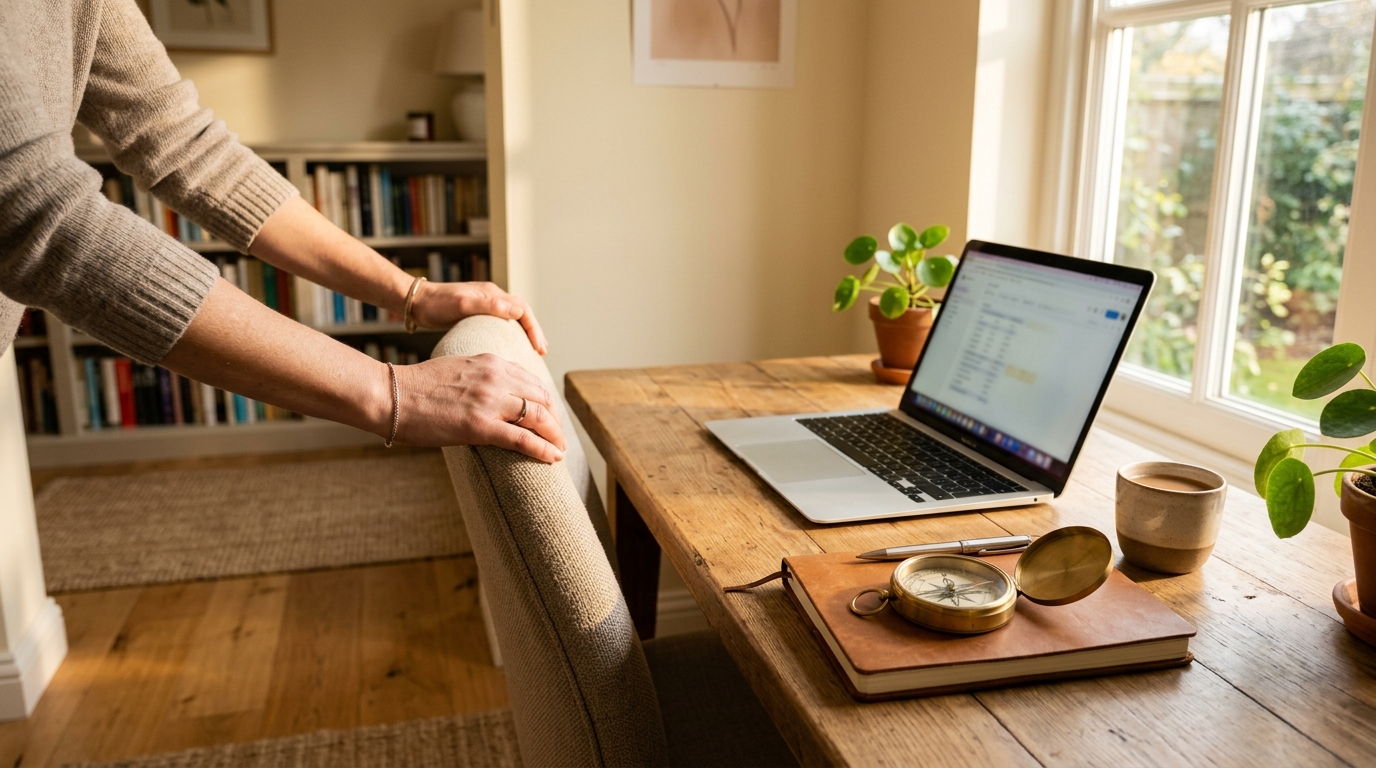
The direction you face while working is the single most important Vastu factor for both environments. But the reason it matters differs.
In a home office:
Face East (for creativity, learning, growth) or North (for wealth, opportunity, clarity). The reason: at home, you're primarily doing deep individual work. You need the personal-energy support that these directions provide.
At home, you can usually control your desk direction entirely — arrange it however you want. There's no excuse not to face East or North.
In a corporate office:
Face North (ideal for career advancement, dealings with senior authority) or East (for creative and technical work). Why: in corporate settings, hierarchy and visibility matter. Facing North specifically aligns you with the authority direction — subtly supporting your standing with leadership.
The challenge: in corporate offices, desk direction is often assigned. You may not have a choice. If you can't face North or East, we'll discuss remedies later in the article.
A subtle but important corporate distinction:
If you sit in a corporate office and face a bathroom door, a store room, or a chronically-cluttered corner while working — even for hours a day — this creates a subtle drain that home-office principles don't cover. Corporate professionals often develop mysterious "afternoon slumps" or unusual irritability that trace back to what they're facing. Home offices rarely have this issue because we design them ourselves.
Principle #2: What Sits Behind You — Home vs Corporate Priority Differs 🧱
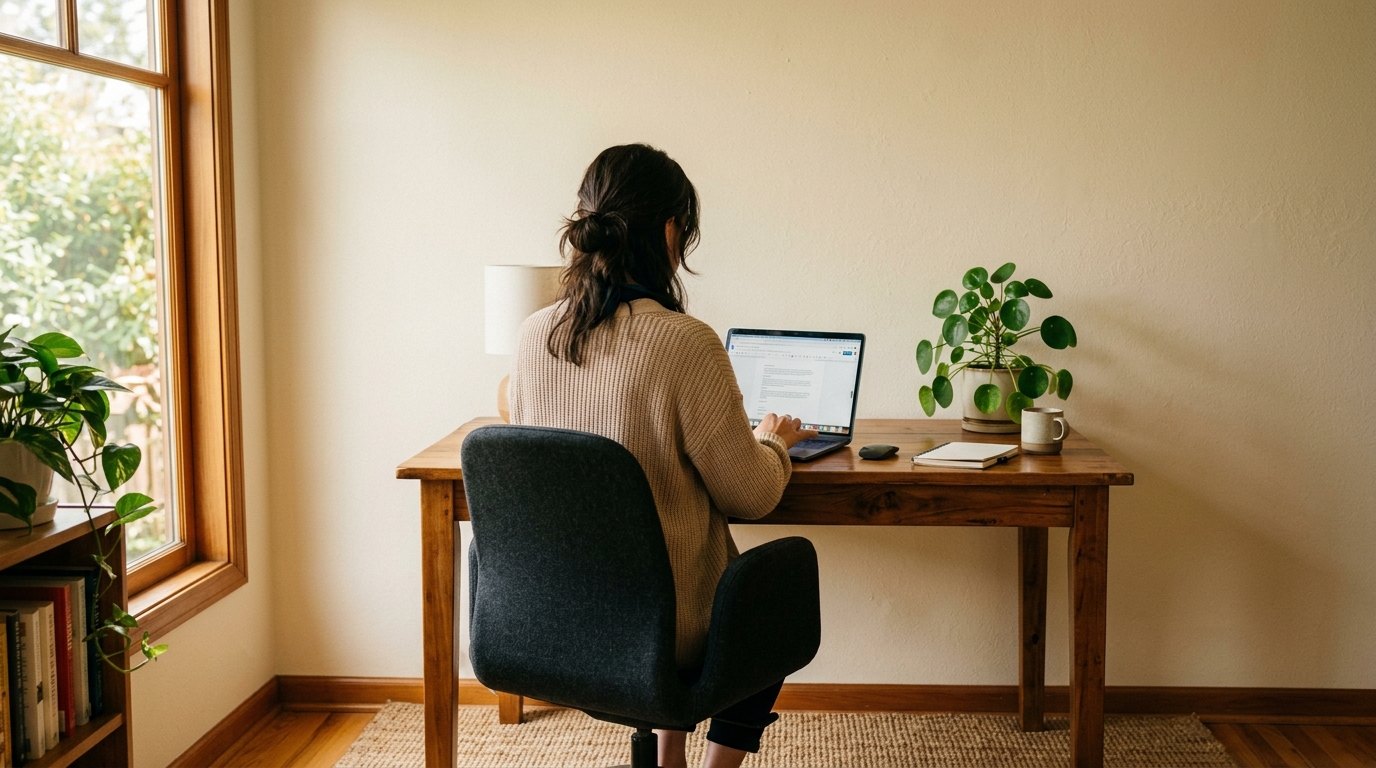
The wall (or lack of wall) behind your work chair is a Vastu factor both environments share. But the priority differs.
In a home office:
Behind you should be a solid wall — always. At home, you're often alone for long stretches. Your nervous system is quietly scanning for safety, especially if you're deeply focused. An exposed back (window, open door, corridor) creates low-grade nervous alertness that drains focus over hours.
If your home office desk faces the "right direction" but has your back to a window, you're violating the more important principle. Rotate the desk. Get the wall behind you.
In a corporate office:
The "solid wall behind" principle still matters — but in corporate contexts, another factor arises: avoid having your back to a high-traffic pathway or main aisle. Even if the wall behind you is technically solid, if colleagues walk behind you all day, the same nervous-system alertness kicks in.
Corporate-specific issue: avoid seating with your back to your manager's cabin or the office entrance. Beyond Vastu, this creates ongoing subconscious anxiety. If you can arrange it, seat yourself in the "command position" — able to see doorways without being in direct line with them.
Principle #3: Command Position — More Critical in Corporate 🎯
The "command position" — being able to see the entrance to a room without being in direct line with it — is a Vastu principle both spaces share. But it's dramatically more important in corporate settings.
Why:
At home, few unexpected people enter your workspace. If your child or spouse walks in, it's a known energy. Startle response is minimal.
At corporate offices, unpredictable arrivals happen constantly. Your manager stops by. A colleague pings you at your desk. HR arranges a surprise conversation. Every unexpected arrival creates a tiny startle response — and if you can't see the entrance, you're subtly bracing for that startle all day.
Corporate professionals with poor command-position seating often report chronic mild anxiety, difficulty concentrating in the afternoon, and unexplained tiredness — all of which improve dramatically when they can see who's approaching them.
Home office command position:
- Position your desk so you can see the doorway
- Not directly in line with the door
- Diagonal placement is ideal
Corporate office command position:
- If assigned a seat that violates this — request a change if possible, or...
- Angle your monitor slightly so you can see peripherally without turning
- Use a small mirror on your desk to see behind you (traditional Vastu remedy for exposed backs)
- Keep the exposed side clean and minimal (adding visual chaos amplifies the exposed feeling)
Principle #4: Lighting — Home Wins, Corporate Struggles 💡
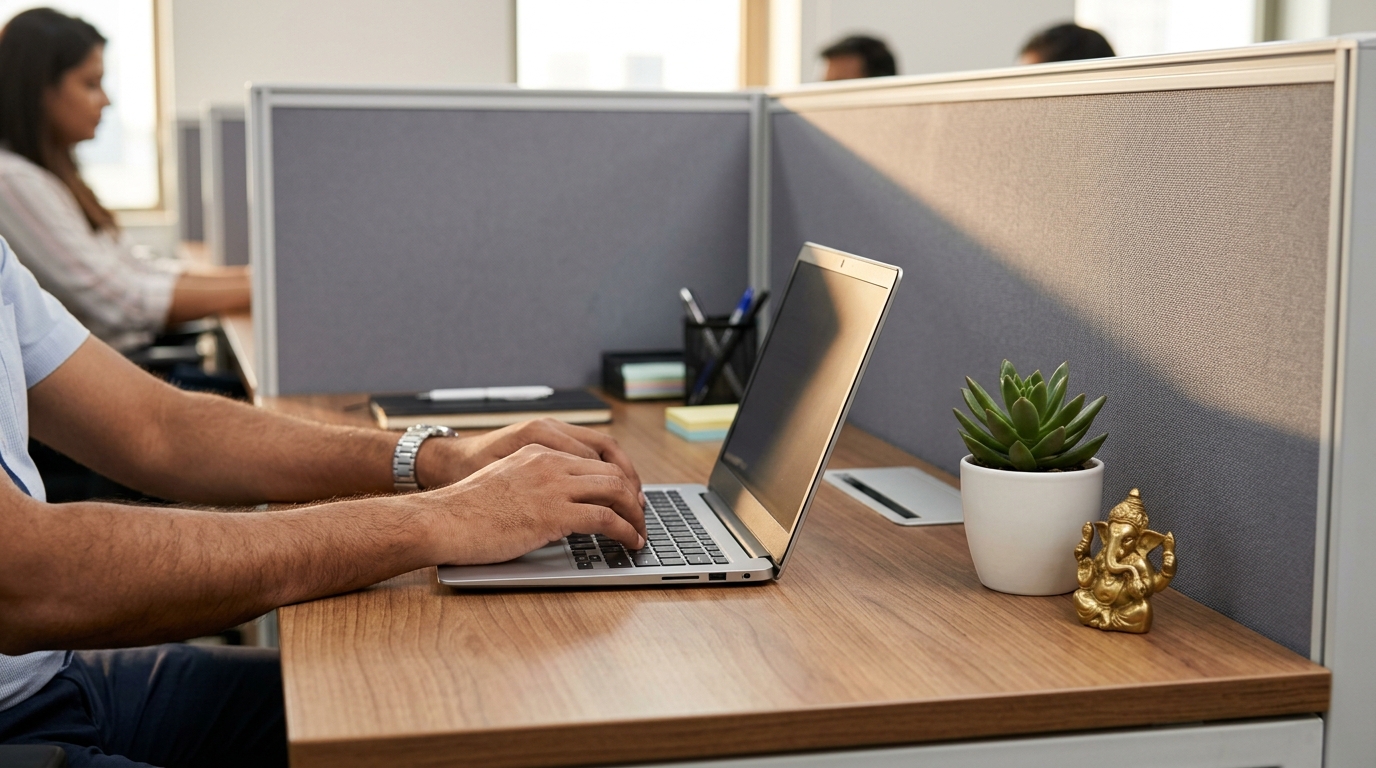
Lighting is one of the most transformative Vastu factors — and one of the biggest differentiators between home and corporate offices.
In a home office:
You have full control. Use it well.
- Natural light from the East is ideal — position your desk near an East-facing window
- Warm-toned LED for artificial lighting — never harsh white or blue-toned
- A dedicated desk lamp at the South-East corner of your desk (the fire zone — supports drive and focus)
- Avoid overhead-only lighting — creates harsh shadows and fatigue
In a corporate office:
You often have little to no control. Corporate offices frequently use:
- Harsh fluorescent lighting
- Blue-toned LEDs
- Bright uniform light that eliminates variation
These are all Vastu-negative and modern-science-negative. Studies on office lighting consistently show that harsh fluorescent lighting reduces productivity, increases eye strain, and disrupts circadian rhythm.
Corporate lighting remedies:
- Bring your own warm-toned desk lamp if allowed
- Position your seat near a window if possible
- Take frequent breaks near natural light sources
- If your office has an outdoor space, use it for calls
- Advocate for warmer lighting if you have influence
Modern hybrid workers often notice this: they feel dramatically better on WFH days despite doing the same work. Lighting is often the invisible reason.
Principle #5: Clutter — Different Rules 🗑️
Both environments benefit from decluttering. But the specifics differ.
In a home office:
The clutter that hurts you most is personal-life clutter creeping into work space:
- Unfolded laundry visible during calls
- Kids' toys or books
- Grocery bags
- Personal papers mixed with work papers
- Kitchen dishes creeping into view
The rule for home offices: maintain the psychological boundary between work and personal life through visual separation. Your workspace should feel like a workspace — even if it's just a corner of a larger room.
In a corporate office:
The clutter that hurts you most is accumulated work debris:
- Old files and papers from projects long completed
- Post-it notes covering the monitor
- Empty coffee cups
- Cables snaking across the desk
- Random office supplies from years ago
Corporate professionals often unconsciously accumulate work identity through visible clutter — as if a "busy" desk signals importance. Actually, it signals difficulty prioritizing.
Corporate declutter principle: at the end of every week, clear the desk completely. Start Monday morning with an empty, clean workspace. This is Vastu-aligned and productivity-aligned.
Principle #6: Personalization — Encouraged at Home, Careful in Corporate 🖼️
What you put on your desk and walls matters. But the principles differ between contexts.
In a home office:
Encouraged:
- Family photos (in the East or South corners)
- Educational or inspirational images
- A small plant (money plant, jade, or small snake plant)
- A small brass diya or symbol of intention
- Sacred symbols aligned with your values
- Personal art that inspires you
- A vision board or goal reminders
Why: Home offices work better when they feel like yours. Personalization creates ownership, which creates focus.
In a corporate office:
Careful with:
- Overly personal family photos (subtle privacy issue, also energy leakage)
- Religious symbols too prominently displayed
- Political statements
- Anything that could be misinterpreted by colleagues
- Too many personal items (signals "camping here" rather than "professional")
Encouraged:
- One or two family photos, discreetly placed
- A small healthy plant
- A single meaningful object (a small brass Ganesh, a small compass, an inspiring quote)
- Professional certifications on the wall (aspirational + status)
Why: Corporate spaces need to communicate "I am a serious professional." Excessive personalization can subtly undermine professional standing.
Principle #7: The Meeting Room — Corporate Only 🪑
This is a corporate-specific factor with no home-office equivalent.
Meeting rooms shape decisions, relationships, and outcomes — and their Vastu significantly affects the quality of what happens inside.
Best meeting room principles:
- Rectangular tables — energetically balanced
- Person leading the meeting should sit facing East or North (with authority direction)
- Never allow anyone to sit with back to the door — creates unconscious anxiety
- Adequate natural light — meetings held in dim rooms tend toward pessimism
- Fresh air — closed, stuffy meeting rooms produce foggy decisions
- A plant in the corner — softens the corporate energy
- Neutral colors — reds and aggressive colors create conflict
If you lead teams and can influence meeting-room design or booking:
- Choose rooms with windows and natural light
- Sit in the "leader position" facing North or East
- Insist on well-ventilated rooms
- Avoid meetings in dim, cramped, or overcrowded rooms — the physical constraint becomes psychological constraint
We covered team-energy principles in our struggling business article — meeting rooms are where much of this plays out.
Principle #8: The Boundary Between Work and Life — Home Only 🚪
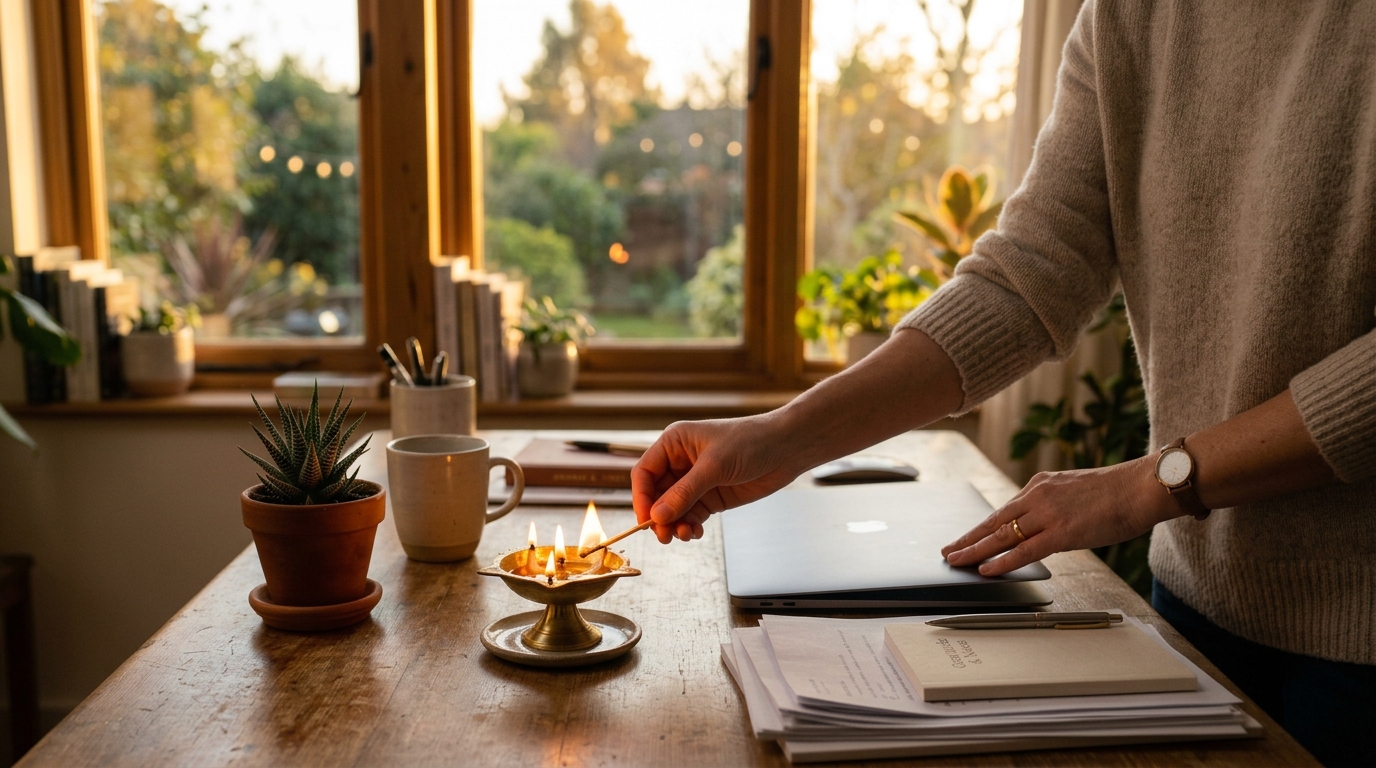
This principle is entirely home-office specific — and one of the most important.
At home, the boundary between "at work" and "not at work" is entirely constructed by you. If done poorly, work bleeds into all hours and personal life bleeds into work hours. Both suffer.
Vastu-aligned home office boundary principles:
Physical separation:
- Ideally, work in a dedicated room with a door you can close
- If that's not possible, work in a dedicated corner with visible boundaries (a screen, a rug, a specific desk)
- Never work from bed (destroys sleep quality AND work focus)
- Never do personal activities at your work desk
Time separation:
- Have a clear "start work" ritual (light a small diya, make your first coffee, open your notebook)
- Have a clear "end work" ritual (close your laptop, tidy the desk, physically leave the space)
- Don't check work email from your work chair in the evening
- Don't take personal calls from your work chair during the day
Energetic separation:
- Clean the workspace at the end of each day
- Add a small "reset" element (a lit diya at start of day, a plant that needs daily watering)
- On weekends, cover the desk with a beautiful cloth to signal "closed"
- Consider a small dedicated Ganesh image at your home workspace — remover of obstacles, blesses the work
This boundary principle is what makes home-work sustainable long-term. Without it, home-working professionals burn out within 18-24 months.
Principle #9: The Team Around You — Corporate Only 👥
This is a corporate-specific factor with no home equivalent — and one of the most nuanced.
The people sitting near you affect your work energy. Their moods, their focus, their conflicts, their success — all subtly reach you throughout the day.
Vastu-aware corporate seating awareness:
Positive seating adjacencies:
- Sitting near high-performing, positive colleagues
- Sitting near natural light and green plants
- Sitting near meeting rooms (indicates involvement in important discussions)
- Sitting near senior leaders (visibility opportunity)
Negative seating adjacencies:
- Sitting near chronically-negative colleagues (their energy affects you)
- Sitting near constant conflict zones (arguments, complaints)
- Sitting near bathrooms or break rooms (high-traffic zones)
- Sitting near broken equipment or clutter zones
- Sitting near colleagues in visibly poor Vastu positions (their struggle affects team energy)
If you're a manager influencing seating:
- Cluster high-performers together — energy compounds
- Separate chronic conflict pairs
- Give sensitive employees (deep-work needs) quieter, protected positions
- Give collaborative employees more visible, connected positions
- Ensure everyone can see meeting rooms or open pathways (not walled in)
The Hybrid Professional's Optimization Playbook 📋
For anyone splitting time between home and office, here's how to optimize each:
On corporate office days:
- Take advantage of visibility, collaboration, meetings, and networking
- Do work that benefits from spontaneous conversation and quick decisions
- Attend all in-person meetings and social touchpoints
- Be seen — the office is partly a performance space
- Don't try to do deep-focus work here if you can avoid it
On home office days:
- Take advantage of the environment you've designed for deep focus
- Do the work that requires uninterrupted concentration
- Do the writing, analysis, and thinking that struggles in open offices
- Take breaks in your own space
- Rest deliberately between calls
The mistake most hybrid workers make: Treating both days the same. Trying to do deep-focus work in the corporate office. Trying to do collaborative work at home. Both fail.
The Vastu-aware alternative: Recognize that each environment has its energetic strengths. Design your work around those strengths.
A Quick Home vs Corporate Vastu Audit ✅
Take 20 minutes to audit both your workspaces:
Home Office:
- Am I facing East or North while working?
- Is there a solid wall behind my chair?
- Can I see the doorway from my desk?
- Is my lighting warm and adequate?
- Is my workspace visually separated from personal spaces?
- Do I have start-of-day and end-of-day rituals?
- Is there a small plant or living element?
- Are personal items intentional, not accidental clutter?
Corporate Office:
- Am I facing a favorable direction (or have I applied remedies)?
- Do I have some wall/support behind me?
- Can I see the pathway toward my desk?
- Is my desk decluttered weekly?
- Are my personal items professional and minimal?
- Am I not sitting near chronic conflict or negative colleagues?
- Do I have at least one small plant?
- Do I take breaks near natural light?
Each "yes" strengthens your work life. Each "no" is a targeted, actionable fix.
🗺️ Map YOUR Home Office Correctly
For the home office side specifically — the environment you can actually control — knowing exactly which direction each wall of your workspace faces is critical. Otherwise you might be optimizing based on guesses.
We built a free tool where you can upload your home's floor plan and instantly see it mapped according to proper Vastu directions — including exactly where your home office should ideally be positioned, which direction to face, and which corners of the room to activate.
👉 Upload your floor plan and optimize your home office in 30 seconds
Just a photo or scan (PNG, JPG, JPEG). Your home office is the workspace you have the most control over. Get it exactly right — and it will support you through years of remote work.
For Hybrid Workers Feeling the Toll 💚
I want to write this section directly to modern hybrid professionals.
You are navigating something that no previous generation had to figure out — how to be productive across two very different work environments while maintaining boundaries, well-being, and family life.
This is genuinely hard. It's not a personal failing when it feels overwhelming. The 20th-century concept of "work-life balance" wasn't designed for hybrid remote work. Your parents don't have context. The books haven't caught up. You're inventing this in real time.
If you're feeling burned out, disconnected from your work, or unable to shift gears well between environments — please don't just optimize your Vastu. Also:
- Talk to your manager about which days serve which purposes
- Set actual boundaries with your family about home-work time
- Build real transition rituals between environments
- Take vacation days when needed
- Consider whether the current hybrid arrangement is even right for you
Vastu is a supportive layer. It's not a substitute for the deeper questions modern work asks of us.
Do the Vastu work. Do the boundary work. Do the emotional work.
You deserve to feel supported in both environments. 🌸
Final Thoughts: Two Environments, One Professional 💫
Here's a thought worth sitting with:
Your professional life used to happen in one place. For thousands of years — including your parents' generation — you had an office. Singular. A place you went to work, that ended when you left.
You're the first generation of Indian professionals to genuinely split your work life across two spaces you inhabit deeply. Both are yours. Both matter. Neither is optional.
Vastu Shastra didn't anticipate this specific challenge — but its principles adapt beautifully to it. Each environment has its own energy needs. Each supports different kinds of work. Each requires different setups to serve you well.
Take an afternoon to think about each workspace with fresh eyes.
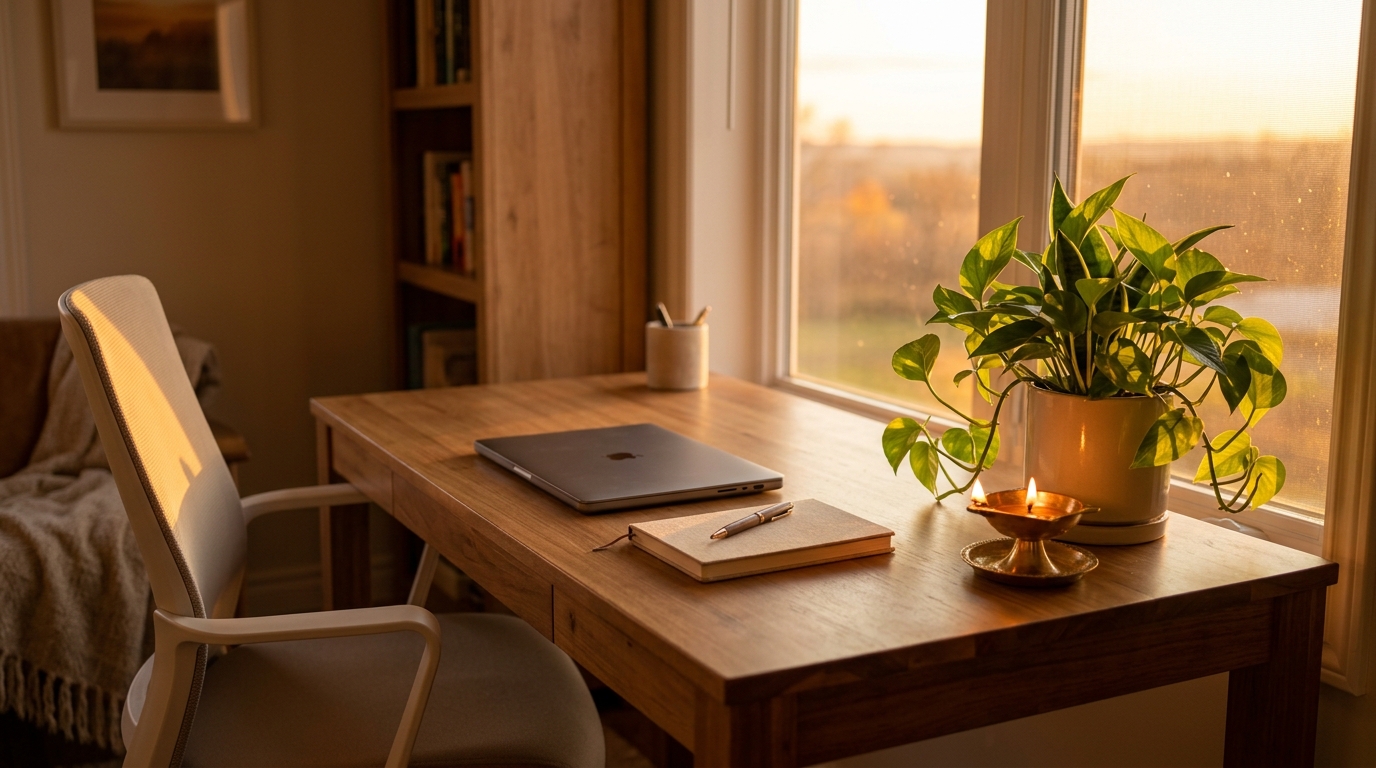
Your home office: Is it designed for deep focus? Does it have the walls, direction, light, and boundaries you need to do your best individual work?
Your corporate office: Are you positioned in the command position? Can you see approaching people? Is your desk decluttered? Do you have small elements that support your professional standing?
Adjust each. Then use each environment for what it's actually for.
You're not choosing between home and office. You're navigating both. Well-set-up, both can become genuine partners in your career.
Set them both up. Then let them do their quiet work of supporting the professional you're becoming. 🌸💼
Do you split your work life between home and office? Take one weekend to audit both spaces using this article — and share it with a fellow hybrid professional who might be struggling to make both environments work. Sometimes the difference between burnout and thriving is understanding that our two workspaces need different things from us. 🙏