
A note before anything else, and please hold it through the whole article: this guide is about preparing the home for a pregnancy and a new baby. It is not medical advice, and no room arrangement influences a pregnancy's health or outcome — that is the work of your obstetrician, your pediatrician, and the care team you trust. Every recommendation below is the supportive environmental layer around good medical care, never a substitute for it. Doctor first, always. Home second, gladly.
With that said honestly — there is a moment every expecting family knows.
The test is positive, the grandparents have been called (twice), and someone — usually a mother or mother-in-law — looks around the flat and says the ancient sentence: "Ghar taiyaar karna padega." The home will have to be made ready.
She's right. And Indian tradition, refined across countless generations of exactly this moment, has an entire gentle protocol for it: how the expectant mother's room is kept, why the household pauses its renovations, how the baby's corner is prepared, the forty days of rest, and the small ceremony of the first welcome home.
This is that protocol — with the tradition's reasoning, its practical twin (they agree remarkably often), and safety standing above every rule in it.
The Expectant Mother's Room: Rest Is the Whole Brief

For the months of pregnancy, one room matters more than every other, and its brief is one word: rest.
- The room: the couple's usual South-West or South bedroom serves perfectly — grounded, stable, away from the home's busiest flows. No relocation needed; deepen what's there.
- Sleep fundamentals, unchanged but now non-negotiable: head to the South or East, bed against a solid wall, no beam overhead (shift the bed rather than live under one), no mirror facing the bed (the sleep science and tradition, the mirror rules).
- Calm the palette and the light: soft warm tones — creams, gentle peach, muted rose (the color map) — and warm dim lighting after sunset. The room should get softer as night approaches.
- Declutter to walking-clear: the tradition wants the mother's paths open and her room unburdened; the practical twin is plainer still — nothing to trip on, nothing to squeeze past, nothing stacked to topple. Clear floors are prenatal care.
- Morning light and daily air: curtains open at waking, ten minutes of cross-breeze daily. The room where most of the resting happens should never go stale (why light matters this much).
- Screens soften: the wind-down hours want the room dim, warm, and quiet. The tradition said "sattvic surroundings for the expectant mother"; the sleep researcher says the same thing with charts.
The No-Renovation Rule
Here the tradition is famously firm: no demolition, drilling, major construction, or wall-breaking in the home during a pregnancy. Generations of grandmothers have enforced it without explaining it.
Our honest reading: whatever one believes about the energetic layer, the practical layer is unarguable — months of dust, debris, paint and adhesive fumes, contractor traffic, noise, and disorder are precisely what a household built around rest should not contain. The classical rule and the industrial-hygiene checklist arrive at the same door.
So: the big renovation waits (and when its time comes, sequence it properly). What is welcome — encouraged, even — is the gentle layer: deep cleaning, decluttering, repairing the small broken things, softening light and textiles. Prepare, don't demolish.
On paint specifically: if the nursery or any room must be painted, do it months early, with low-VOC paint, and air the room thoroughly — fresh paint fumes and a newborn should never share a timeline. When in doubt, ask the pediatrician; that answer outranks any shade card.
The Baby's First Address: In the Parents' Room
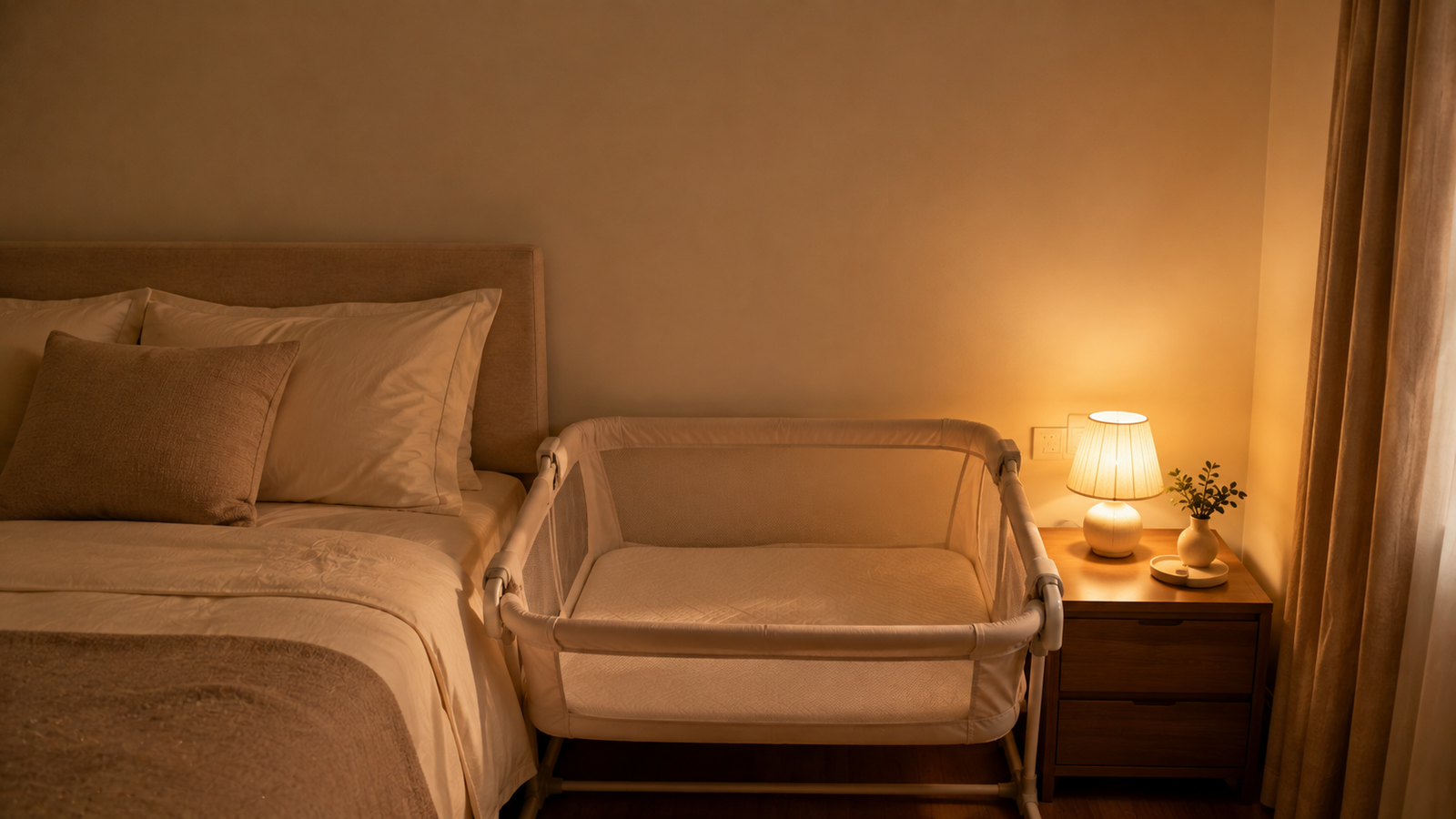
For the early months, the baby's place is a bassinet or cradle in the parents' room — tradition and modern guidance agree — and its placement has a small map of its own:
- Beside the mother's side of the bed, within arm's reach.
- Never under a beam, never under a window, never beneath a shelf — the tradition's "nothing looming over a sleeping child" is also, word for word, the safety inspector's rule.
- Baby's head toward the East or South when laid to sleep, matching the family's own sleep map — the full detail, including everything about infant sleep positioning that belongs to your pediatrician rather than to us, is in our Baby Sleep guide.
- Soft, dim, warm night lighting reachable from the bed; no direct light on the cradle.
Preparing the Nursery
When the baby graduates to their own room:
- Room choice: the home's East side is the classical first pick for a young child's room — the direction of sunrise and growth; North-East and West rooms also serve well (the kids' room map). The South-West stays the parents' anchor.
- Cot placement: against a solid wall, clear of the door's swing and the window's draft, head to the East or South — and positioned so you can see the cot from the door (every parent's 2 AM instinct, formalized).
- Colors: the softest pastels — light greens, gentle blues, warm creams, powder pinks. Walls carry the calm; toys carry the color.
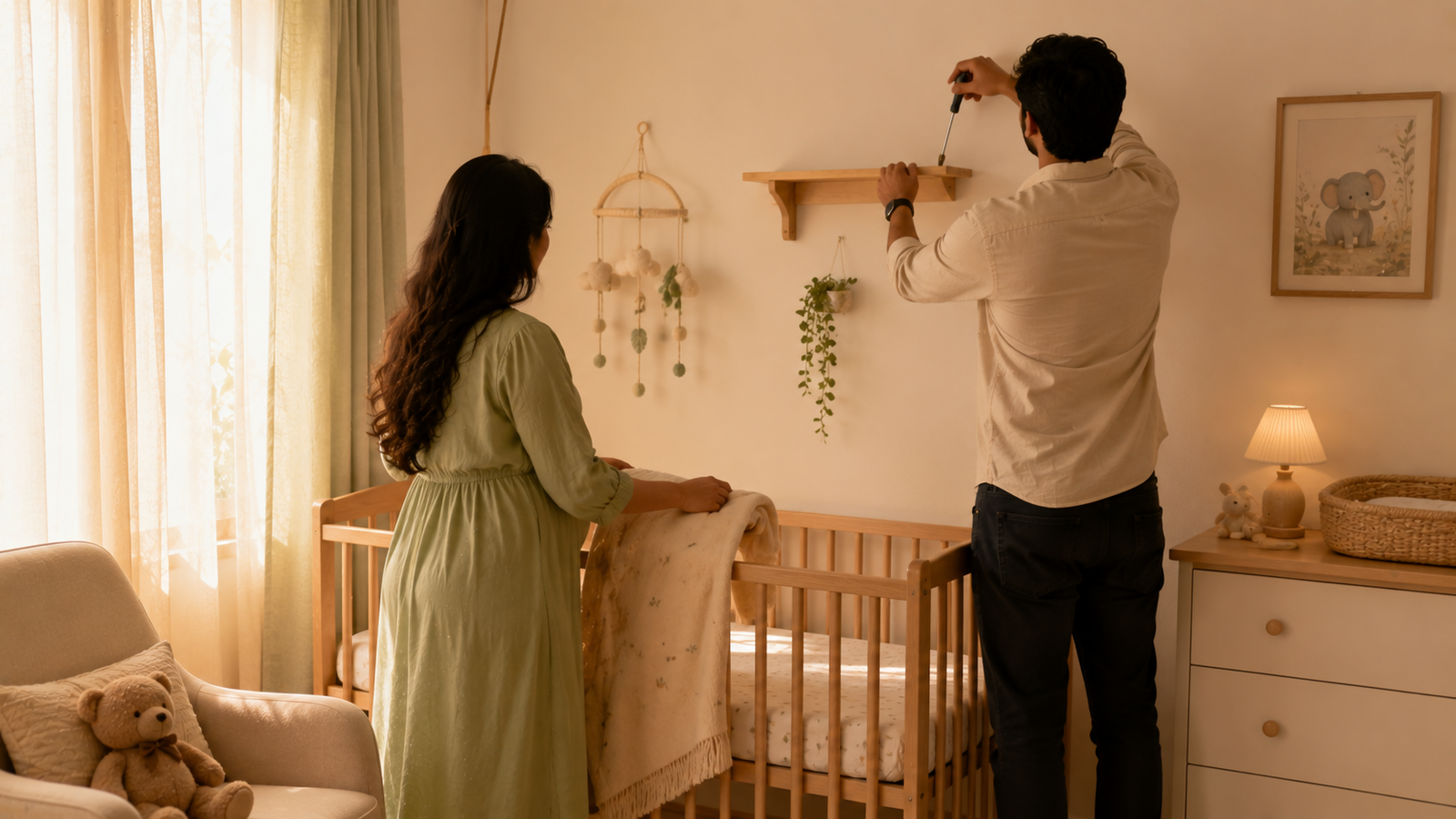
- What does not go in a nursery: heavy wall shelves or frames over the cot (nothing above a sleeping child — the rule again), mirrors facing the cot, dense cable clusters, a television, and tall unanchored furniture of any kind.
- Safety as dharma, stated plainly: every wardrobe and shelf anchored to the wall, blind cords out of reach, socket covers in, cot meeting current safety standards with a firm flat mattress and nothing loose inside it. On any question of cot setup or infant sleep safety, the pediatrician's guidance overrides every traditional preference, including ours. The shastra itself places raksha — protection — above all placement.
- Plants: greenery in the nursery stays minimal, hardy, non-toxic, and out of reach (the plant chooser).
The Godh Bharai at Home
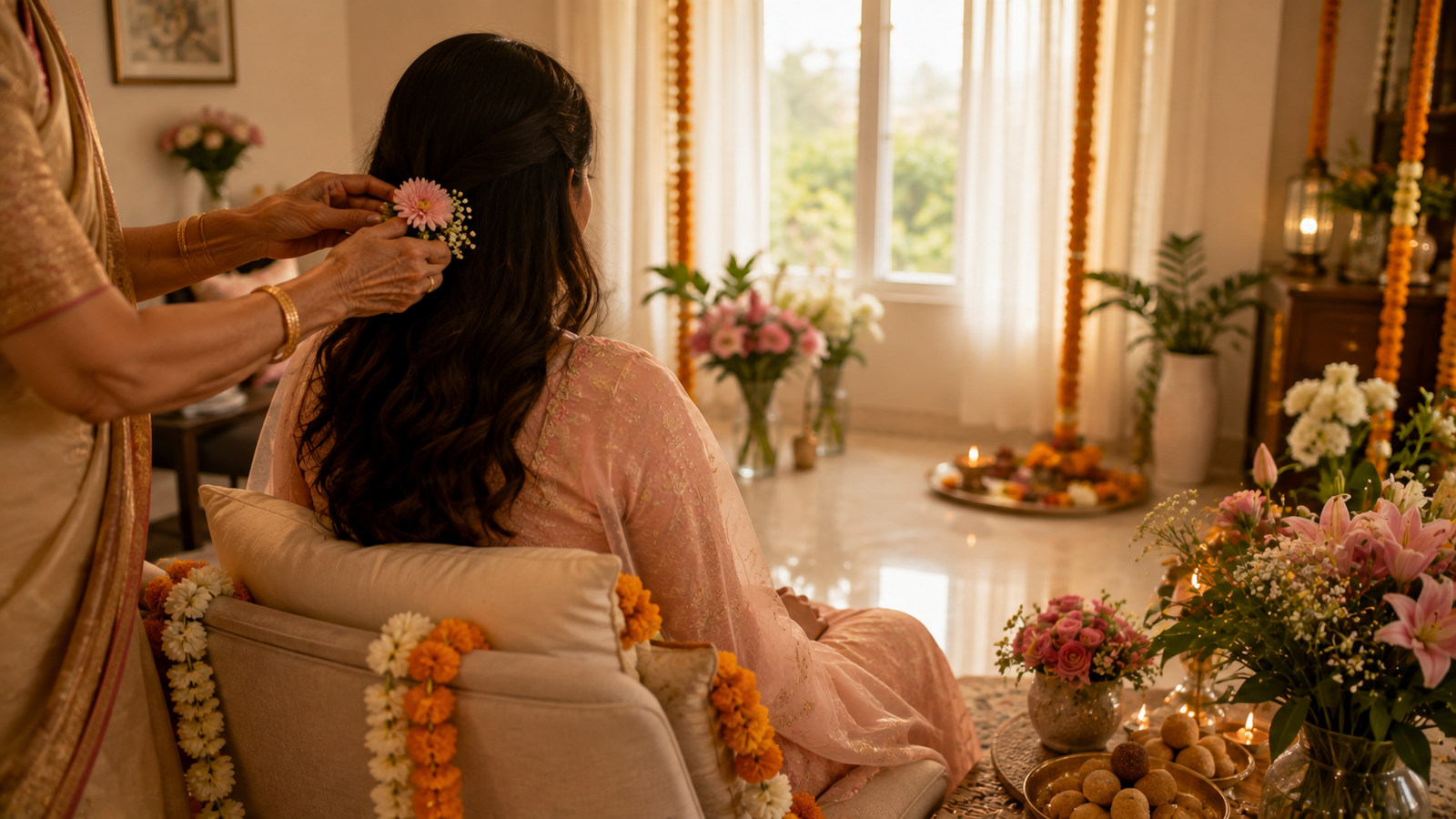
If the baby shower — godh bharai, seemantham, valaikappu by region — happens at home:
- Host it in the living room prepared like a small festival: cleaned, warmly lit, fresh flowers, the North-East corner glowing.
- Seat the mother-to-be facing East, comfortably — cushioned, supported, and never far from a graceful exit to rest. The ceremony honors her; her comfort outranks its choreography.
- The gifts follow the newlywed gift rule (from our couples' guide): integrate, pass forward, or store properly — the nursery should not open its life buried in boxes.
The Forty Days: Jaappa, the Rest Tradition
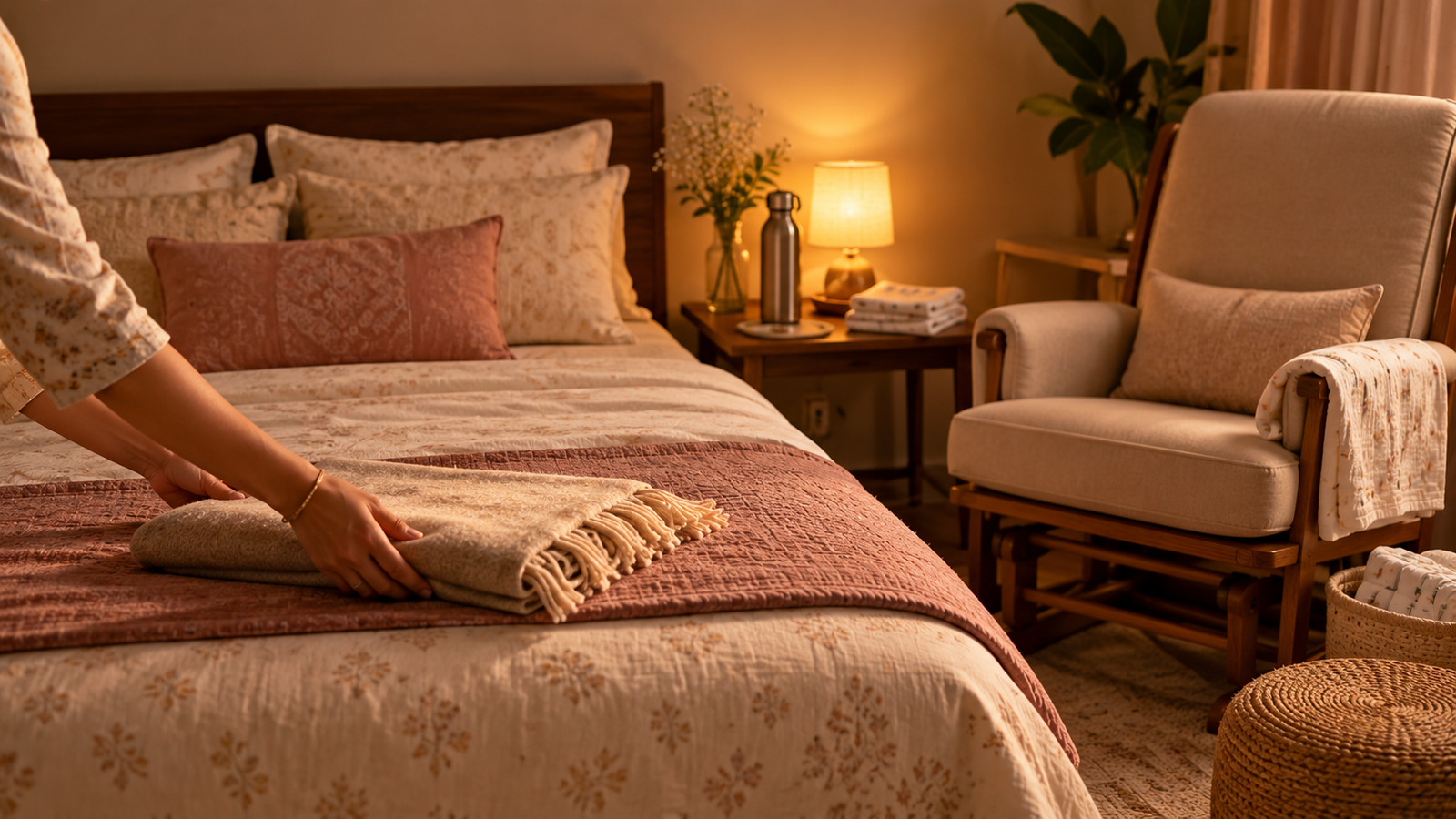
Across India's regions runs the same post-birth institution — the jaappa / confinement period: roughly forty days in which the mother and newborn stay home, rest, and are cared for, traditionally in a dedicated quiet room.
The home's part in honoring it:
- The quietest suitable room, prepared before the due date: bed with solid-wall backing, soft warm light with a dim night option, a comfortable feeding chair, everything the night needs within arm's reach.
- Warmth without staleness: the tradition keeps this room draft-free and warm; keep it aired daily all the same — warm and fresh, not sealed.
- A visitor rhythm the mother controls. The tradition limited visitors for rest and recovery; the modern household enforces it with kindness and a message template. The room belongs to two people's recovery, not to hosting.
- And gently, because it matters: the forty days can be emotionally heavy as well as tender. If the weight feels like more than tiredness, that is a conversation for the doctor — early, and without any hesitation. The home can hold a recovering mother; it cannot do what care professionals do. Both layers, always.
The First Welcome Home
The day the baby crosses the threshold for the first time, tradition offers a small, perfect ceremony:
- The home cleaned and ready in advance — the welcome is prepared before the hospital bag leaves.
- A diya lit at the threshold, a small aarti at the door in many families' custom, and the baby carried in through the main door — never a side entrance — traditionally in the grandmother's or mother's arms, right foot first across the threshold.
- Inside: the home warm, softly lit, quiet. The first hour asks for nothing but arrival.
- Whatever your family's specific ritual — a name whispered, honey ceremonies per your community's custom and your pediatrician's blessing, a coconut at the door — the constant underneath is the same: a home that was made ready, receiving its newest resident with intention.
Common Mistakes
- Renovating or drilling "just one small thing" mid-pregnancy — the rule exists precisely for that one small thing
- Painting the nursery in the final month
- Heavy shelves and frames mounted proudly above the cot
- The mirror facing the crib
- The nursery as gift-box storage until "we sort it later"
- The jaappa room prepared after the birth instead of before
- A visitor schedule the mother didn't set
- Furniture bought beautiful and left unanchored
📐 Map the Nursery Before the Baby Comes
Which room becomes the nursery, where the cot wall sits, which corner holds the jaappa room — every choice above starts with knowing your floor plan's directions, and expecting families have better things to do than guess.
We built a free tool where you can upload your floor plan and instantly see it mapped according to proper Vastu directions — the nursery, the rest room, and the quiet zones, plotted before the due date.
👉 Upload your floor plan and map your baby-ready home in 30 seconds
Just a photo or scan (PNG, JPG, JPEG). The home should be ready before the hospital bag is. This is the fast way to start.
Final Thoughts

There is a night coming — sooner than it seems — when the house will be dark and completely quiet except for one soft lamp, one rocking chair, and the smallest breathing in the world.
Everything in this guide serves that night. The cleared floors, the softened light, the anchored shelves, the rested mother, the cot against its solid wall — all of it is the home, prepared in advance, doing the only thing a home can do for a new family:
holding them, safely, while the real work of love goes on.
Prepare gently. Trust your doctors. Anchor the furniture.
And congratulations — to all of you, including the house. 🤱🪔