
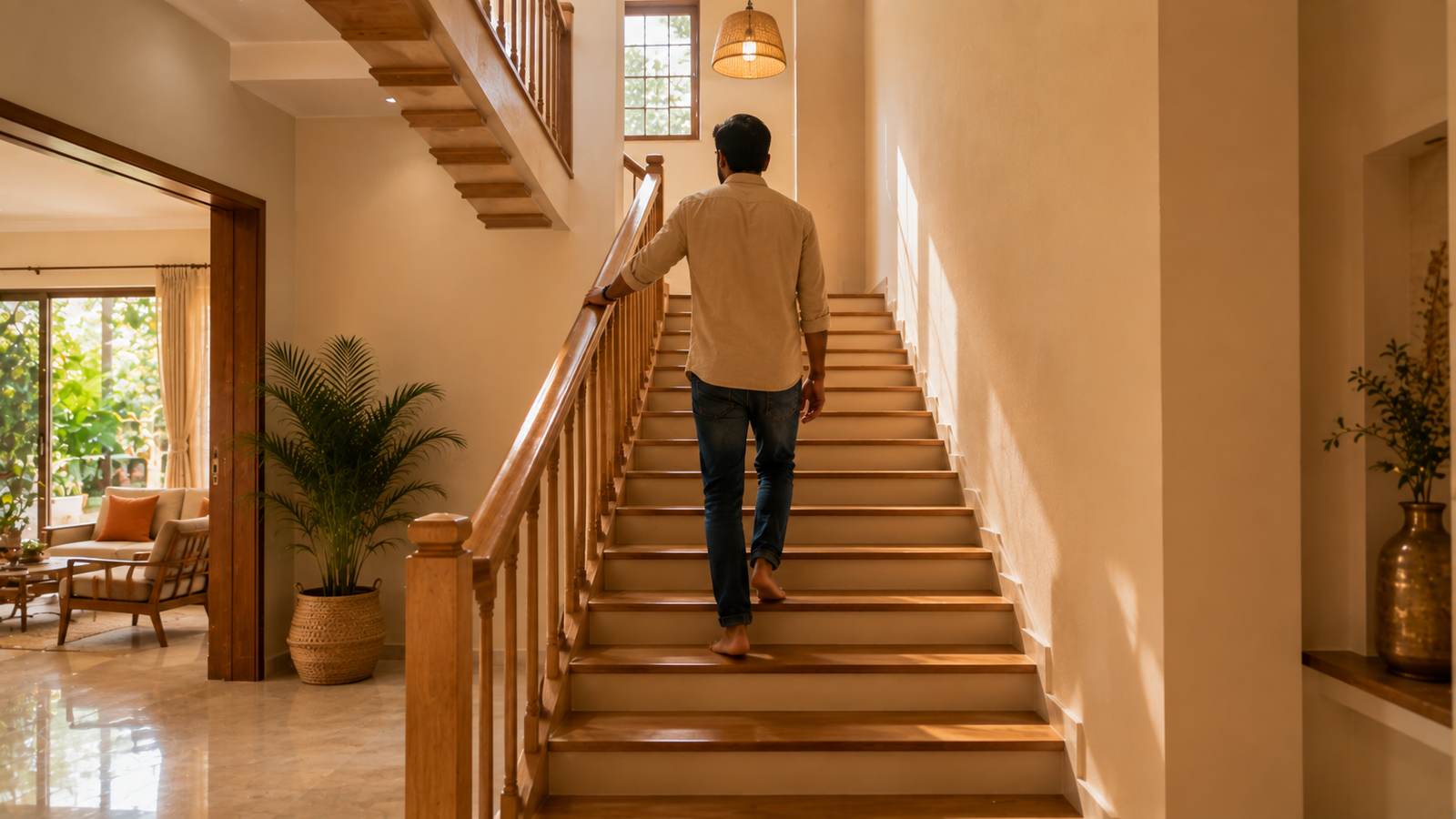
Of all the decisions frozen into a home's concrete, none is harder to undo than the staircase.
A wall can be repainted. A kitchen can — expensively — be shifted. But the staircase is the home's spine: poured, load-bearing, wrapped in the floor plan's logic, and exactly where it is for the next fifty years.
Which is why Vastu Shastra treats it with unusual seriousness — and why the internet's treatment of it is so frustrating. Half the content is a thin five-point list; the other half is doom-language for families whose staircase is already built and going nowhere.
This guide does the whole job: where a staircase belongs when you're still at the drawing stage, the classical rules of climb and count, what may and may not live beneath it, the duplex-buyer's checklist — and, for the majority who already live with the staircase they have, an honest remedies section built on containment and care rather than panic.
Why the Staircase Carries So Much Weight (Literally)
In Vastu's reading, a staircase is three things at once:
- Mass. It is among the heaviest single elements in the home — and Vastu's oldest rule says weight belongs in the South and West, never in the light zones.
- A channel. It conducts movement — and in the tradition's language, energy — between floors, all day, every day.
- A shadow-caster. Staircases create enclosed, often dark volumes beneath them, and dark unused voids are where a home's stagnation collects.
Get all three right and the staircase is simply good architecture. Get them wrong and the home carries a heavy, busy, shadowed element in exactly the zone that needed to stay light.
Placement: Where the Staircase Belongs
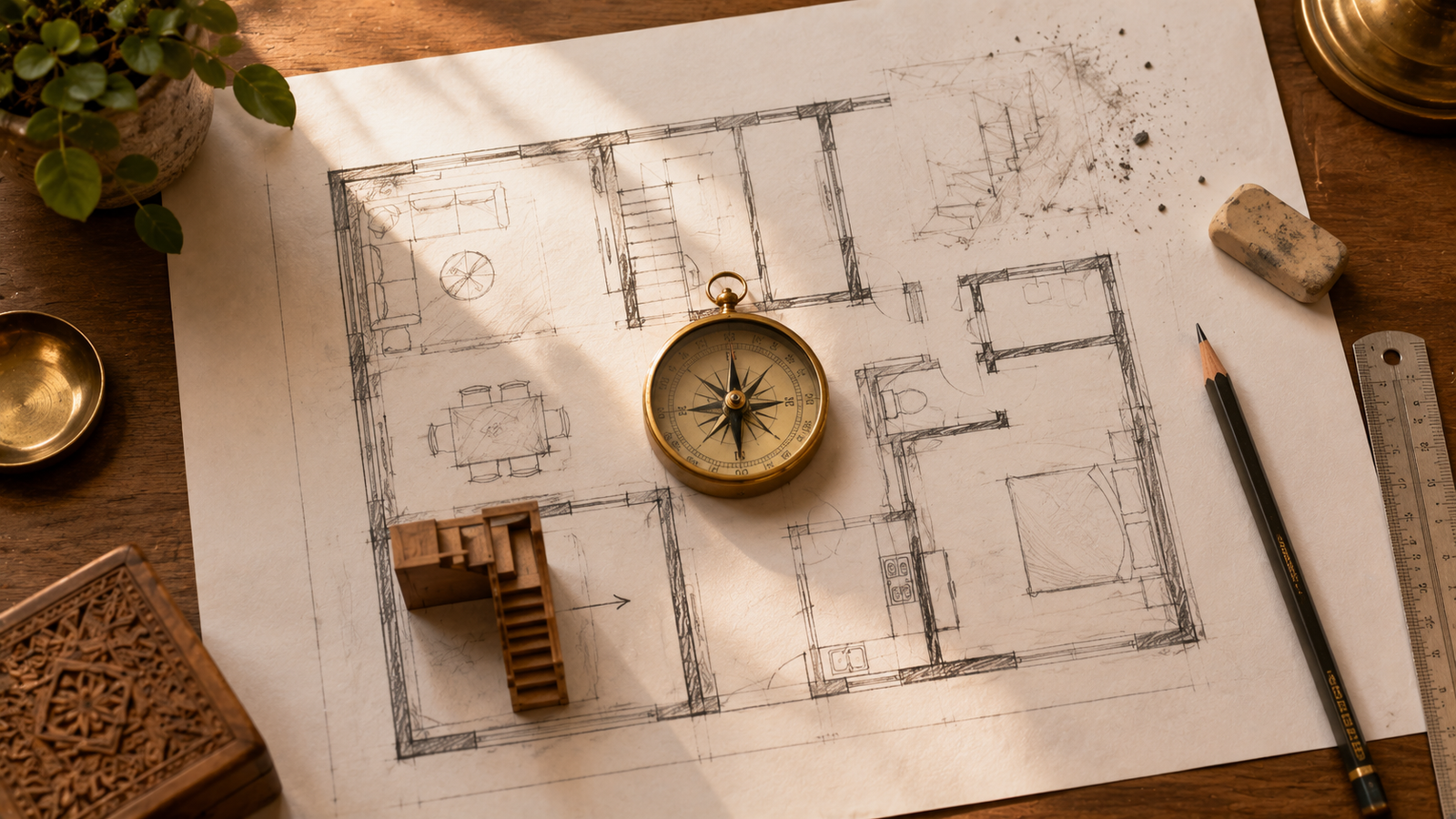
Ideal zones: South, West, or South-West — the home's heavy quadrants, built to carry mass.
Acceptable with care: South-East and North-West in some layouts, assessed case by case against what else those zones hold.
Never:
- The North-East (Ishanya). The most serious staircase defect — heavy mass and constant churning movement planted in the zone meant to stay the lightest and stillest in the home. If you are at the drawing stage and the architect's draft shows a North-East staircase, this is the revision worth insisting on. It is far cheaper to move on paper than to remedy in concrete.
- The Brahmasthan (center). The second classic error, and beloved of dramatic modern elevations — the sculptural central stair. The center of the home is its breathing space; a staircase there fills the lungs with concrete. In compact G+1 designs where a central-ish stair is unavoidable, push it off the exact center and keep the surrounding volume open and lit.
Inside vs. outside: external staircases (common in Indian independent homes for terrace or upper-unit access) follow the same zonal logic — South, West, or South-West faces of the building, and never wrapping the North-East corner.
The Classical Rules: Climb, Count, and Form
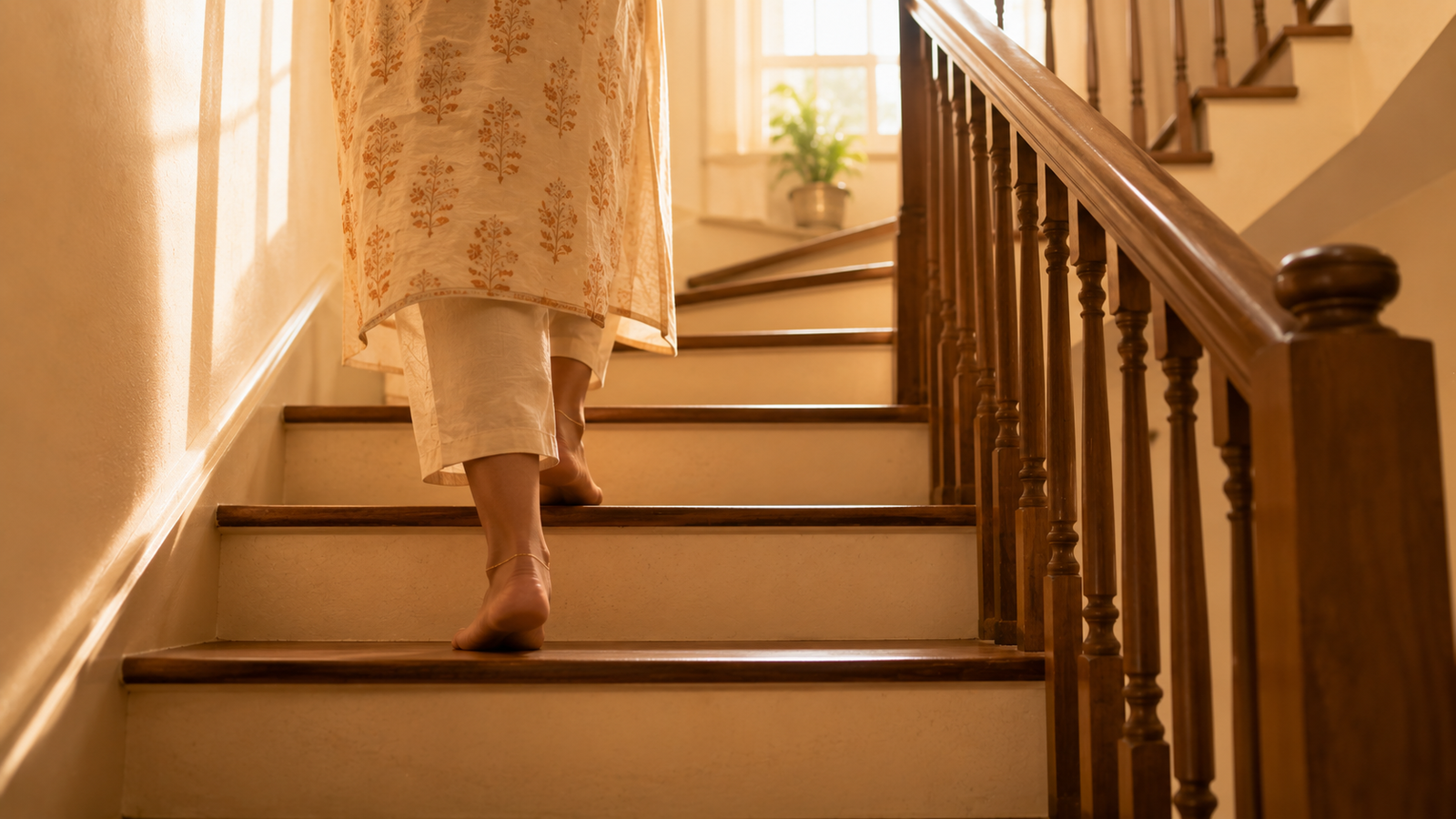
- Direction of climb: clockwise. Ascending, you should turn clockwise (left to right). The tradition's reasoning runs deep — clockwise is the direction of pradakshina, of the sun's path — and its practical companion is that the design reads naturally to the body. At the drawing stage this costs nothing to specify.
- Number of steps: odd. The old carpenter's rule — 9, 11, 15, 17, 21 — with each flight ending on an odd count. Traditions differ on the arithmetic's finer points; the widely kept version is simply odd, per flight.
- Form: straight flights with landings are the tradition's preference. Spiral staircases get a genuine caution — the tight corkscrew is read as a churn, and (the engineer agrees) they are the least safe form for children and elders. If space forces a spiral, place it in the South/West zones, external where possible, and never as the home's main stair.
- Start and end: a staircase should not begin or end directly facing the main door — arriving energy shouldn't be met by an immediate channel upward, and (again the practical twin) a stair discharging into the entrance is a collision zone. A few feet of offset or a simple screen resolves it.
- Materials and colors: solid, well-crafted, and light in color — the staircase is one place the tradition dislikes both flimsiness and heavy dark drama. Light warm tones, sturdy railings, no glass-floored theatrics over living spaces. (Palette logic per zone is in our Colors guide.)
Beneath the Stairs: The Rules Everyone Breaks
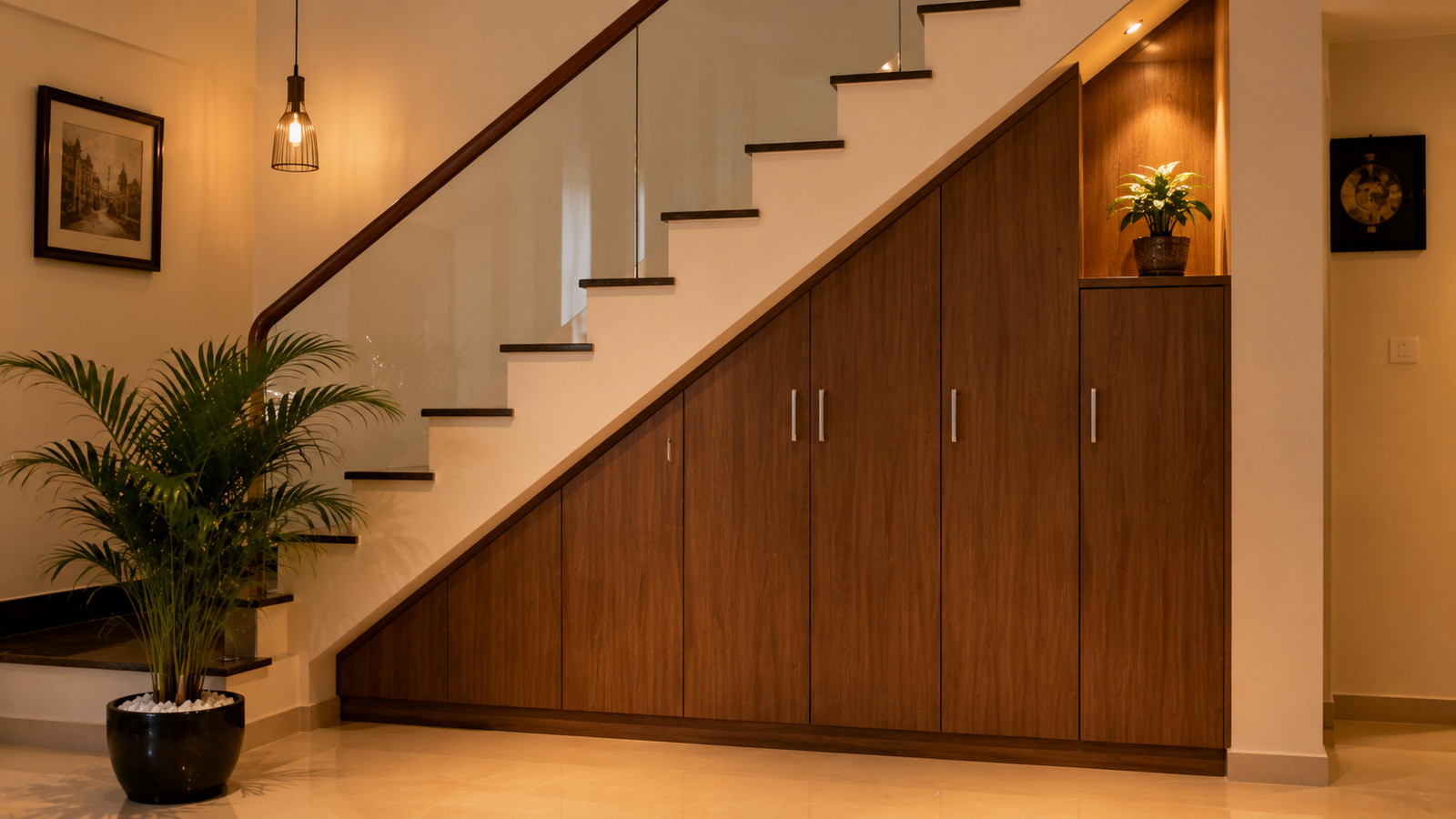
The triangular void under a staircase is India's most creatively misused space — and the tradition has firm opinions:
Never under the stairs:
- A pooja space. The single most common and most serious under-stairs mistake. The sacred corner of the home cannot sit beneath a churn of daily footfall in a cramped shadow — no matter how charming the niche looks in the render. Every festival guide we've written repeats this rule because every year, festival mandaps end up there. Give the deities a proper zone (pooja guide here).
- A kitchen or cooking point. Agni does not belong compressed under traffic.
- A bathroom or WC, where the plan can possibly avoid it.
- A bed, desk, or seating nook — nobody should live, work, or sleep beneath the churn.
Acceptable under the stairs: clean, organized, closed storage — the household's South-West-style function in miniature. Shoe cabinets (closed, tidy), utility storage, a neat closet. The two disciplines: keep it organized (an open junk-pit under the stairs is the stagnation trap in its purest form), and keep it lit — a small light inside the storage, used, changes the space's whole character.
Buying a Duplex or Penthouse? The Staircase Checklist
For duplex, penthouse, and villa buyers, run these five checks on the plan before booking:
- Which zone holds the staircase? (South/West/South-West = clean pass; North-East = the walk-away conversation)
- Does it sit on or crowd the Brahmasthan?
- Does it face the main door?
- Is the climb clockwise, with odd counts per flight?
- What has the builder tucked beneath it — and is the "puja nook under the stairs" being marketed as a feature? (Now you know better.)
The full property-screening method is in our Buying Property guide — and if you're evaluating from abroad, the NRI guide covers reading all of this off a PDF.
Already Built? The Honest Remedies
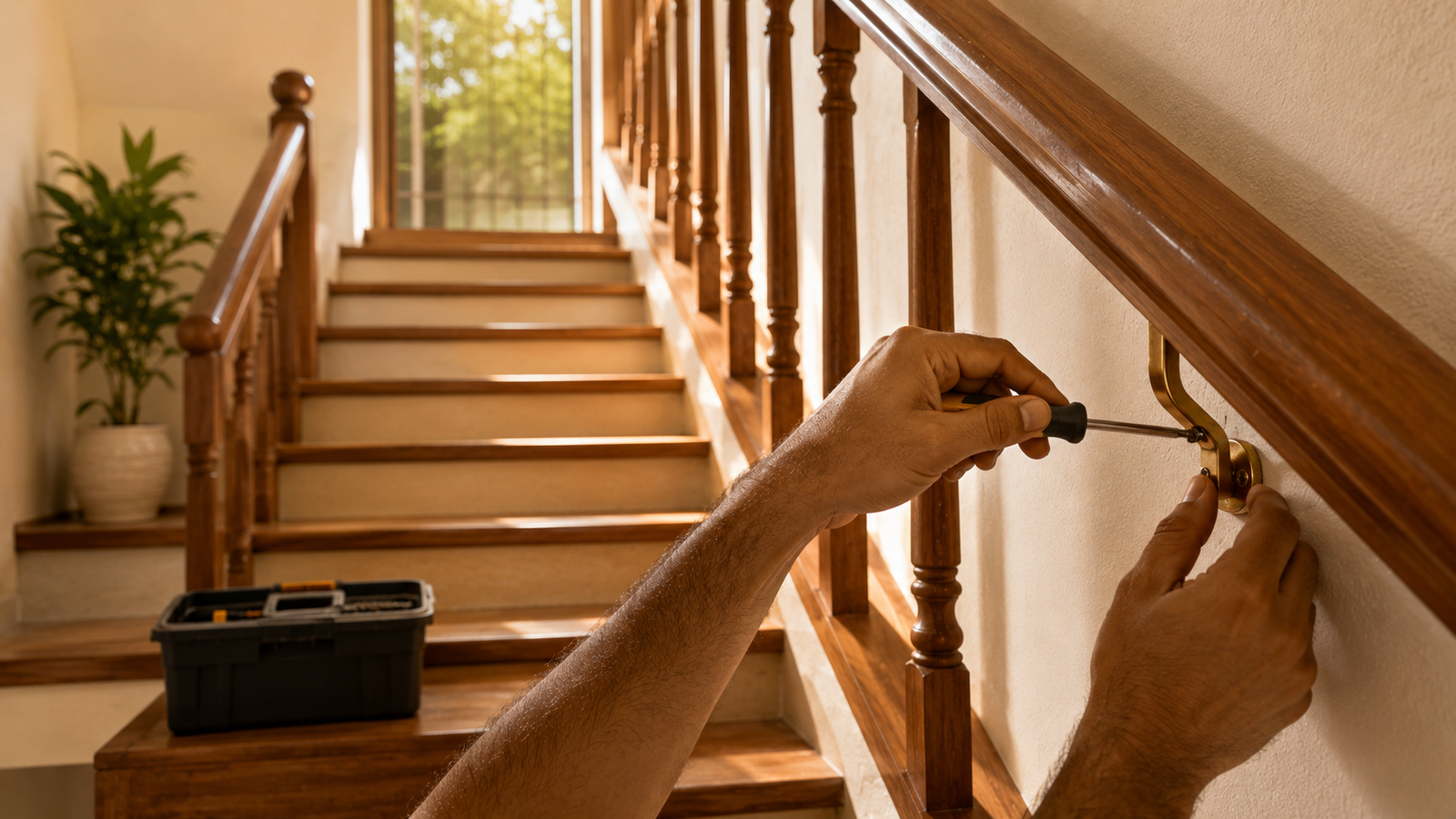
Now the part most families actually need. Your staircase exists, it's in an imperfect zone, and it is not moving. Here is the honest containment playbook — no demolition, no miracle gadgets:
- Light it generously. A dark staircase compounds every defect it has; a warmly, consistently lit one is half-remedied already. This is the single highest-impact fix.
- Empty the churn. No clutter on the steps — the Indian staircase's fate as a shelf for things "going up later" ends today. Steps stay clear; the flow stays clean.
- Fix the fabric. Loose railings, cracked steps, squeaking treads, peeling paint — a staircase in disrepair is a defect worn openly. Repair outranks every symbolic remedy.
- Sort the under-stairs void. Convert open junk storage to closed, organized cabinets; evict the pooja niche to a proper corner with apologies and ceremony; add that interior light.
- Green the base. A healthy plant at the foot of the stairs softens the channel's energy — the plants guide has the zone-appropriate choices.
- Repaint toward light. If the staircase is dark-toned, a light warm repaint is the cheapest character change it can receive.
- No mirror facing the flight. A mirror doubling the churn of the staircase is one of the placement mistakes our Mirror guide flags — reposition it.
- For the North-East staircase specifically: apply everything above with double discipline, and strengthen the home's compensating zones — an immaculate, glowing alternate North-East corner (the method), and proper weight in the true South-West. Containment plus compensation is the honest ceiling of what remedies can do here — and done well, it is genuinely a lot. If a major renovation ever comes, this defect joins the priority list (renovation sequencing here).
- Safety as dharma: railings at the right height, anti-slip on the treads, a night light for the flight — especially in homes with children and elders (the elders' room guide pairs with this). No energetic principle outranks a family that doesn't fall.
Common Staircase Mistakes
- The North-East staircase approved at drawing stage "because the plan flowed better"
- The sculptural central stair filling the Brahmasthan
- The pooja nook under the stairs — charming render, serious defect
- Steps as permanent storage shelves
- A dark, unlit flight in an otherwise bright home
- Spiral main staircases in family homes
- Mirror at the landing facing the flight
- Open junk-pit under the stairs, growing since move-in day
📐 Check Your Staircase Zone Before the Concrete Pours
Whether you're finalizing an architect's drawing, booking a duplex, or auditing the home you're in — the staircase question is answered by one thing: knowing exactly which zone it occupies.
We built a free tool where you can upload your floor plan and instantly see it mapped according to proper Vastu directions — the staircase's zone, the Brahmasthan, and everything around them, plotted in seconds.
👉 Upload your floor plan and check your staircase zone in 30 seconds
Just a photo or scan (PNG, JPG, JPEG). Paper revisions are free. Concrete ones are not.
Final Thoughts

The staircase is the one Vastu decision your home will never let you quietly revise — which makes it the one most worth getting right at the drawing stage, and most worth tending honestly ever after.
If you're still on paper: South or West, clockwise, odd counts, nothing sacred beneath it. If you're already living with it: light it, clear it, repair it, and let the rest of the home compensate.
A staircase kept bright, clean, and sound carries more than people between floors. Tend the spine, and the whole home stands straighter.
Climb well. 🪜