
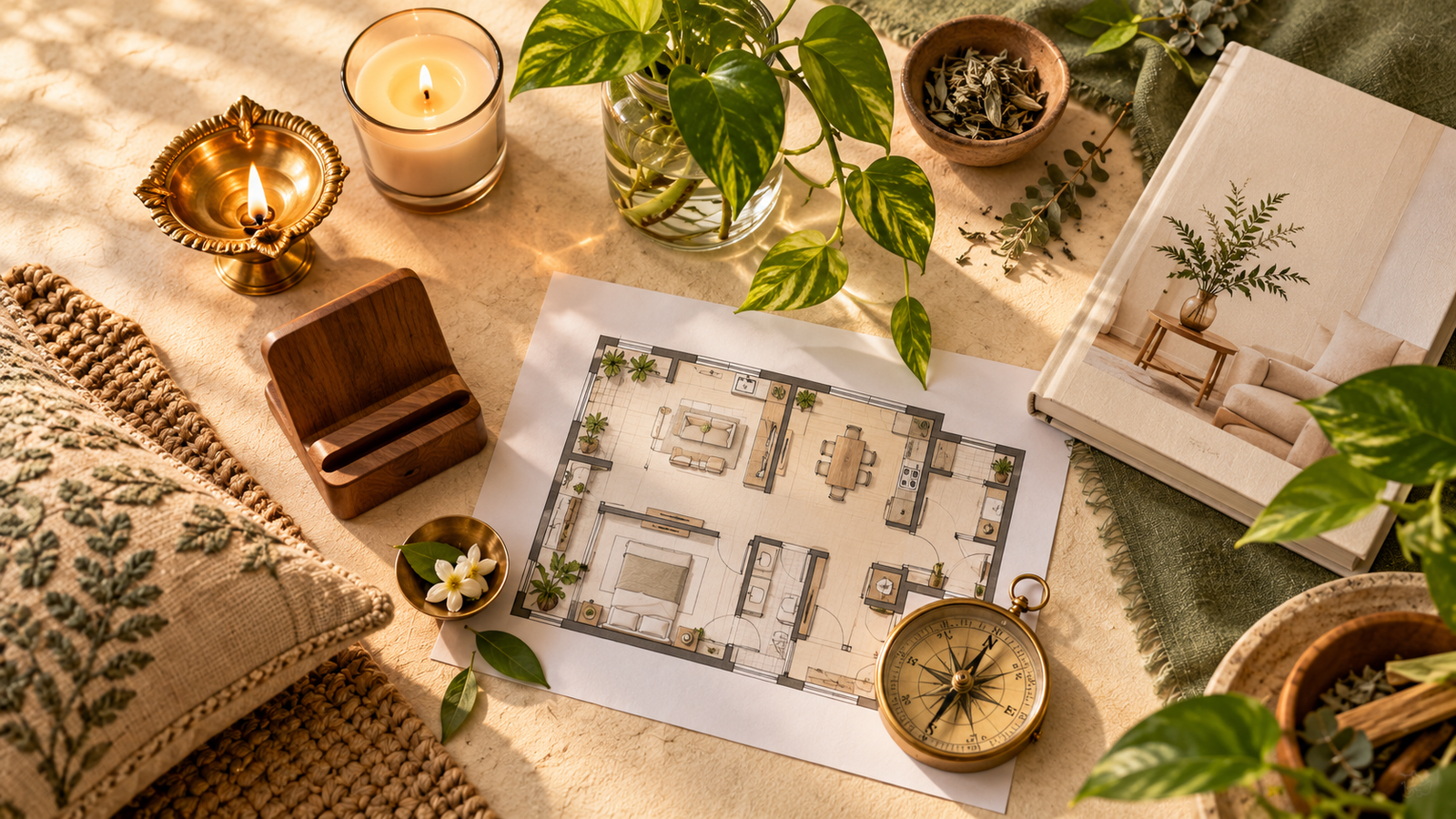
Let's start with an honest scene.
You're 27, or 31, or maybe 35. You live in a rented flat in Bengaluru or Pune or Mumbai. You own exactly one Himalayan salt lamp that you bought after a particularly stressful Q3. Your windowsill has three plants — one thriving, one optimistic, one that you're "keeping an eye on." You've done a sound bath. You've deleted Instagram off your phone (this is the fourth time). You have strong opinions about your morning light.
You would describe yourself as someone who is "not into astrology but also checks their Co-Star."
And if someone in your family mentions Vastu — your grandmother, probably — you smile the way you smile at things you find charming but have firmly outgrown.
Here is what nobody has told you yet: you are already doing Vastu. You just don't call it that.
This is the article that introduces you to yourself.
The Uncomfortable Overlap
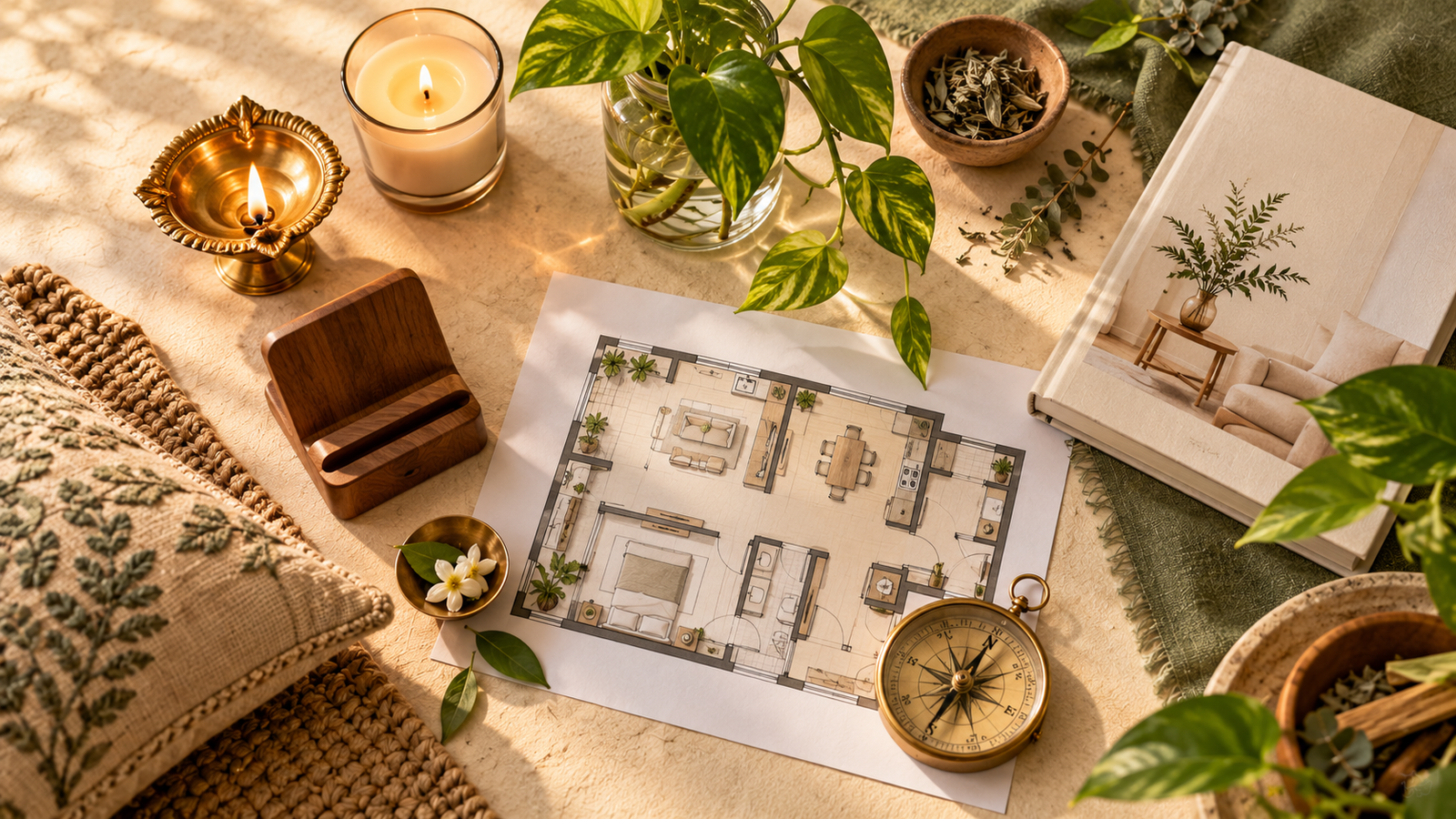
Let's run through the wellness habits that define the urban millennial and Gen Z lifestyle, and see what they map to:
You believe morning light is non-negotiable. You've read the Andrew Huberman episode, you know about cortisol and circadian rhythms, you open your curtains first thing. Vastu has insisted on East-facing windows and unobstructed morning light since before the printing press existed. Same insight. Different vocabulary.
You're obsessed with decluttering. You've read Marie Kondo. You've watched the documentary. You "spark joy" your wardrobe twice a year. Vastu's foundational principle — that accumulated objects hold stagnant energy — is what you're acting on. The sensation of lightness after a clear-out that you've been trying to explain to skeptical friends? The tradition named it 3,000 years ago.
You keep plants. Not because your grandmother told you to. Because they make you feel better and your apartment feels more alive. Vastu placed specific plants in specific zones for exactly the reasons you're putting them on windowsills: air, life, daily care, the sensation of something growing. (Our full plant map has the zones, if you're curious.)
You care about your sleep environment. No screens before bed, blackout curtains, the right temperature. Vastu's bedroom prescriptions — head to the South or East, solid wall behind you, nothing chaotic in the room — are a sleep-optimization protocol in spatial form. (The sleep direction guide covers this completely, with the science alongside the tradition.)
You've thought seriously about your desk setup. You've read about "deep work." You know about the "command position" in interior design — never facing a wall, always with a sightline to the door. That command position is a Vastu principle. Word for word.
You own a sound bowl, or incense, or camphor tablets, or a diffuser. You've replaced synthetic room fresheners with natural scents because the synthetic ones give you a headache. Vastu's insistence on natural fragrance — sambrani, camphor, incense — is the same preference, encoded as ritual. You're doing the ritual; you just skipped the name.
You are suspicious of synthetic materials and love "natural" textures. Wood, stone, clay, linen, cotton. Vastu describes these as sattvic — pure, life-giving, energetically clean. The modern indoor air quality research confirms it: synthetic materials off-gas chemicals for years. You sensed it before you knew the data.
The pattern should be clear by now. You didn't inherit these preferences from your grandparents. You arrived at them independently, through wellness content, environmental science, psychology podcasts, and the lived experiment of your own body and space. The tradition arrived at the same conclusions through thousands of years of accumulated observation.
You were never "not into Vastu." You were just using different words.
What Vastu Gives You That the Wellness Industry Doesn't
Here's where it gets more interesting — the parts of the tradition that your morning routine doesn't yet have:
Direction. The wellness industry tells you what to do (declutter, let in light, sleep better). Vastu tells you where to do it. North for wealth flow. South-West for the relationship and stability zone. North-East for the sacred, clear, light corner. The "where" is the part most modern wellness content skips — and it's the part that turns individual good habits into a coherent spatial system. (Start with the room-by-room map.)
A daily ritual anchor. The wellness industry is excellent at selling you morning routines. It's less good at giving you something that costs nothing, takes two minutes, and connects you to something larger than productivity optimization. The brass diya. The Tulsi watering. The two minutes at a quiet corner before the phone comes on. These are the things your wellness stack is missing — not because they're mystical, but because they're small enough to actually do every single day.
A framework for transitions. Moving to a new city? Starting over after a breakup? Moving abroad? The tradition has specific protocols for exactly these moments — how to leave a home, how to enter a new one, what to carry, what to set up first. The wellness industry sells you journaling prompts. Vastu gives you a sequence.
Permission to not be perfect. Modern wellness has a brutal perfectionism problem — you're either doing the full cold-plunge-meditation-journaling-no-phone morning routine or you've failed. Vastu's approach is fundamentally different: do what you can, where you can, with what you have. A renter in a North-East-toilet flat isn't doomed. A person with no pooja room isn't excluded. A student in a hostel with half a shelf can still have a corner that's theirs. (See the student guide.) The tradition was designed for real lives, not aspirational ones.
The Parts You're Probably Getting Wrong
Honesty is the whole point of this blog, so here's the list:
The cactus on your desk. We know it looks cool. We know it matches the aesthetic. The tradition — and your own experience, if you're honest — suggests that a thorny, defensive plant in your immediate work zone doesn't exactly soften the quality of the hours you spend there. Try a pothos or a snake plant. They're harder to kill and have the advantage of not being, on a molecular level, made of spikes.
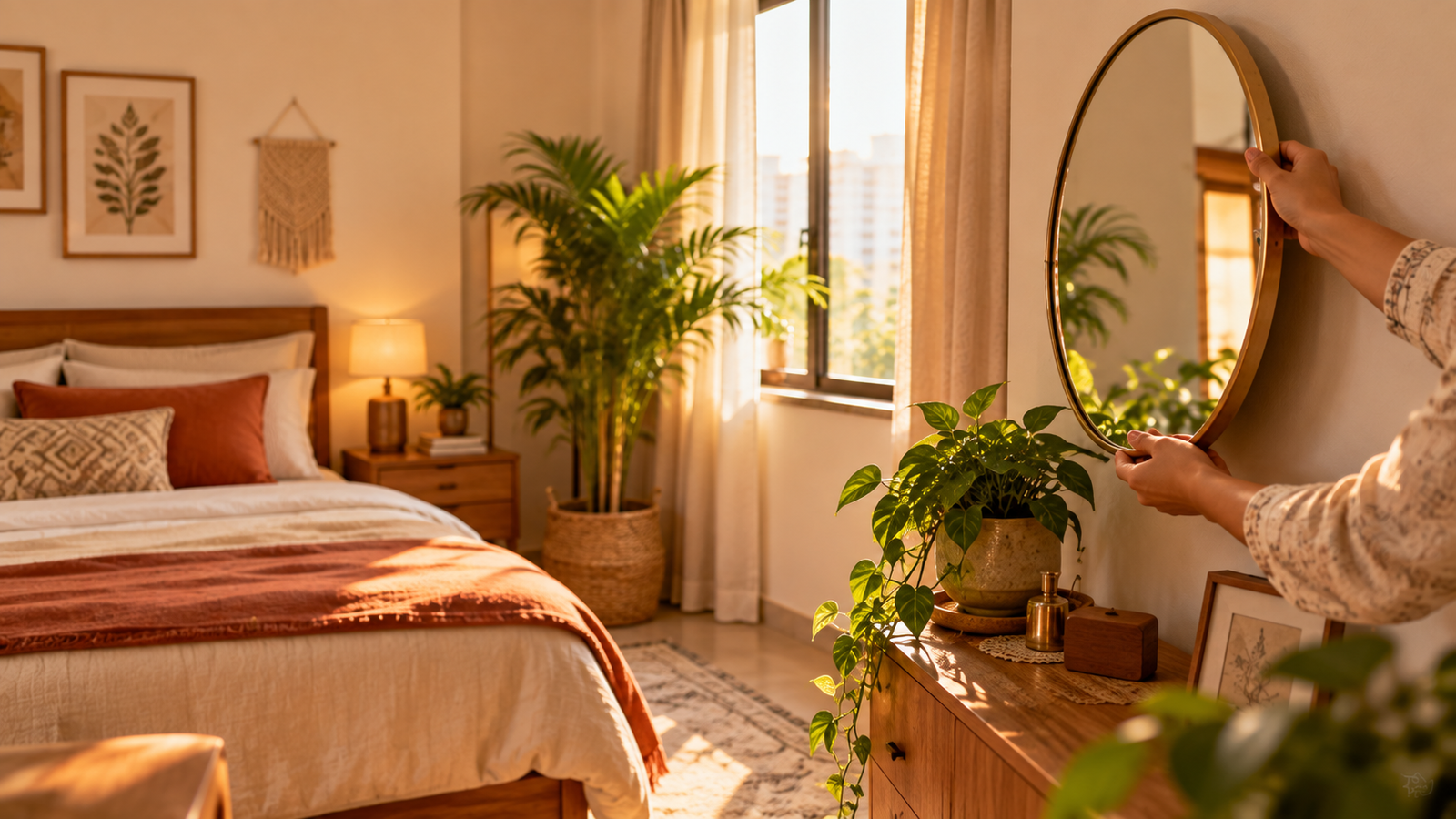
The mirror facing your bed. You put it there because the opposite wall needed something. It's been subtly messing with your sleep for eight months. This is the most common millennial bedroom mistake and also the easiest fix. (Full mirror guide.)
The dark "moody" bedroom. Charcoal walls, blackout curtains that never open, the cool ambient light from your setup. Your aesthetic is valid. Your nervous system is tired. The room where you're supposed to recover is the room you've made least conducive to recovery. Warm tones and morning light cost no money to add; they just require curtains that open. (Color guide.)
The dead plant you haven't thrown out yet. You know the one. The tradition's position: a dead plant is worse than no plant, because it's the visible presence of something you stopped caring for. You would never keep a dead plant in the background of a photo. Give it the same standards as your feed.
Your "junk drawer" that has quietly become a "junk corner" that has quietly become a "junk zone." You've decluttered three times and the same energy keeps accumulating in the same corner. That corner has a zone. Check the map. (Here.)
The "Sacred Corner" You're Actually Missing
This is the piece of the tradition that almost no wellness content delivers, and the one that addresses the specific complaint most young urban professionals make about their lives:
"I have everything I'm supposed to have. I still feel like something is missing."
Vastu's answer is structural: every home needs one corner that asks nothing of you.
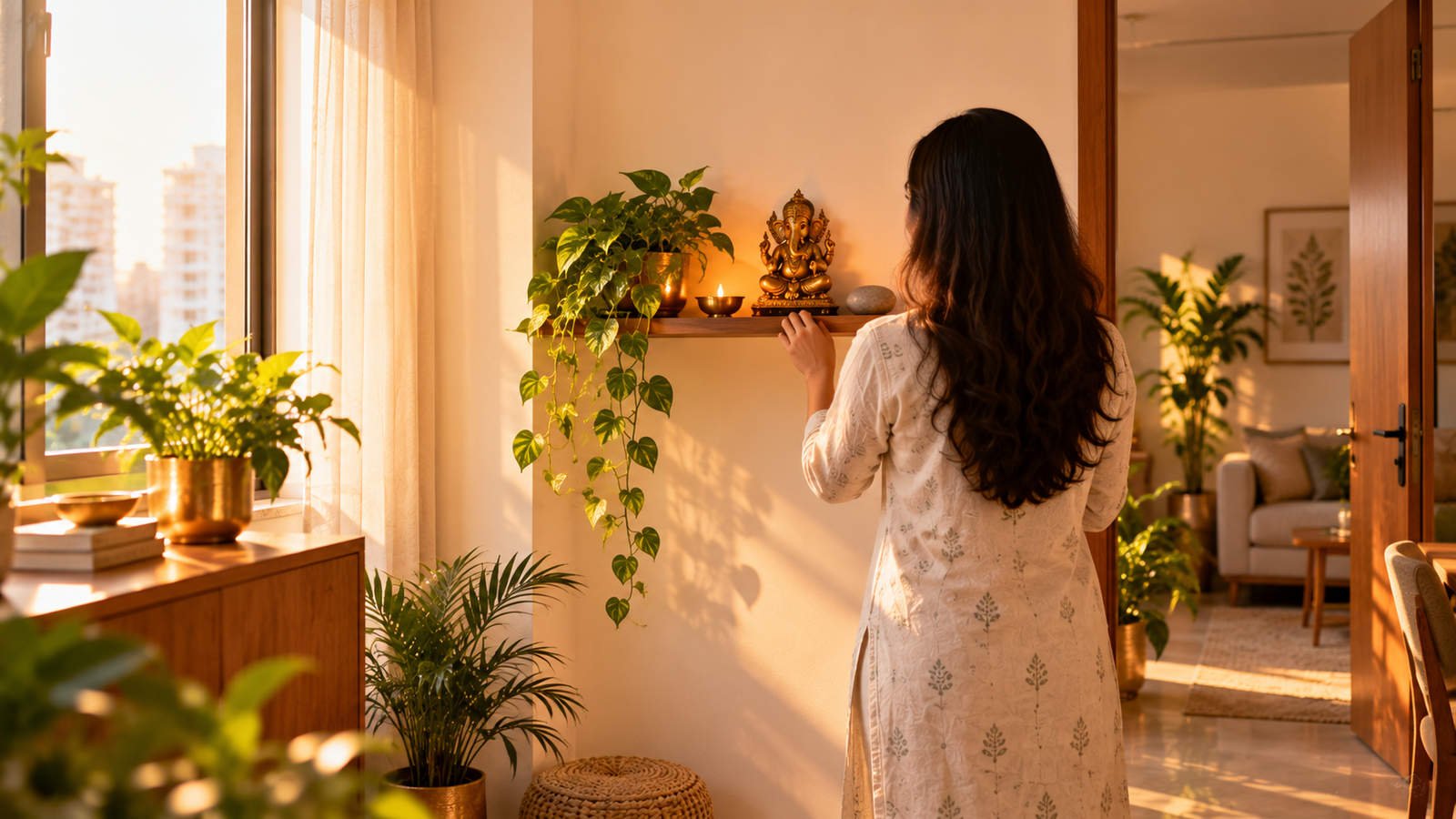
Not your desk (productivity). Not your bed (recovery). Not the gym corner (optimization). A corner whose only function is to be still and quiet and slightly sacred — a plant, a diya, something that has meaning, nothing that demands anything.
In every home our Pooja Room guide describes, this is the North-East corner. But in a rented studio, or a PG, or a flatshare where you have exactly one shelf, it's wherever you deliberately put it. Three things: one object that matters to you, something living (a plant or a diya), and the commitment to keep it clean and unhurried.
The wellness industry wants to sell you a meditation app. The tradition is suggesting a corner. The corner is free. It works because it's physical — which is the thing the app can never be.
How to Actually Start (The Non-Overwhelming Version)
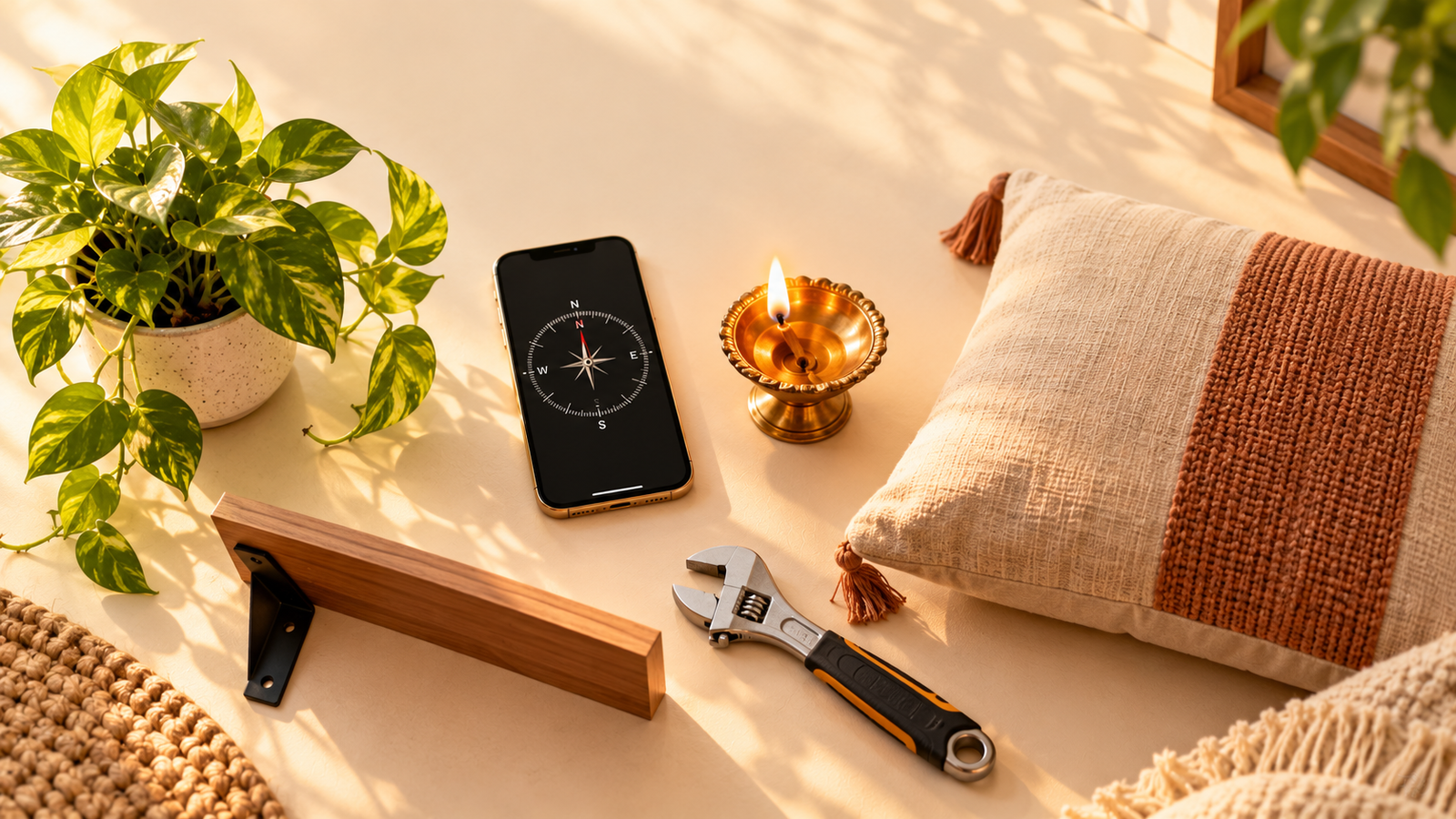
You don't have to do all of this. You don't have to do most of this. Here is the genuine minimum that makes a difference:
- Compass app → find your East. Open windows every morning. Five seconds. This is the entire foundation.
- One plant, kept genuinely alive. If it dies, replace it. Don't preserve it out of guilt.
- Move the mirror off your bed. Fifteen minutes. Free. Immediate effect on sleep quality.
- Set up one corner that's yours. Small shelf. Something meaningful. A diya on festival days. Keep it clean.
- Head to the South or East while sleeping. Just move the pillow. The most overlooked, highest-return adjustment in the guide.
- Fix the one broken thing you've been ignoring. The dripping tap, the sticking drawer, the bulb that's been out for three months. The tradition is right about this: small neglects normalize neglect. One repair changes the whole home's register.
That's it. Six things, none requiring permission, renovation, or spending money. Start there and see what happens.
The Honest Boundary
Vastu is not therapy. It's not medicine. It's not a replacement for the actual professional support that a difficult life season might require. The wellbeing guide makes this explicit, and it bears repeating here: a well-arranged home is the supporting layer around a good life. It amplifies what's working. It doesn't fix what fundamentally needs human intervention.
But for the low-grade heaviness that a lot of young urban life carries — the feeling that something about the flat is working against you, that you can't concentrate, that the evenings don't restore you the way they should — the spatial layer is genuinely worth addressing. And the tradition, it turns out, was thinking about exactly your life. Just in Sanskrit.
📐 See What Your Home's Zones Actually Are
The compass app finds East. The floor plan tool finds everything else — which corner is actually your North-East, where your South-West really sits, why the corner you intuitively avoid might be the zone the map predicts you'd find heavy.
We built a free tool where you can upload your floor plan and instantly see it mapped according to proper Vastu directions — in 30 seconds, on your phone.
👉 Upload your floor plan and map your space in 30 seconds
Just a photo or scan (PNG, JPG, JPEG). Your flat has a map. You've just never seen it drawn.
Final Thoughts
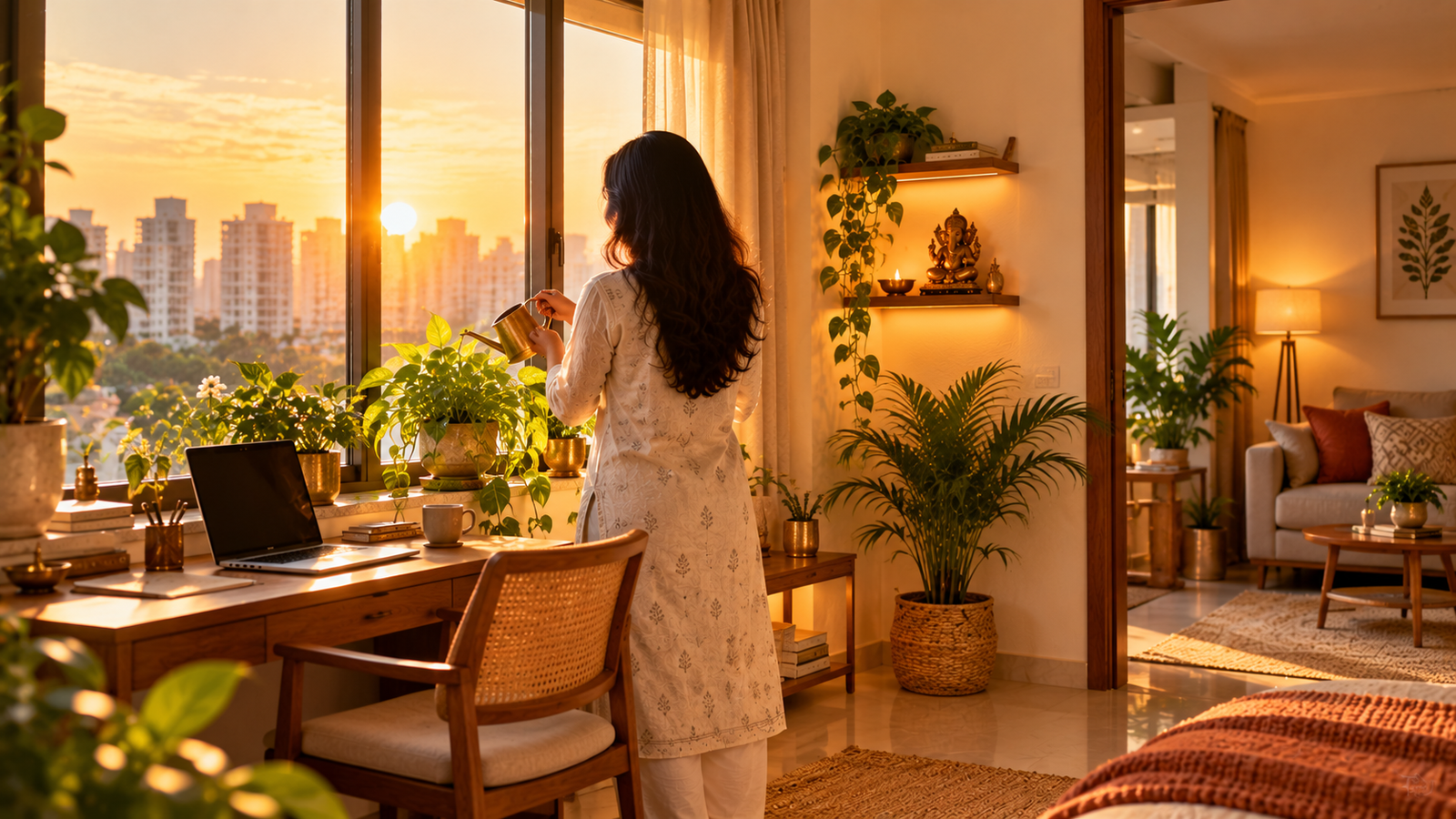
The tradition that your grandmother was gesturing at — past the fear-based content, past the gadget-selling, past the WhatsApp forwards about which photo should face which wall — is something much simpler and much more useful:
Your space shapes you. Shape it with intention.
You already believe this. You already act on it in a dozen ways. You've just been missing the framework that connects it all.
Welcome to Vastu. You've been here longer than you think. 🪴✨