
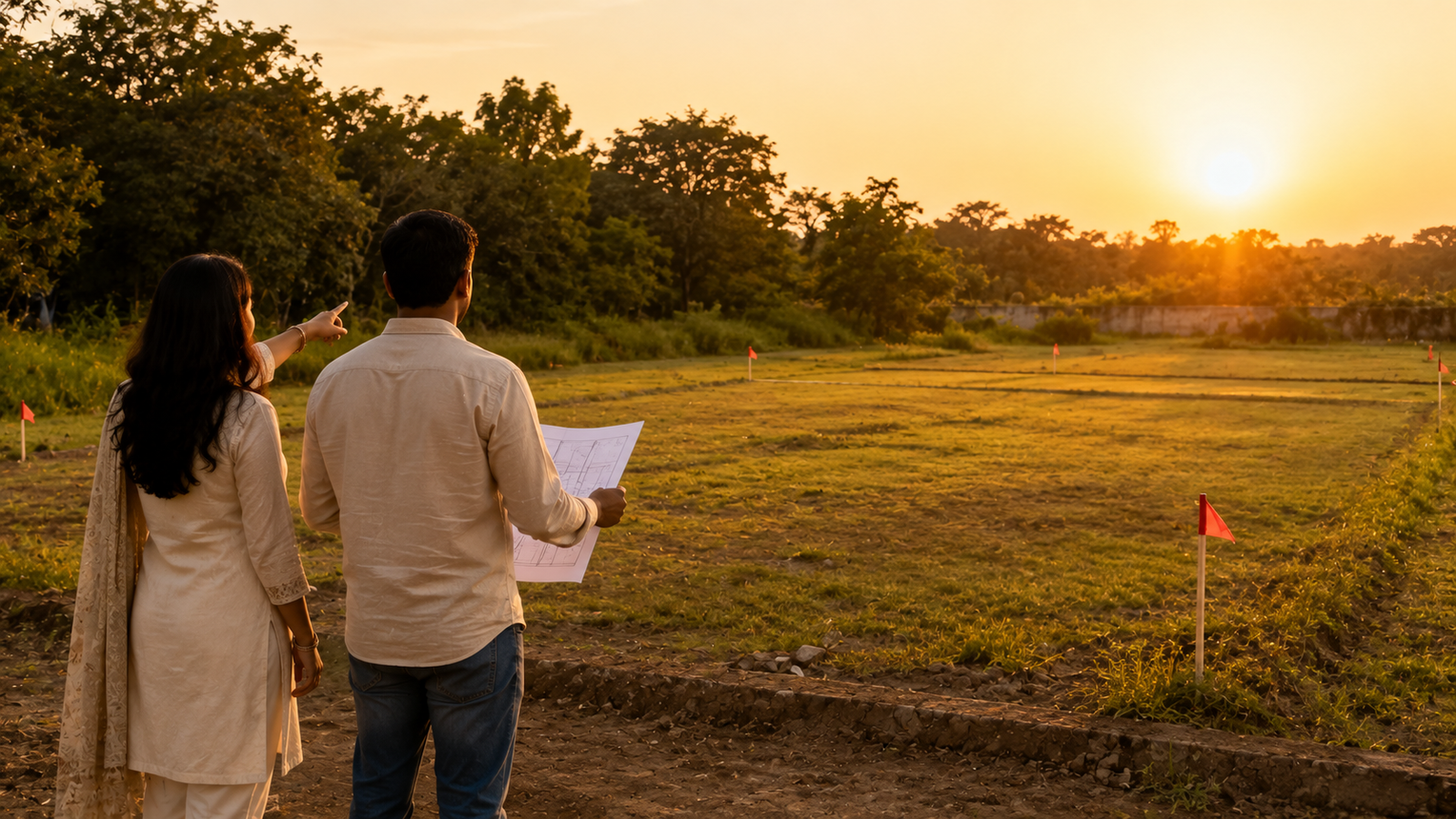
Every Vastu guide we have ever written — the room maps, the staircase zones, the water placements, the door remedies — operates inside one boundary that was drawn before any of it:
The plot.
The land's shape, slope, corners, roads, and surroundings set the ceiling on everything built upon it. A gifted architect on a defective plot spends the whole project compensating. An ordinary house on an excellent plot inherits advantages no renovation can buy later.
And unlike everything downstream, the plot decision is absolutely final. Kitchens move. Staircases can, at ruinous cost, be rebuilt. The land is the land — its missing corner will be missing in your grandchildren's time.
Which is why classical Vastu devotes more attention to land selection than to any other single subject — and why this guide walks the entire traditional inspection: shape, corners, slope, roads, surroundings, soil, and history, ending with the honest three-way sort every buyer needs: fixable, permanent-but-livable, and walk away.
(One boundary of our own before we begin: this article covers the Vastu layer only. Title verification, encumbrance checks, land-use zoning, RERA status, and registration are legal disciplines — engage a property lawyer for them without exception. Vastu tells you whether the land suits a home; the lawyer tells you whether it can legally be yours. You need both, and neither substitutes for the other.)
Plot Shape: The First Look
The tradition's order of preference is simple and firm:
- Square — the ideal. Equal energies on all sides, effortless zoning, the classical perfect canvas.
- Rectangle — excellent, especially with the length-to-width ratio kept moderate (up to roughly 1:2). Most good residential plots live here.
- Gaumukhi ("cow-faced": narrower at the front, wider at the back) — traditionally favorable for residences: the home opens modestly and deepens into abundance.
- Shermukhi ("lion-faced": wider at the front, narrower at the back) — traditionally suited to commercial use (the bold wide face greets the market), and considered unfavorable for homes.
- Avoid for residence: triangular plots, sharply irregular polygons, L-shapes with severe cuts, and plots that taper to points — the tradition reads unstable geometry as unstable foundations for family life, and the architect will separately tell you they waste buildable area and complicate every wall.
Mild irregularity can sometimes be resolved by compound-walling a clean rectangle within the plot and treating the remainder as external garden — one of the few genuine shape remedies that exists. Severe irregularity cannot be walled away.
Corners: The Make-or-Break Check

If shape is the first look, corners are the verdict. Stand on the survey sketch and check all four:
- North-East (Ishanya) extended — the single most prized feature a plot can have. An NE corner that projects outward, opening the plot toward the morning light, is classical gold.
- North-East cut or truncated — the single most serious plot defect, and effectively permanent. A missing Ishanya corner cannot be purchased back, walled back, or remedied back. This is the definitive walk-away finding for a residential plot when alternatives exist.
- South-West extended or cut — both problematic: the SW must be present, square, and strong — neither bulging nor missing. A weak South-West corner undermines the plot's anchor.
- South-East and North-West irregularities — assessed case by case; milder than the NE/SW verdicts but worth mapping before, not after, the token advance.
Slope: Which Way Does the Land Lean?

Water taught us the rule (in the water guide); land confirms it:
- Sloping down toward the North, East, or North-East — excellent. Rain and flow drain toward the light zones; the South-West naturally stands highest and heaviest. This is the terrain the entire zonal system assumes.
- Sloping down toward the South-West or South — inverted terrain: the anchor corner sits lowest, the light corner highest. Partially fixable with earthwork — filling and leveling to correct the gradient — but honest costing belongs in the purchase decision, not the post-registration surprise.
- Check it simply: visit after rain and watch where the water goes. The puddles are the survey.
Roads: Position, Corners & the Thrust Question

- Best road positions: roads on the North and East sides. The prize configuration is the corner plot with roads on both the North and East — light, access, and openness on exactly the right faces.
- Good: North road alone, East road alone; West and South roads are workable with entrance planning (the south-entrance playbook exists for exactly this).
- The T-junction (veedhi shoola / road thrust): a road driving head-on into the plot. The tradition's caution is old and firm; the traffic engineer's is newer and identical — headlights, noise, and the statistically real risk of vehicles overshooting the junction. A thrust into the plot's North-East can be partially absorbed with heavy green screening and compound design; a thrust into the South-West is the harder verdict. Either way, price the defect honestly — the market already quietly does.
- Dead-end plots (last plot on a closed lane) carry a milder traditional caution — assess with the whole picture.
Surroundings: What the Neighbors Do to the Land
Walk the neighborhood at morning and evening before deciding:
- Water bodies (lake, river, canal) to the North or North-East — classical excellence.
- Large open ground or park to the North/East — light and air on the right faces, permanently unblocked. A quiet premium feature.
- Tall structures to the South and West — actually favorable: mass where mass belongs, shade against the harsh afternoon.
- Tall structures looming over your North-East — the reverse, and worth weighing: your light corner in permanent shadow.
- High-tension power lines over or beside the plot — the tradition objects; the practical concerns (clearance rules, resale hesitance) are their own answer. Avoid.
- Immediately adjacent cremation grounds or similar — the tradition's caution is well known; the resale market's is identical. Weigh honestly.
- Temple adjacency — nuanced in tradition (positions relative to the plot matter, and a temple's activity has practical daily rhythms); a case-by-case assessment rather than a blanket verdict.
- Great old trees on the plot — an asset in the right zones (South/West) and a foundation question in the wrong ones; peepal and banyan against future walls carry both the tradition's and the structural engineer's identical objection.
Soil: The Oldest Tests, and the Modern One

Classical texts inspect the earth itself, and the old tests remain charming and useful:
- Look and smell: even-toned, firm earth with a clean smell reads well; plots of debris fill, foul-smelling patches, or refuse layers announce their history.
- The pit test (traditional): dig a small pit, refill it with the same soil. Earth left over — dense, generous soil — read favorably; a pit the soil cannot refill read as hollow ground.
- The water pit (traditional): fill a small pit with water; ground that holds it a while was preferred to ground that swallows it instantly.
- The modern non-negotiable: whatever the traditional tests say, commission a geotechnical soil investigation before design begins. The tradition tested for auspiciousness; the lab tests for bearing capacity. A plot that fails the lab fails, full stop.
- Land history: ask what the land was before. Former ponds and landfills carry both traditional and engineering burdens; long-cultivated or long-inhabited land reads well in both books.
The Honest Sort: Fixable, Livable, Walk Away
Every plot inspection should end in three columns:
Fixable (price the fix, then proceed): adverse slope (earthwork), mild shape irregularity (compound-wall a clean rectangle), West/South road (entrance planning), modest NE shadowing (setback and landscaping).
Permanent but livable (negotiate, compensate, decide with open eyes): shermukhi shape for a residence, SE/NW corner irregularities, dead-end position, T-thrust into non-critical faces with room for screening.
Walk away (when alternatives exist): the cut North-East corner, a severely weak or missing South-West, high-tension lines overhead, hostile land history, failed soil investigation, and any seller resisting a proper survey sketch. The market holds more plots than lifetimes; the defects in this column outlast both.
Buying a Plot Remotely?
Every check above except the soil smell and the rain visit can be run from a survey sketch, satellite view, and a video walk — the same remote method our NRI property guide details for flats, applied to land. Delegate the rain-day visit to family with a camera; the puddles photograph honestly.
Common Plot Mistakes
- Falling for the view and never drawing the corners
- Token advance paid before the survey sketch is in hand
- "We'll fix the slope later" — without pricing the earthwork now
- The cut North-East rationalized because the rate was good
- Traditional soil tests done, geotechnical investigation skipped
- Roads assessed for commute, never for position and thrust
- Buying the plot the builder ranked cheapest in the layout — and never asking why it ranked cheapest
- Vastu inspection done after registration, as decoration
📐 Map the Plot Before You Register It
Corners, slope zones, road positions, and the buildable rectangle — every verdict in this guide comes down to plotting the land's directions precisely, and eyeballing a survey sketch misleads exactly when it matters most.
We built a free tool where you can upload the plot's survey sketch or layout plan and instantly see it mapped according to proper Vastu directions — corners graded, zones drawn, before a rupee moves.
👉 Upload the plot sketch and map the land in 30 seconds
Just a photo or scan (PNG, JPG, JPEG). Everything you will ever build stands on this decision. Make it looking at the map.
Final Thoughts

The tradition inspects land the way one should inspect anything permanent: patiently, in person, after rain, with the corners drawn and the history asked.
Because that is what a plot is — the one purchase in a family's life with no undo, the boundary inside which every future guide on this blog will either work easily or work hard.
Square where it can be, open to the North-East, high in the South-West, honest in its soil. Find that land, let the lawyer bless the papers, and everything built afterward starts ahead.
The land remembers everything. Choose land worth remembering you well. 🗺️