
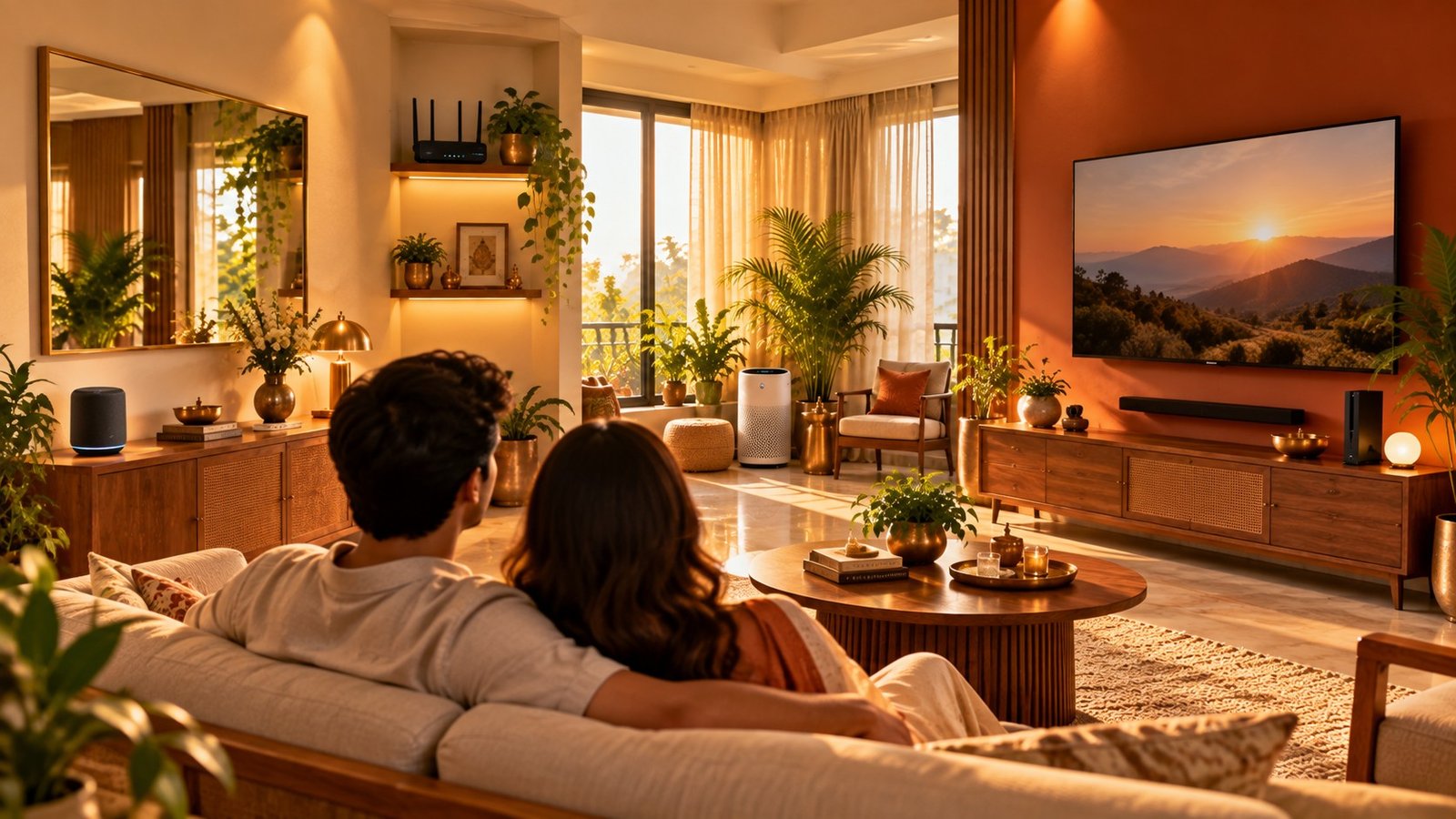
Your home is getting smarter. The router broadcasts through every wall. The smart speaker sits somewhere on a shelf, always listening. The TV dominates one wall of the living room. The air purifier hums in a corner you chose by instinct. Security cameras watch the entrance. Smart bulbs change temperature on a schedule you set once and forgot.
And none of the manuals — not one — told you where to put any of it.
That gap is what this article closes.
Vastu Shastra has always been a science of energy flow through a home — how forces move through zones, where they concentrate, where they deplete. In 2026, some of those forces have names like WiFi, Bluetooth, electromagnetic fields, blue light, and ambient sound. The tradition didn't anticipate the router, but its principles map onto smart home placement with surprising precision.
This is not a fear-mongering article about "EMF dangers" or "WiFi radiation." The honest position: modern smart home devices, used reasonably, are safe. What Vastu adds is not a warning — it is a placement framework that makes your devices work better, feel better, and align with the home's energetic geography rather than fight it.
Let's go device by device.
The Router & WiFi Hub: The Home's New Nervous System
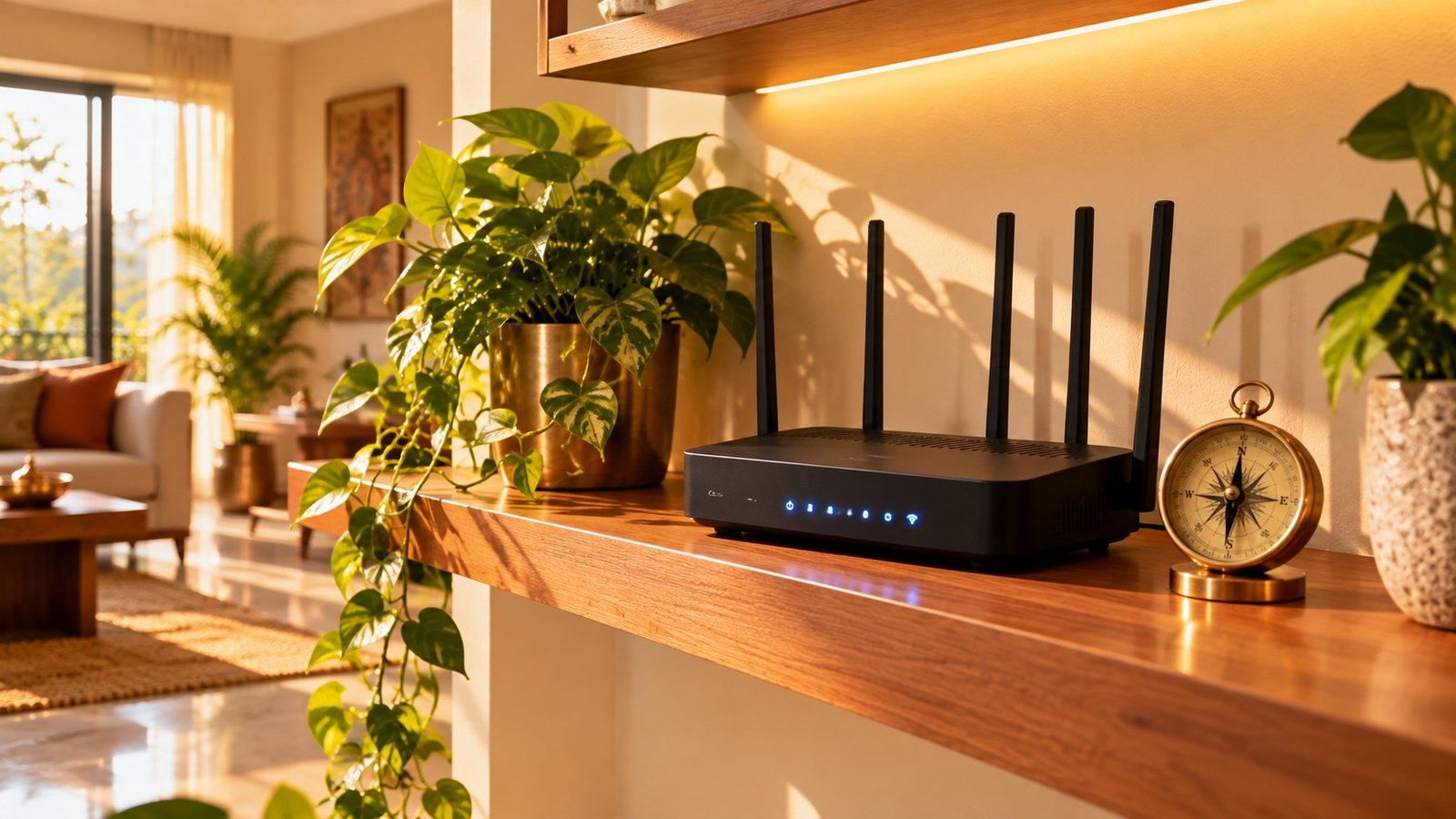
The router is, in Vastu terms, a Vayu (air/wind element) device — it broadcasts invisible signals in all directions, constantly, filling the home with a field of connectivity. It is the closest thing the modern home has to a central nervous system.
Best placement: North or North-East of the home — the zones of flow, connection, and clarity. A router in the North ensures its signal spreads most beneficially toward the living and working zones. North-East amplifies the clarity principle.
Why it also makes technical sense: placing the router centrally or toward the home's activity zones (North, East) rather than in a back bedroom or service area gives better coverage to the rooms you actually use — a WiFi principle that happens to be a Vastu principle.
Avoid:
- South-West — the stability and rest zone; constant electromagnetic broadcast from the heaviness corner creates a subtle but real sense of restlessness in the room most meant for grounding. The master bedroom in the South-West especially should not house the primary router.
- Directly in the bedroom at all — this one is both Vastu and sleep hygiene. The bedroom is the recovery zone; keeping active broadcast devices out of it (or switching to WiFi scheduled to reduce activity after 10 PM) honors the room's function.
- The North-East if your pooja space is there — the sacred corner and the constantly-broadcasting device are incompatible roommates. One of them moves.
The practical fix most families need: move the router from "wherever the cable came in" (usually a back room or corner determined by the builder's wiring) to the most central North-leaning position your cable length allows. A WiFi extender in the North-East of the living area, paired with a router repositioned toward center-North, solves both the technical coverage problem and the Vastu placement.
The Smart Speaker: Vayu in a Cylinder
The smart speaker — your Alexa, Google Home, or Siri-enabled device — is a sound and air element object: it speaks, it listens, it fills the room with voice. In Vastu terms, sound belongs with Vayu (air), and Vayu's home is the North-West.
Best placement: North-West of the living room — the zone of air, movement, and communication. A smart speaker in the North-West is exactly where the tradition would put a dundubhi (drum) or any sound-producing object in a classical home.
Second best: the North — the zone of flow and clarity. If the North-West isn't practical, North works well.
Avoid:
- The pooja corner and its surrounding zone — a device that speaks commercial content and plays advertisement jingles does not belong near the sacred space. Keep at least the North-East corner free of smart speaker presence.
- Directly facing the main entrance — a device that announces itself to every arrival (and potentially broadcasts conversations toward the door) is both a privacy and a Vastu mismatch. The entrance is a threshold; it shouldn't carry chatter.
- The bedroom — the same bedroom-as-recovery principle. If you want a bedroom smart speaker for alarms and sleep sounds, position it away from the bed itself, not on the bedside table.
The Television: The Fire on the Wrong Wall
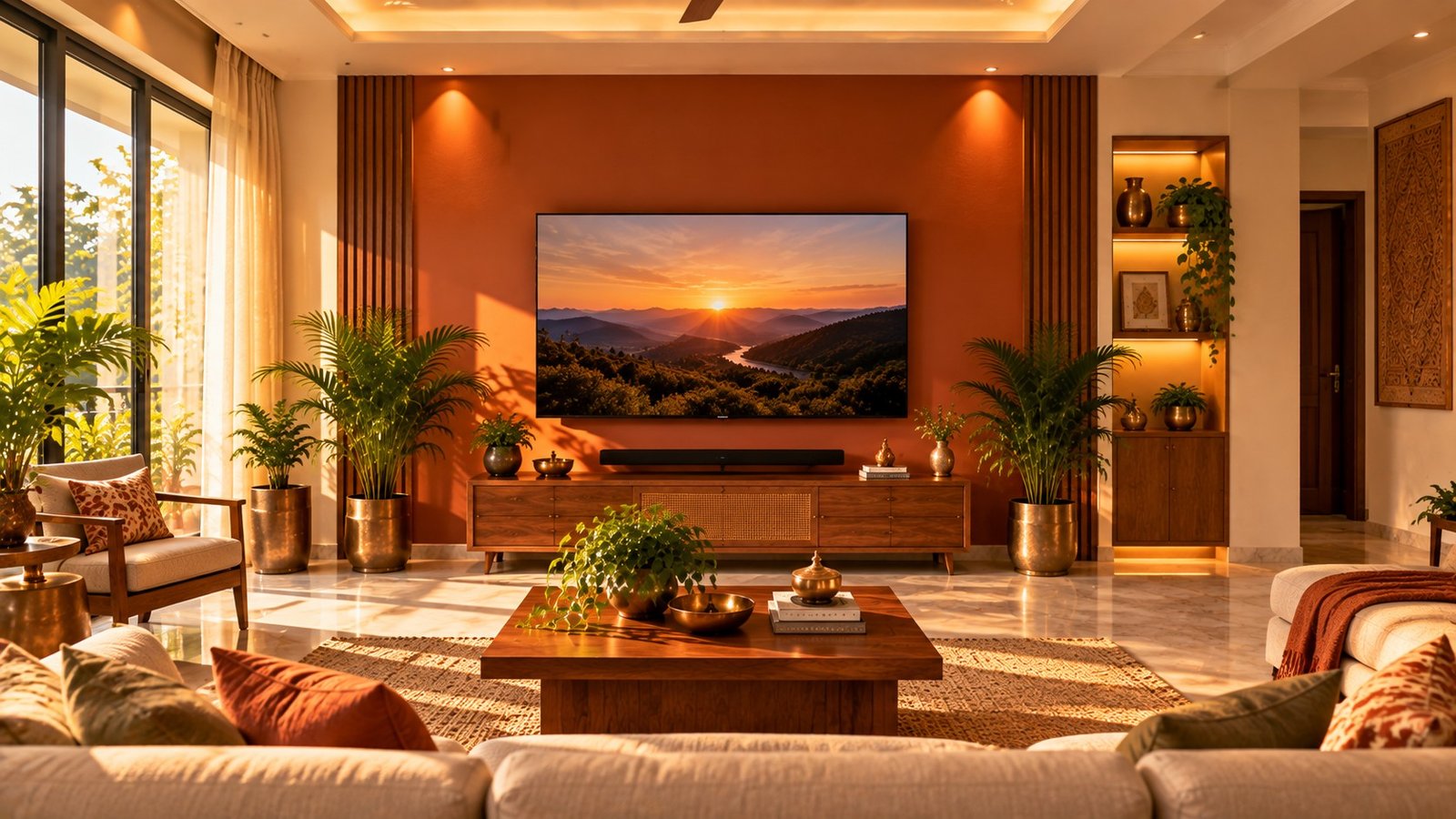
The television is Vastu's most interesting modern challenge — it is, in elemental terms, a fire element object (light, movement, stimulation, heat) that most families install on whatever wall faces the sofa, regardless of direction.
Best placement: South-East or South wall of the living room — the fire zone, facing North or East for viewers. This means the family watches TV while facing North or East — the clarity and flow directions. The TV's light and stimulation sits in its elemental home; the viewers face their beneficial directions.
The common mistake: a television on the North or East wall means viewers face South or West — the heavy, inward-turning directions. Families who find evenings in front of the TV oddly draining or uninspiring are sometimes experiencing this directional mismatch.
The bedroom TV question: Vastu's position is consistent with every sleep researcher's position — no TV in the bedroom, or at minimum no TV facing the bed. A TV on the wall opposite the bed (visible when sitting up, not while lying down to sleep) is the compromise where avoiding it entirely isn't possible. A TV directly facing the sleeping position is one of the most common modern bedroom Vastu errors — it keeps the fire element active in the rest zone all night, even on standby.
The "TV wall as design feature" trend: when the entire South wall becomes a media wall — TV, speakers, console, backlighting — this is actually excellent Vastu. The South wall carrying all the fire-element technology is its elemental assignment. The issue only arises when this wall ends up on the North or East through layout convenience.
Smart Lighting: The Most Powerful Vastu Upgrade Available
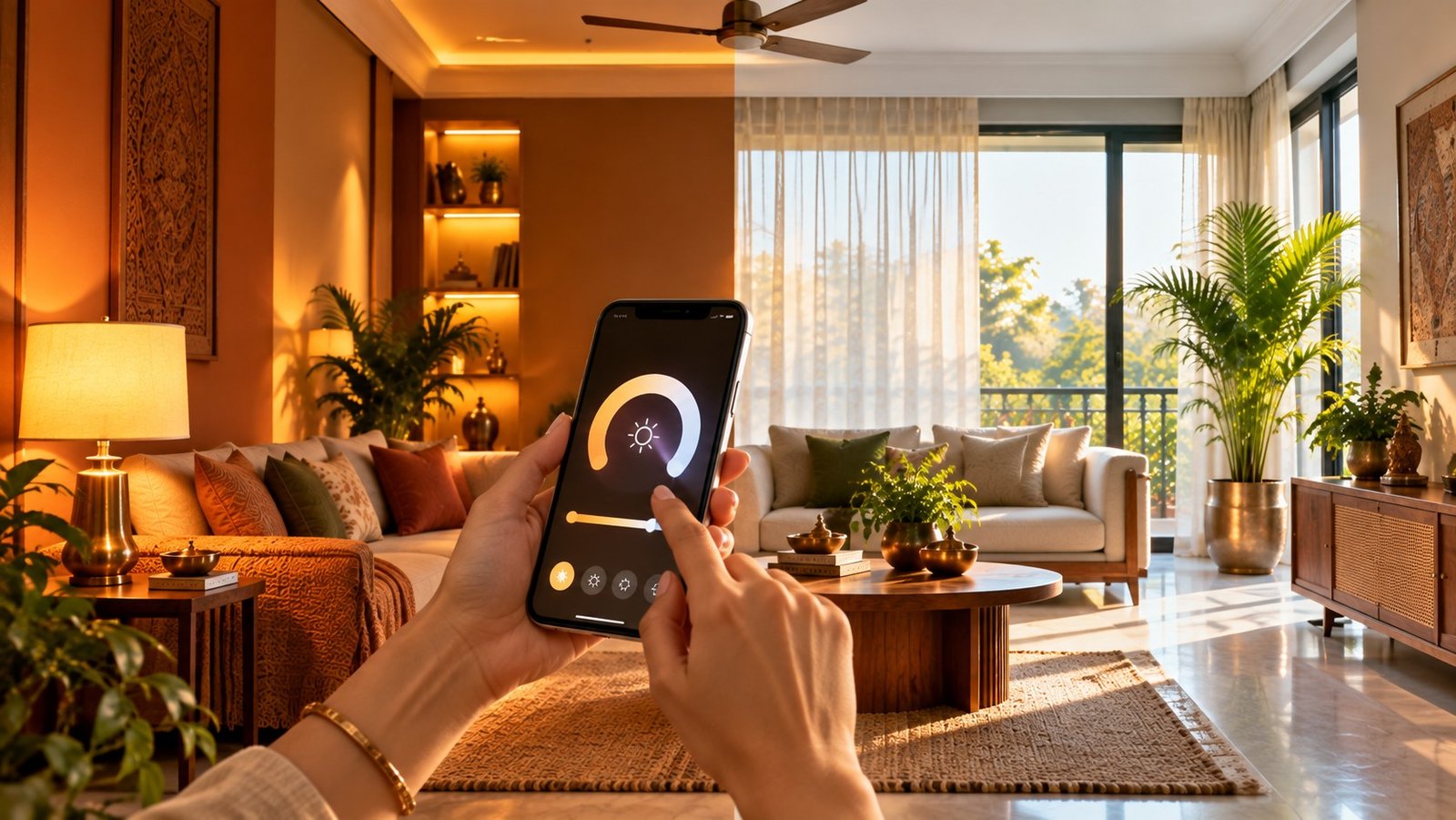
Smart bulbs and lighting systems are, genuinely, the highest-leverage smart home Vastu upgrade available — because light is the tradition's foundational element, and the ability to program it means you can live by the Vastu light prescription automatically.
The prescription:
- Morning (6–10 AM): bright, cool-white light (5000–6500K) in the East and North zones of the home — the direction the rising sun would naturally illuminate. This is the circadian rhythm support that the Gen Z Vastu article describes, now automatable.
- Evening (6 PM onward): progressively warmer light (2700–3000K) throughout, dimming as bedtime approaches. The tradition's diya-at-dusk principle, automated.
- Bedroom nighttime: the warmest possible setting (1800–2200K), never cool-white after 8 PM.
- Pooja space: warm, dedicated light — never the same scene as the rest of the living room; the sacred corner deserves its own warmth, easily achieved with one smart bulb on its own scene.
The motion sensor note: motion-activated lights in the entrance, corridor, and bathroom are an excellent Vastu-compatible upgrade. The tradition wants the home's paths lit and clear; motion sensors ensure that without waste. The one exception: motion sensors directly in the bedroom path that trigger full brightness at 3 AM are actively hostile to recovery. Dim, warm, motion-activated night lights in the corridor outside the bedroom are the right version.
The Air Purifier: Vayu Personified
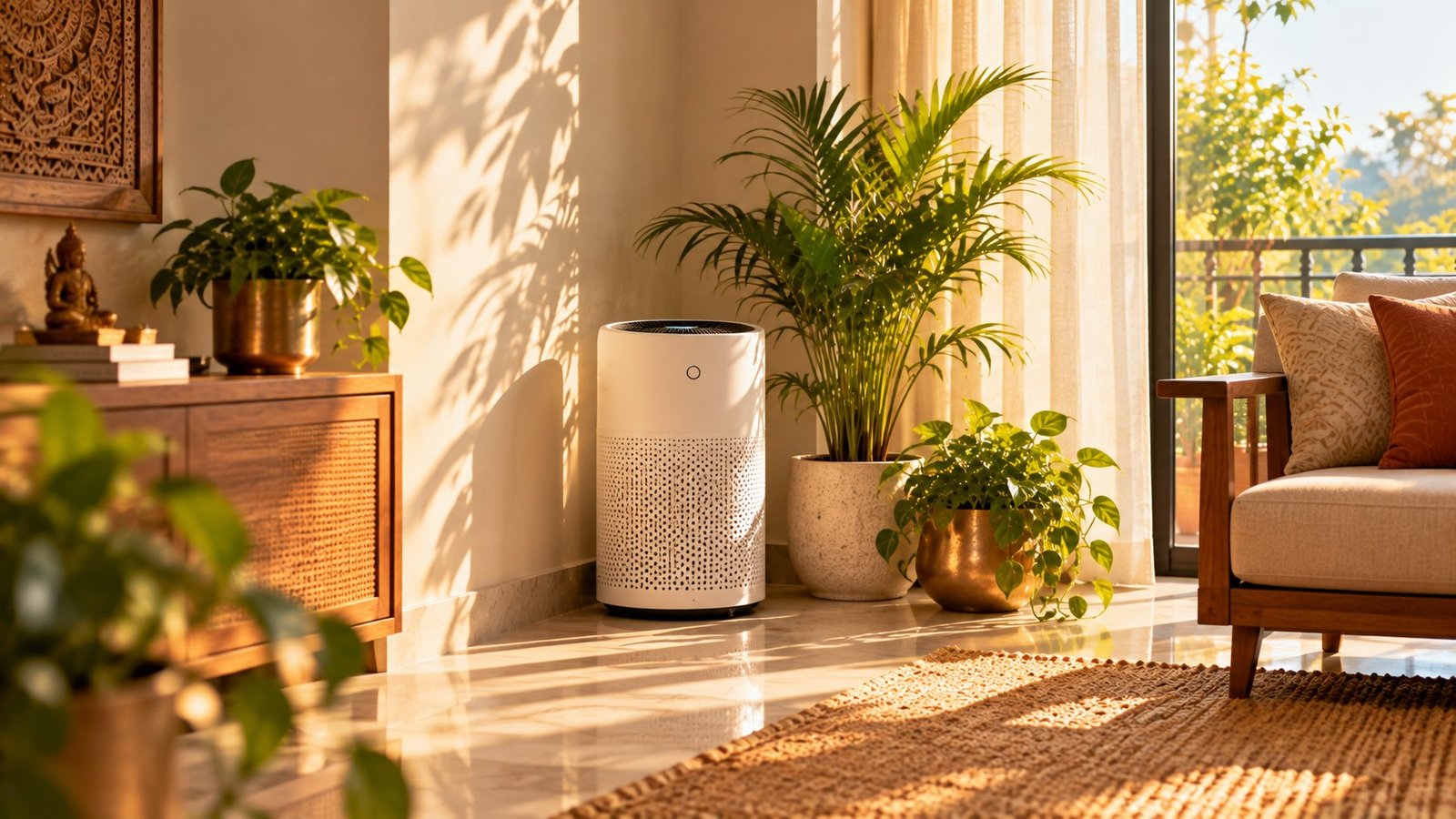
The air purifier is the smart home device Vastu would most enthusiastically endorse — it literally purifies the air, which is precisely what the Vayu element's health function is described as in classical texts.
Best placement: North-East — the sacred, clarity zone. An air purifier in the North-East, quietly cleaning the home's air, is doing Vastu's work in the most literal possible way: the zone of clarity and divinity, made physically cleaner.
Second best for bedrooms: beside the bed, slightly off to the side — close enough to function, not so close that its sound disrupts sleep (most modern purifiers have a quiet mode; use it).
Avoid: tucked away in a South-West corner or behind furniture where its intake and output are obstructed. An air purifier works by moving air; blocking it defeats both its mechanical and its elemental purpose.
Security Cameras: The Eyes of the Threshold
Security cameras raise an interesting Vastu question: they are guardian objects, watching over the home — which aligns them with the protective energy of certain zones.
Entrance camera: above the main door, facing outward — this is traditional guardian placement, the same position as the Panchamukhi Hanuman we recommend for south entrances (South door guide). The camera as modern guardian of the threshold is entirely consonant with tradition.
Perimeter cameras: facing the South and West approaches — the zones where protective, watchful energy belongs. A camera watching the South-West corner of a property is, in Vastu terms, in its right zone.
Avoid indoor cameras in: the pooja space (sacred space deserves privacy), the bedroom (rest zone deserves intimacy), and facing the North-East directly (the open, trusting, sacred zone should not be the surveilled one).
The privacy-Vastu overlap: Vastu's sense of zone sanctity maps naturally onto modern privacy thinking. The zones that deserve protection from surveillance — bedroom, sacred corner, dining space — are the same zones our intuitive privacy sense identifies. No coincidence; both emerge from the same understanding of what a home's different spaces are for.
Smart Thermostats & AC Units
AC units belong in the West or North-West of a room — the air/Vayu zones. An AC pushing cool air from the West across a room toward the East mirrors the natural wind patterns the tradition describes.
Avoid: AC units in the North-East (a significant defect — cold air machine in the sacred zone disrupts both the Vayu and water elements), and directly above the bed (cold air descending on the sleeping position is both bad Vastu and bad sleep hygiene).
The smart thermostat opportunity: program it to reduce activity during prayer/pooja times (the North-East and pooja zone stay quieter), and to warm the home gently before waking — the pre-dawn temperature rise that supports natural awakening rather than cold shock.
What Smart Homes Get Right About Vastu — Without Knowing It
Here is what strikes me most about the smart home revolution when I look at it through the Vastu lens: the homes that smart home designers describe as optimal and the homes that Vastu describes as optimal are converging on the same picture.
Circadian lighting = Vastu's light-follows-the-sun principle, automated. Air quality monitoring = Vastu's insistence on fresh air and cross-ventilation, measured. Sound management = Vastu's Vayu zone placement for music and announcement, programmable. Zone-based temperature control = Vastu's elemental zone management, digitized. Motion-activated path lighting = Vastu's insistence on clear, lit paths through the home, sensored.
The smartest homes of 2030 will, by optimizing for human wellbeing through environmental control, independently arrive at the same spatial principles a 3,000-year-old tradition encoded by observation. The vocabulary will be different. The homes will look the same.
The One Smart Home Device Vastu Would Invent
If the tradition could design one device, it would be this: a sensor that measures the quality of stillness in the North-East corner of your home — how often it's clear, how well-lit it is, how undisturbed. Not electromagnetic signal strength, not air quality PPM. Stillness. Clarity. The quality of the sacred zone's freedom from everything else.
No such device exists yet. The closest thing is simply: no device in that corner at all.
Keep the North-East clear of technology. That corner doesn't need a gadget. It needs the absence of gadgets. That, in 2026, is its own form of luxury.
📐 Map Your Smart Home's Vastu Zones Before Installation Day
Router, TV, air purifier, smart speaker — every placement decision above starts with knowing which wall is actually your North, which corner is your South-East, and where your North-East truly falls.
We built a free tool where you can upload your floor plan and instantly see it mapped according to proper Vastu directions — so your smart home installation starts with the right map, not an afterthought.
👉 Upload your floor plan and map your smart home zones in 30 seconds
Just a photo or scan (PNG, JPG, JPEG). Smart technology in the right zones. Ancient wisdom, modern home.
Final Thoughts
Your home is getting smarter. What this guide adds is one layer the device manuals will never include: not just how the technology works, but where it belongs in the space it inhabits.
The router that broadcasts clearly and cleanly from the North. The speaker that announces from the North-West. The TV that sits in fire's own zone. The air purifier that quietly cleans the sacred corner. The lights that follow the sun's rhythm automatically.
A smart home that is also a Vastu home is not a contradiction. It's a more complete definition of what "smart" means.
The technology knows your voice commands. Now it knows its place. 🏠📱