
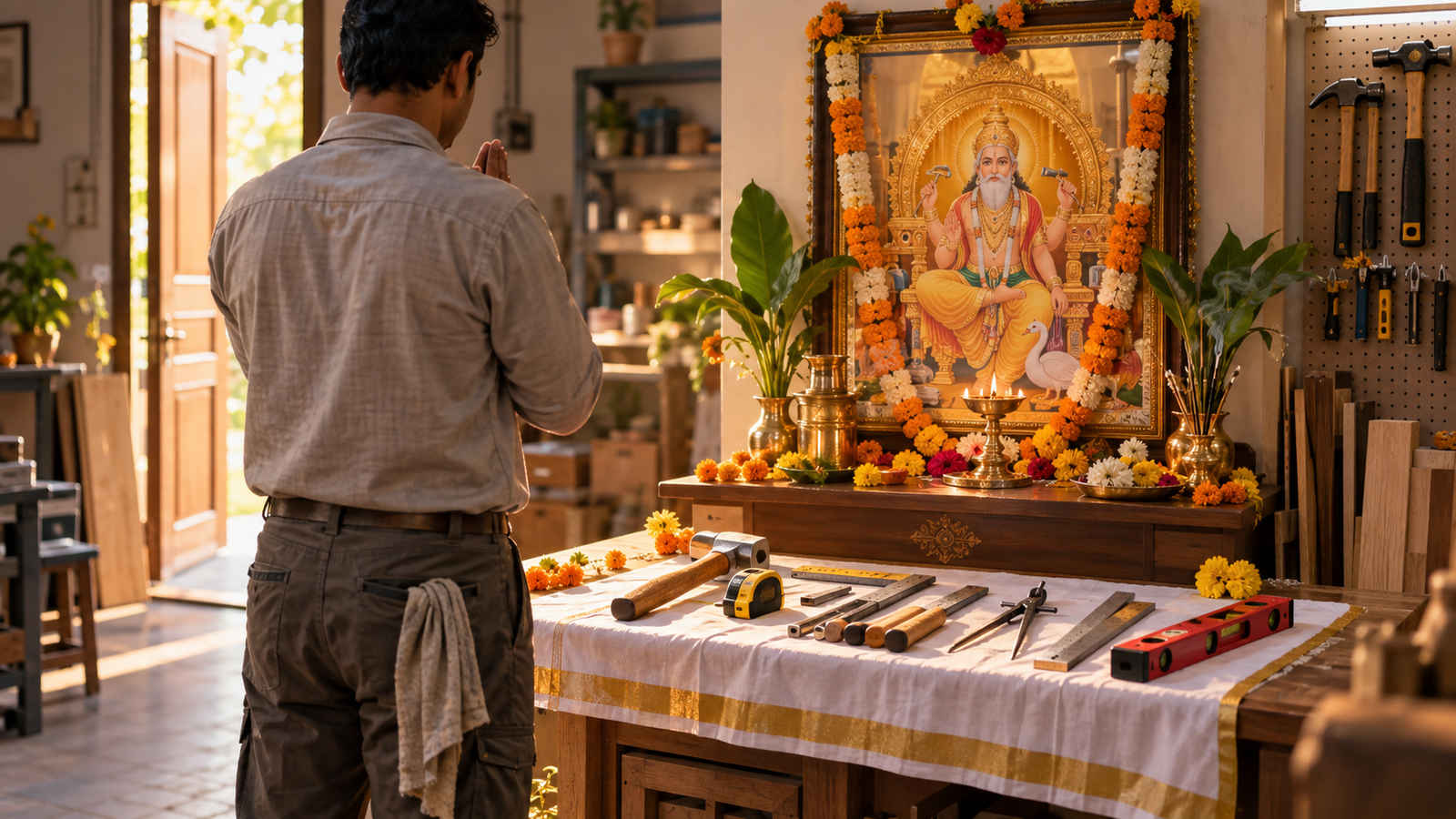
Lord Vishwakarma created Vastu Shastra.
The divine architect who designed Dwarka, fashioned Indra's Vajra, built Lanka and Hastinapur, and drew the celestial blueprints for every god's palace — he is also, in the tradition's telling, the originator of Sthapatya Veda, the ancient science of sacred architecture that became what we call Vastu Shastra today.
Every room we've ever written about, every direction we've ever mapped, every corner we've called sacred — all of it traces back to him.
Vishwakarma Puja 2026 falls on Thursday, September 17 — Kanya Sankranti, when the sun enters Virgo. The puja muhurat runs from 7:15 AM to 4:15 PM IST</cite>, a generous window that makes this one of the most flexible festival days of the year.
This is the one day we honor the deity behind the whole discipline — and behind every professional craft, every tool, every machine, every building, every act of making. This guide covers the home puja, the workplace puja, what gets worshipped (and why), the tools that should rest today, and what the annual Vishwakarma reset offers your workspace that no other festival quite delivers.
Who Vishwakarma Is — The Patron of All Making
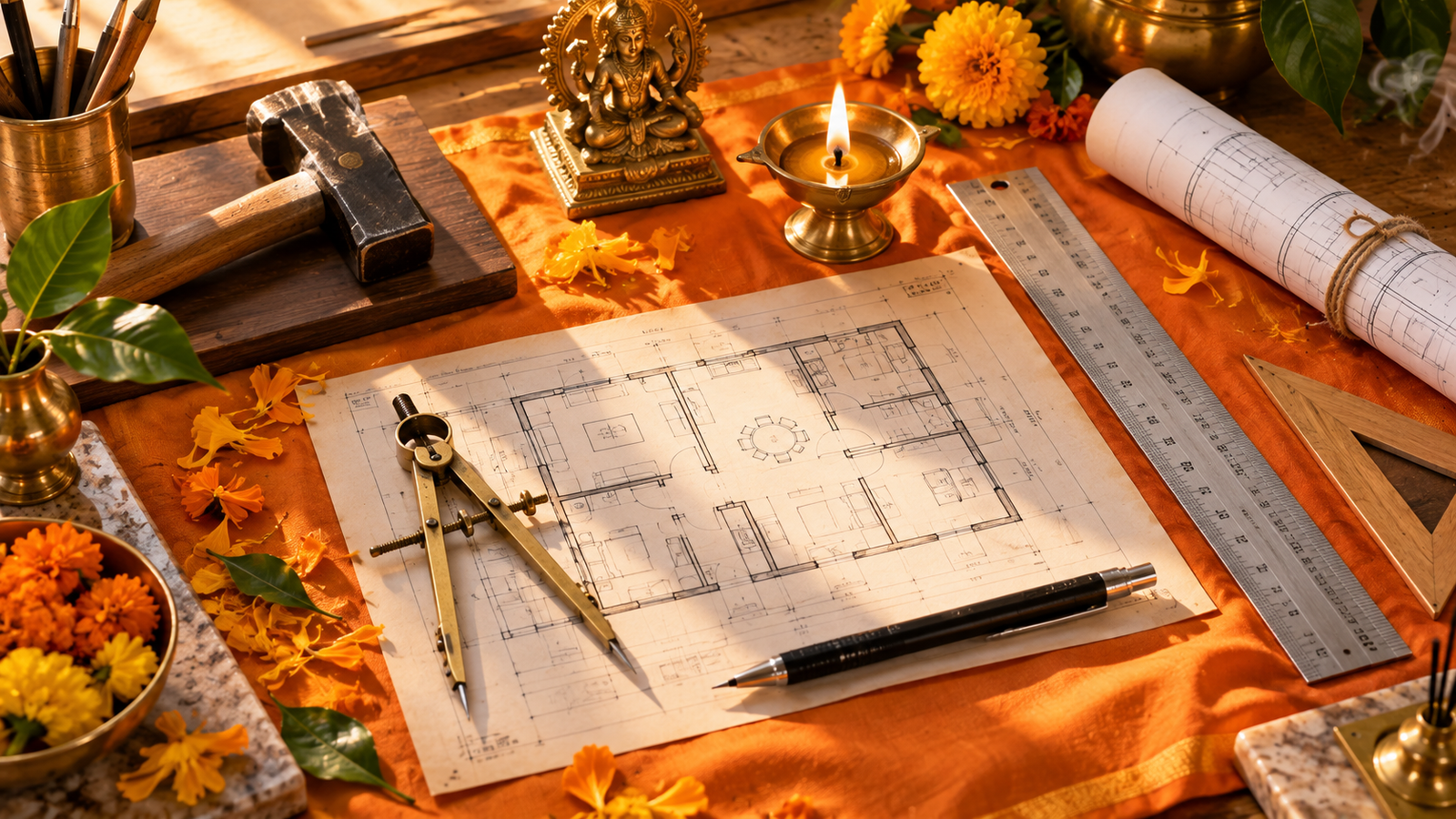
Lord Vishwakarma is the divine architect and master of Sthapatya Veda, the celestial craftsman who designed the heavens, earth, sacred weapons, and magnificent cities like Dwarka and Lanka. In the Rigveda he is described as Vishwakarmaa — the one who made everything.
The tradition's specific list of his creations is worth pausing over:
- Dwarka — Lord Krishna's golden city, built in the sea
- Lanka — Ravana's island fortress, the most magnificent city of its age
- Hastinapur and Indraprastha — the great cities of the Mahabharata
- The Vajra — Indra's thunderbolt weapon, forged from the sage Dadhichi's bones
- Pushpaka Vimana — the flying vehicle of the gods
- The palaces of every deva
And then, underlying all of it: Vastu Shastra — the science of sacred space, direction, element, and proportion that has guided Indian architecture for millennia.
This is the most auspicious day for craftsmen, engineers, mechanics, factory workers, IT professionals, machinery operators, and business owners to bless their tools, equipment, machines, and workspace. But for a Vastu blog, it is also simply: the birthday of our whole discipline. We celebrate it with particular warmth.
The Home Puja: Honoring the Maker in Your Own House
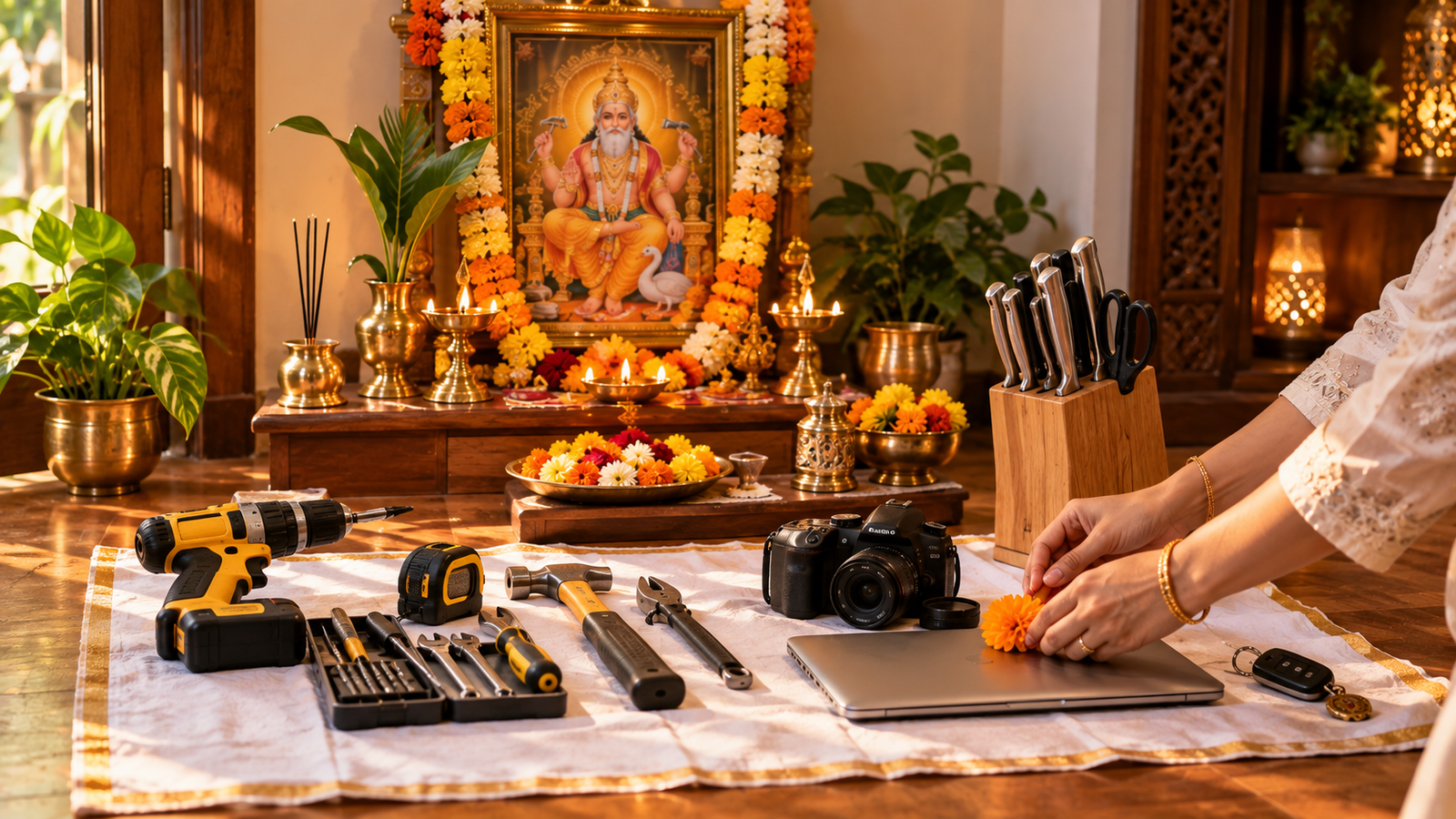
Vishwakarma Puja at home is for every family that makes things, builds things, repairs things, or works with any tool or instrument — which is to say, every family.
Setting up the altar:
- A clean, raised platform (the same chowki principle from every other festival guide) in the home's East or North-East zone — this is, uniquely, a puja whose deity governs directions and sacred space, so his altar honors those principles.
- An image or idol of Lord Vishwakarma — traditionally depicted holding architectural tools, seated on an elephant or a swan, often shown with four arms holding a water pot, a book of sacred architecture, a noose, and a craftsman's tool.
- Fresh flowers, a lit diya, incense, and an offering of sweets or prasad.
- The muhurat runs generously: <cite index="29-1">7:15 AM to 4:15 PM IST</cite> — perform the puja at whatever point in this window the family can gather.
What gets worshipped today:
This is Vishwakarma Puja's most distinctive feature — it is the one festival where the tools of your profession become sacred objects:
- At home: kitchen appliances, the sewing machine, any tools in a workshop or garage, musical instruments, craft supplies, the home's main electricity board (the infrastructure that powers everything), the family vehicle, and — in modern practice — laptops, phones, and any device used daily for work.
- At the workplace: machines, equipment, computers, vehicles, architectural drawings, engineering instruments.
- The tools are cleaned, placed before the altar, and included in the puja. After the worship, <cite index="25-1">the tools worshipped are not used until the next day</cite> — they rest on their sacred day, as every laboring thing deserves to occasionally.
What this means in practice: Clean the tools and machines before the puja — not after. Vishwakarma receives clean offerings, and a machine that goes before the deity caked in oil and dust is a small but meaningful contradiction. The cleaning is part of the worship.
The Workplace Puja: Factories, Offices, Studios & Shops
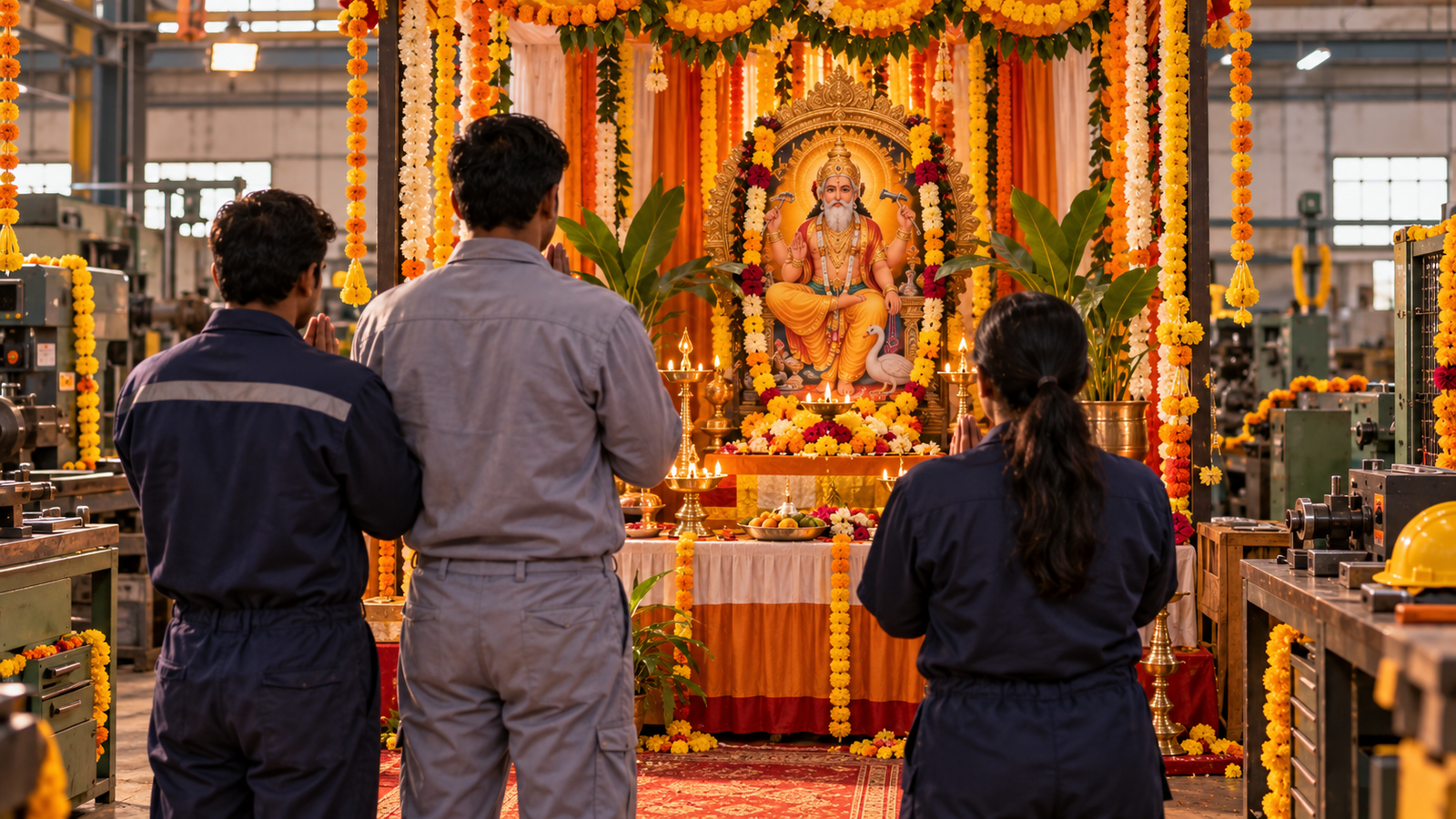
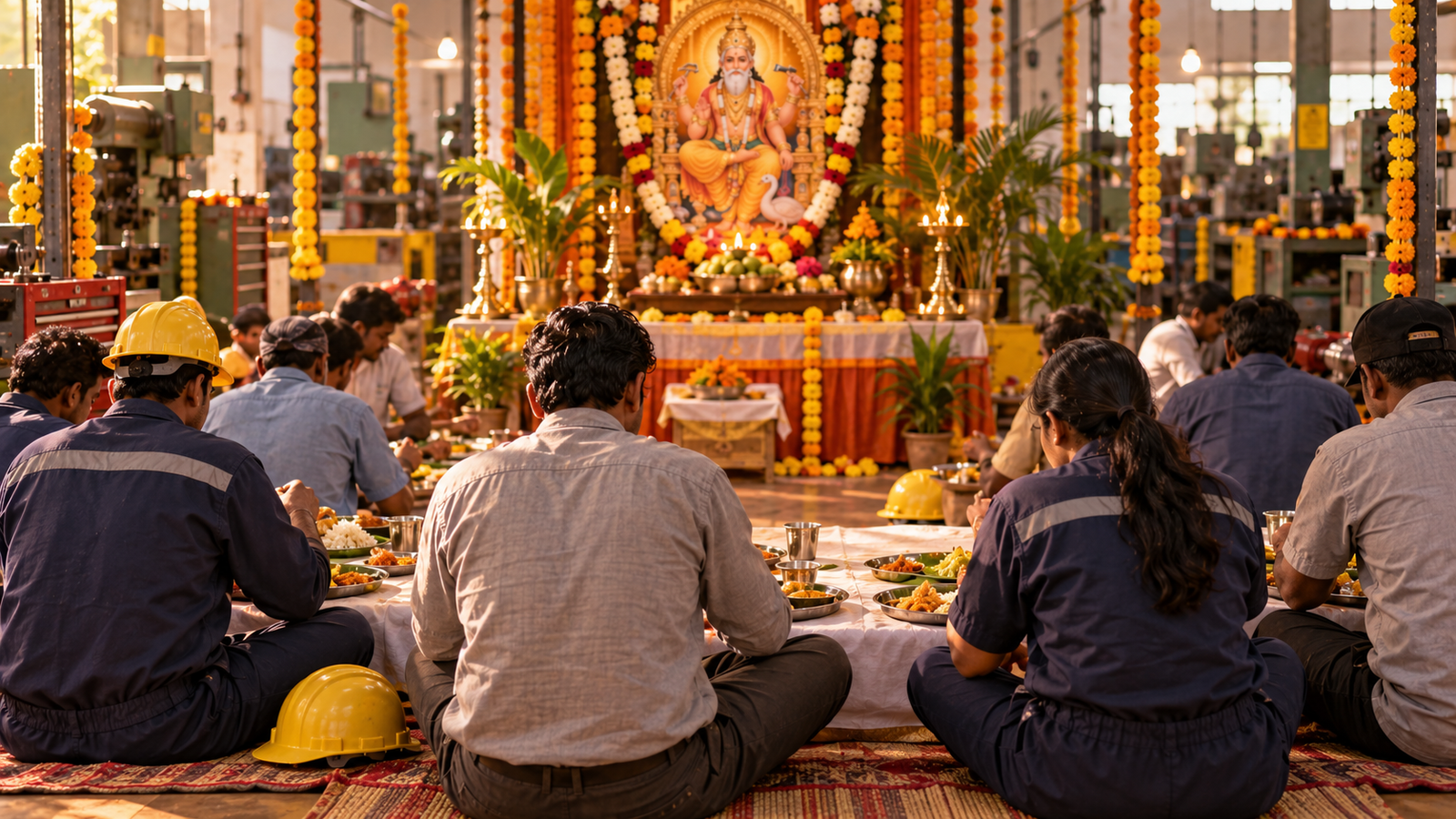
<cite index="25-1">Beautiful pandals and decorated idols of Lord Vishwakarma can be seen with the whole staff and workers gathering to perform the puja. The whole factory is cleaned and decorated. Even the tools used by every worker are worshipped and are not used until the coming day.</cite>
For professional spaces — shops, offices, studios, restaurants, construction sites — Vishwakarma Puja is the annual sacred reset:
Before the puja:
- Deep cleaning of the entire workspace — floors, machines, equipment, desks, and the corners that get ignored the other 364 days. This is not casual tidying; it is the same cleaning discipline we apply to homes before every major festival.
- Repair everything that's been deferred. The tradition says Vishwakarma does not bless a broken machine honored with flowers but left unrepaired. Fix what's been sitting broken before the puja, not after.
- Organize the tools and equipment — each in its place, cleaned and presented. The deity of all making deserves to see the work well-kept.
The puja itself: A senior member of the establishment (owner, manager, or senior craftsperson) leads the puja with the full team gathered. Prasad is distributed to everyone — this is one of the festivals most strongly associated with owners and workers sharing a meal together, the workplace hierarchy laid aside for one afternoon.
After the puja:
- Tools and machinery rest for the day — no production, no heavy work.
- The team shares the feast. This communal meal is not optional decoration; it is the festival's explicit social purpose.
- For business owners: this is the annual day to genuinely thank the people whose hands and skills are the business. Whatever form that gratitude takes — a word, a gesture, the shared prasad — it belongs today.
IT Professionals, Remote Workers & the Digital Tools
<cite index="30-1">Vishwakarma Puja is the most auspicious day for IT professionals and machinery operators to bless their tools and workspace.</cite>
In the modern economy, your tools are your laptop, your monitor, your microphone, your smartphone, your drawing tablet. They are as legitimately Vishwakarma's domain as any factory lathe — perhaps more so, since the divine architect's original portfolio included the flying Pushpaka Vimana, which was essentially the aerospace technology of its age.
For the home-working professional, the Vishwakarma puja at home includes:
- Clean and organize the home office fully before the puja (home office principles).
- Place the laptop, phone, and any instruments of your work before the altar during the puja — not symbolically, but sincerely.
- Wipe down every screen, cable, and device as part of the pre-puja cleaning. Restart computers and clear old files: the digital equivalent of cleaning before the festival.
- <cite index="22-1">Keep symbols near the altar: closed laptop, vehicle keys, small tokens for appliances, books and tools</cite> — all invited into the blessing.
- If you work with a camera, a musical instrument, a doctor's stethoscope, a teacher's books — all belong in the puja today. This festival has no narrow definition of craft.
The Vastu Connection: Honoring the Science's Own Creator
This point deserves to be said plainly: every principle on this blog traces back to Vishwakarma's tradition.
The directional map we use — North for Kubera, South-East for Agni, North-East for divinity — comes from Sthapatya Veda, the sacred architectural science he is credited with originating. The pooja room in the North-East, the kitchen in the South-East, the master bedroom in the South-West: all of it is Vishwakarma's blueprint.
Performing Vishwakarma Puja in a Vastu-aligned home is therefore its own kind of completeness — the science honoring its source, the blueprint bowing to its author.
If there is one article on this blog where performing the full home puja really matters, this is it.
Kanya Sankranti: The Year's Most Stable Festival Date
Unlike most Hindu festivals that shift across the Gregorian calendar by 10–20 days each year, Vishwakarma Puja is Solar — fixed to the sun's entry into Virgo (Kanya Sankranti) rather than the lunar calendar. <cite index="22-1">It consistently falls on September 17th each year.</cite>
This makes it the easiest festival to plan for: the same date, every year, forever. Put it in the family calendar once and it's there permanently.
Regional Variations Worth Knowing
- West Bengal, Odisha, Jharkhand, and Tripura celebrate it as Biswakarma Puja — one of the year's most important festivals, with elaborate workplace pandals, kite-flying, and the communal feast taking center stage.
- Gujarat and parts of Rajasthan: some communities observe Vishwakarma Jayanti in January instead.
- Bihar and some northern states: an additional Vishwakarma observance after Diwali, in the month of Magh.
- Kerala: observed on Rishi Panchami.
All are correct — the deity is the same; the calendar is regional.
Common Vishwakarma Puja Mistakes
- Worshipping tools that haven't been cleaned — the cleaning is part of the worship, not a pre-step
- Using the tools and machines on the day of puja — they rest today
- The communal feast treated as optional — it is the festival's social core
- Skipping the pre-puja repair — a broken machine honored but unrepaired is a contradiction
- IT professionals treating digital tools as "not applicable" — if it's your livelihood, it belongs in the puja
- Owners skipping the team gathering — this is the one day the workplace hierarchy genuinely steps aside
📐 Your Workspace Has a Vastu Map Too
Whether it's a home office, a shop, or a factory floor, knowing your workspace's actual directions — which wall is South-East for the Agni of your machinery, which corner is North-East for your altar — makes Vishwakarma Puja the day it's meant to be.
We built a free tool where you can upload your floor plan and instantly see it mapped according to proper Vastu directions — the science that Vishwakarma himself is credited with giving us.
👉 Upload your floor plan and map your workspace in 30 seconds
Just a photo or scan (PNG, JPG, JPEG). Honor the science's creator in the science's own terms.
Final Thoughts

Every other festival on this blog asks a home to honor a deity who visits it.
Vishwakarma Puja asks us to honor the deity who designed it — and every tool that built it, and every craft that maintains it, and every professional skill that earns the income that keeps the lights on inside it.
Clean the tools. Fix what's broken. Gather the team. Share the prasad. Let the laptop rest for one afternoon.
The divine architect built the universe. The least we can do is clean our desk.
Om Vishwakarmane Namah. ⚒️🙏